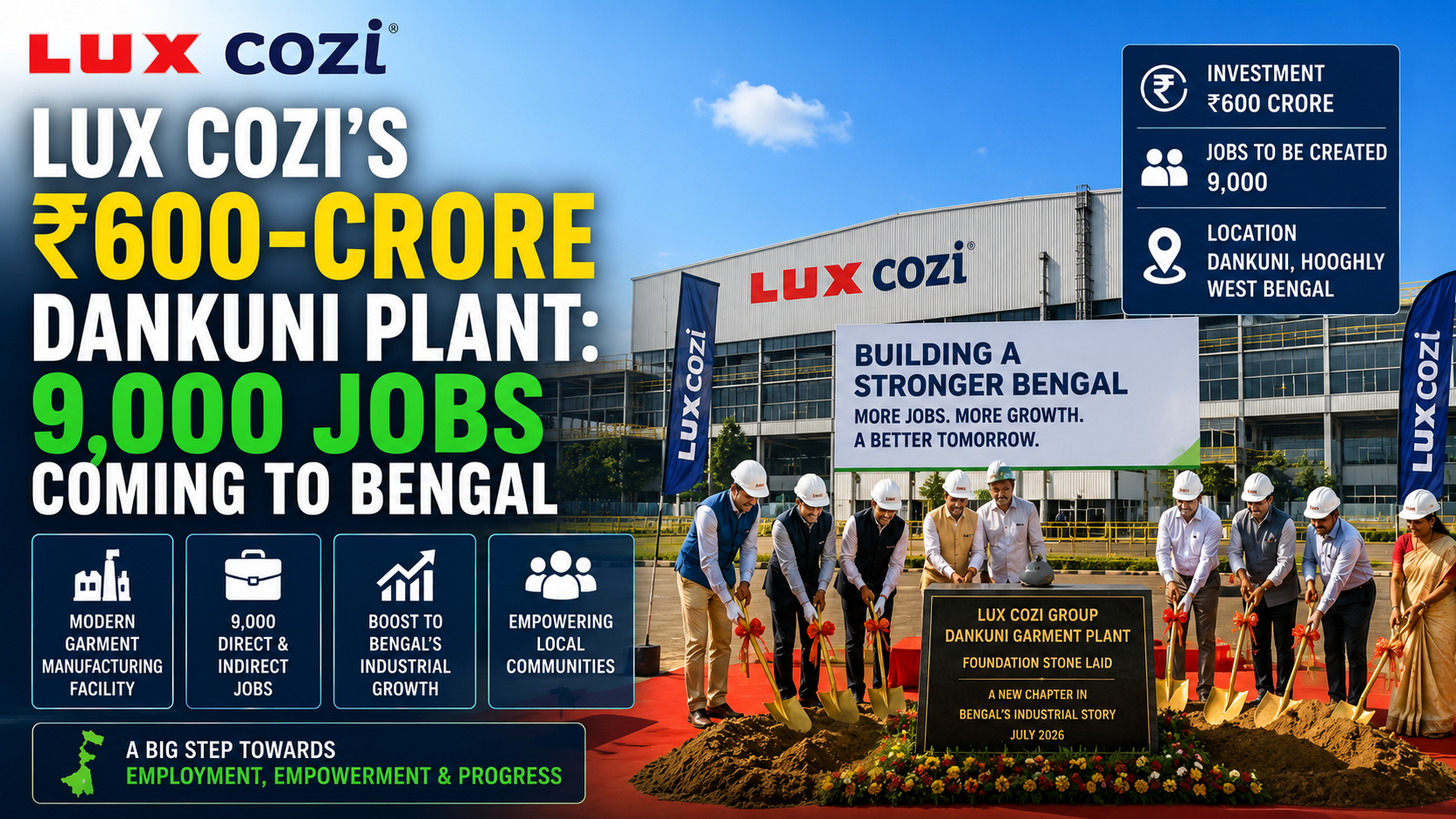
Lux Cozi Group has broken ground on a ₹600-crore garment manufacturing plant in Dankuni, West Bengal. It's a move the company says will create 9,000 jobs, marking one of the largest private industrial investments the state has seen in the textile sector in recent memory.
- Lux Cozi Group is investing ₹600 crore in a new garment manufacturing plant in Dankuni, West Bengal.
- The plant is expected to generate 9,000 jobs, according to the company.
- The investment is described as one of the largest private-sector textile commitments in West Bengal in recent years.
- For workers and job-seekers in and around Dankuni, this is a direct employment opportunity in organised manufacturing.
What Is Being Built and Where
Dankuni, a fast-growing industrial corridor in Hooghly district, sits about 30 kilometres from Kolkata. The state government has had it on its radar for industrial expansion for years. Lux Cozi Group — the Kolkata-based innerwear and casualwear brand — has now chosen this location for its new large-scale garment facility.
Per the company, the plant will be built with a total investment of ₹600 crore. That's not a small number for any single textile project in eastern India. To put it in context, the entire annual budget of many district administrations in West Bengal runs lower than that figure.
The company hasn't publicly disclosed a construction timeline or an expected date of full operations, according to available information.
9,000 Jobs — Who Gets Them
The number that matters most here is 9,000. That's the figure Lux Cozi Group has put out as the expected employment this plant will generate.
For a daily-wage worker or a young woman from a semi-urban household in Hooghly or Howrah district, a garment plant of this scale isn't just a statistic. It's the difference between seasonal contract work and a fixed monthly income with provident fund contributions. Garment manufacturing in India has historically been one of the largest formal employers of women from lower-income households. A plant of this size, if it reaches stated capacity, could shift that equation meaningfully for tens of thousands of families in the region.
The company hasn't broken down the job profile — whether these will be direct factory-floor roles, supervisory positions, or include indirect employment in supply chains and logistics. That detail matters, and it hasn't yet been made public.
What This Means for West Bengal's Industrial Landscape
West Bengal has struggled for decades to attract large-scale private manufacturing investment. The state lost significant industrial ground through the 1980s and 1990s, and efforts to rebuild that base have had mixed results. Against that backdrop, a ₹600-crore commitment from a home-grown brand carries both economic and symbolic weight.
Lux Cozi isn't an outside investor arriving with scepticism about Bengal. It's a brand that was built here, employs people here, and has now chosen to deepen its manufacturing roots in the state rather than move capacity elsewhere. That's a signal the state government and industry bodies aren't likely to miss.
The textile and garment sector also fits West Bengal's existing workforce profile. The state has a large pool of workers with skills in weaving, stitching, and finishing — many of them employed in the unorganised sector. A formal plant of this scale has the potential to pull some of that labor into organised employment, which comes with better wages, job security, and social security benefits.
What Investors in Lux Cozi Should Know
Lux Cozi Group's listed entity, Lux Industries Limited, trades on the BSE and NSE. A ₹600-crore capital expenditure of this size is a material development for any mid-cap consumer goods company. Retail investors tracking the stock will want to watch for official filings that detail the funding structure — whether it's financed through internal accruals, debt, or a combination of both.
Large capex announcements carry both upside and risk. If the plant reaches stated capacity and the 9,000-job target is met on schedule, it represents a meaningful expansion of Lux Industries' production base and could improve margins over time. On the other hand, capital-intensive projects in manufacturing carry execution risk, and investors should watch quarterly filings for updates on progress and cost trajectories.
No analyst estimates or brokerage commentary on this specific investment were available at the time of writing.
Frequently Asked Questions About the Lux Cozi Dankuni Plant
Where exactly is the Lux Cozi plant being built?
The plant is being built in Dankuni, located in Hooghly district of West Bengal, roughly 30 kilometers from Kolkata. Dankuni sits along a major industrial corridor and has been identified by the state government as a priority zone for manufacturing investment.
How many jobs will the Lux Cozi Dankuni plant create?
Lux Cozi Group expects the plant to create 9,000 jobs. The company hasn't yet publicly disclosed how many of these will be direct manufacturing roles versus indirect employment in logistics and supply chains.
How much is Lux Cozi investing in the Dankuni garment plant?
Lux Cozi Group has announced a total investment of ₹600 crore in the new garment manufacturing facility in Dankuni, West Bengal. The company hasn't yet disclosed the funding breakdown between internal accruals and external borrowings.
Is Lux Cozi a listed company? What is its stock ticker?
Lux Cozi is part of Lux Industries Limited, which is listed on both the BSE and NSE. Investors tracking this development should monitor the company's official stock exchange filings for updates on the Dankuni plant's construction timeline and financial impact.
When will the Dankuni plant be operational?
Lux Cozi Group hasn't publicly announced a completion date or an expected date for the plant to begin commercial operations, according to information available at the time of writing. Official filings with stock exchanges are the most reliable source for updates on this project's progress.
West Bengal's textile sector has been waiting for an investment of this size for a long time. Whether it delivers on the full promise of 9,000 jobs will depend on execution — and that story is only just beginning.
Investment Disclaimer: This article is for informational purposes only and does not constitute investment advice. Stock market investments are subject to market risks. Past performance is not indicative of future results. Please consult a SEBI-registered financial advisor before making investment decisions.