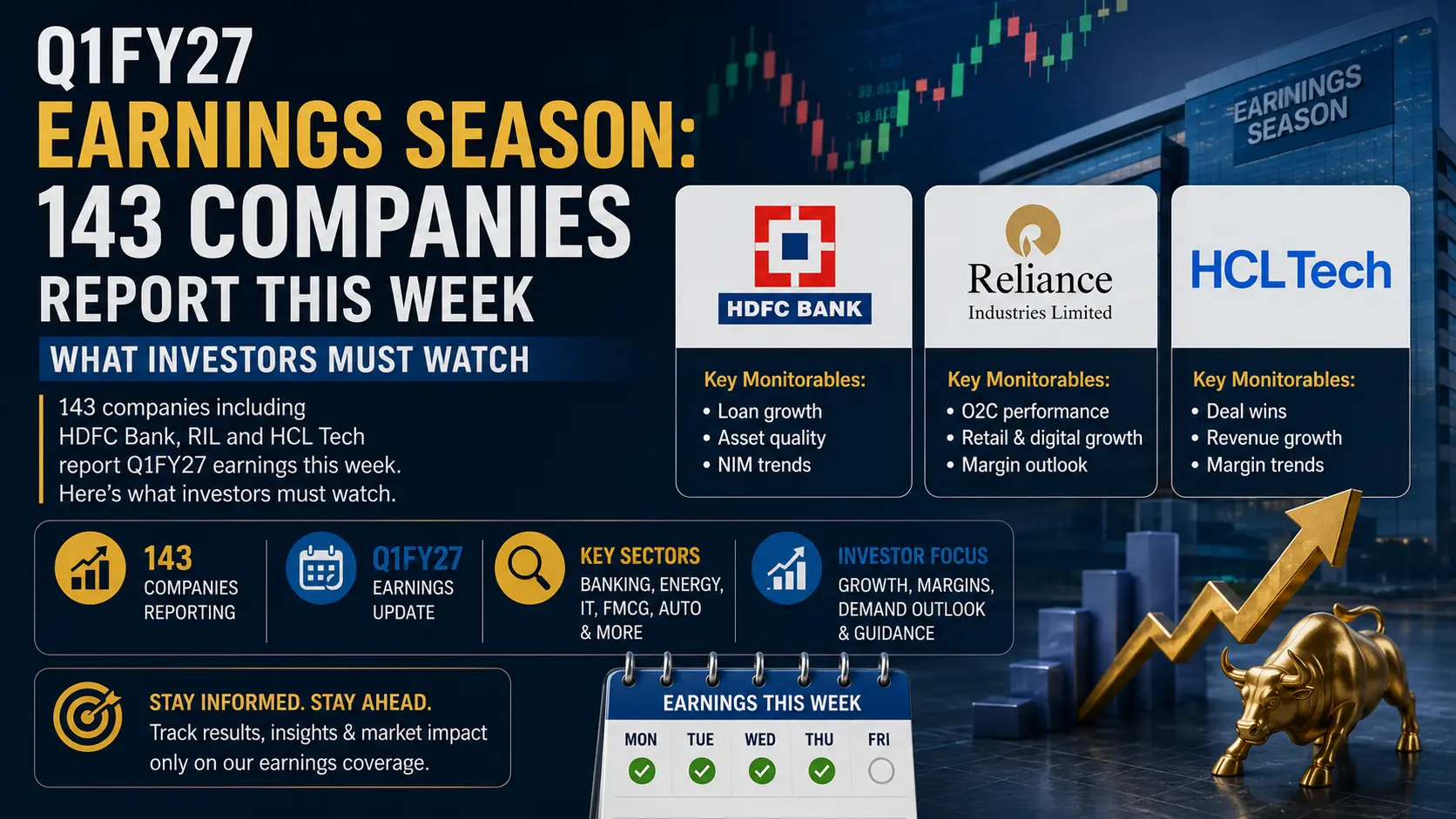
A hundred and forty-three companies open their books this week — and for anyone with money in Indian equities, the next five trading days will tell you more about the health of corporate India than any analyst note has in months. HDFC Bank, Reliance Industries, and HCL Technologies are among the marquee names reporting Q1FY27 results. Their numbers will set the tone for the broader market through the rest of the financial year.
- 143 companies are reporting Q1FY27 results this week, including HDFC Bank, Reliance Industries, and HCL Technologies.
- Q1FY27 results cover the April–June 2026 quarter — the first read on how corporate India has performed this financial year.
- Retail investors and mutual fund holders should watch management commentary on margins and demand, not just headline profit numbers.
- Sector-wide signals from these results will shape Sensex and Nifty 50 direction in the weeks ahead.
Why This Earnings Week Is Different
Every earnings season matters, but the Q1FY27 season carries extra weight. It's the first quarterly report card of a fresh financial year. And it arrives at a moment when global uncertainty, domestic consumption trends, and interest rate expectations are all pulling in different directions. Investors actually need to know more than whether HDFC Bank posted a profit. It almost certainly did. The real question is whether that profit came with margin pressure, rising bad loans, or a slowdown in loan growth that signals trouble ahead.
For a retail investor in Pune who holds an equity mutual fund — the kind that has HDFC Bank as its single largest holding — this week's results aren't an abstract event. They're a direct input into whether their portfolio ends this quarter in the green or the red. Same goes for anyone who holds Reliance Industries through an index fund. RIL's sheer weight in the Nifty 50 means its results move the entire index, not just its own stock price.
The Three Names That Will Move Markets
HDFC Bank (NSE: HDFCBANK) is the one to watch most closely. After its merger with HDFC Ltd, the bank has been navigating a complex integration while managing its deposit-to-loan ratio under close regulatory attention. The headline net interest income figure will matter. But analysts will be reading the commentary on credit costs and deposit mobilisation even more carefully. Any sign that the bank is struggling to grow deposits at the pace needed to fund its loan book will hit the stock hard.
Reliance Industries (NSE: RELIANCE) is a different story. RIL is now so diversified — oil-to-chemicals, retail, and Jio telecom — that its results function almost like a snapshot of the Indian economy itself. The telecom segment's average revenue per user, the retail segment's footprint expansion, and the margins in its traditional refining business will each tell a different story. Investors shouldn't treat the consolidated net profit as a single number. It's four businesses in one filing.
HCL Technologies (NSE: HCLTECH) will give the clearest early signal on how India's IT sector has fared through a quarter marked by global client caution and artificial intelligence-driven restructuring of technology budgets. Revenue growth guidance for the rest of FY27 — not the Q1 number itself — is what the market will price in immediately after the result drops.
What the Headline Numbers Won't Tell You
Experienced market watchers know that the press release number — the one that flashes across TV tickers — is almost never the most useful data point. Here's what actually matters in each result.
For banks: watch gross non-performing assets as a percentage of total loans, net interest margins, and the cost of deposits. A bank can post a record profit while quietly absorbing rising credit costs. And the stock will fall the moment the market figures that out.
For IT companies: watch total contract value of new deals signed, the share of deals involving AI-related work, and attrition rates. A company that's winning fewer new contracts but delivering existing ones cheaply can look healthy for one quarter and hollow the next.
For conglomerates like RIL: segment-level EBITDA margins matter far more than consolidated revenue. A strong retail quarter masking a weak refining quarter is a very different business signal than both growing together.
Management commentary during earnings calls carries as much market weight as the numbers themselves. When a CFO hedges on the demand outlook or says visibility beyond one quarter is “limited,” that word travels fast across trading desks.
What This Means for the Sensex and Nifty
Markets don't move on results alone — they move on whether results beat or miss what analysts had already priced in. If HDFC Bank posts a result that's technically strong but falls short of the consensus estimate, the stock can fall even on a good day. This is the expectations game that trips up most retail investors who read a headline and buy or sell on instinct.
The broader Sensex and Nifty 50 will be sensitive to any guidance revisions this week. A single large-cap company cutting its full-year revenue target can shave hundreds of points off the index before lunch. Conversely, a beat with an upward revision in guidance tends to lift the index for the rest of the day and often into the next session.
Foreign institutional investors, who hold significant stakes in all three marquee names reporting this week, will be watching the rupee-dollar rate alongside results. A weak rupee inflates the reported revenue of IT exporters like HCL Tech in rupee terms. But it also raises import costs for companies like RIL. Currency impact disclosures in quarterly filings are worth reading, not skipping.
How to Actually Use This Earnings Week
If you hold individual stocks in any of the 143 companies reporting, the single most useful thing you can do is read the investor presentation — not just the press release — when results drop. Most listed companies publish these on the BSE and NSE filing portals within hours of announcing results. The investor presentation breaks down the numbers by segment, geography, and quarter-on-quarter movement in a way the press release doesn't.
If you hold mutual funds, your exposure to this week's results is real but indirect. A diversified equity fund typically holds positions across dozens of companies. So a single bad result rarely moves your NAV dramatically. What moves NAVs is a broad earnings miss across a sector, or a guidance cut from a market heavyweight that triggers wider selling.
For long-term investors — those with a horizon of five years or more — a single quarter's result is almost never a reason to exit a position. What's worth tracking is whether the trend across three or four consecutive quarters shows a business losing pricing power, gaining debt, or seeing its core market shrink. One weak quarter is noise. Four weak quarters is a signal.
Frequently Asked Questions About Q1FY27 Earnings Season
What is Q1FY27 and which quarter does it cover?
Q1FY27 refers to the first quarter of the financial year 2026–27, covering April, May, and June 2026. Indian companies follow an April-to-March financial year, so Q1 is always the April–June quarter. Results reported this week reflect business performance during those three months.
Why do HDFC Bank and Reliance results matter so much to the overall market?
HDFC Bank and Reliance Industries are among the heaviest-weighted stocks in the Nifty 50 index. Their combined index weight means that a sharp move in either stock can swing the Nifty by hundreds of points on its own, directly affecting every index fund and most diversified equity mutual funds in India.
What should a retail investor actually watch in earnings results?
Skip the headline profit number and read for three things: margin direction (are profits growing faster or slower than revenue?), management guidance for the next quarter, and any change in debt levels. These three signals tell you far more about a company's health than a single quarter's net profit figure does.
Where can I find the actual Q1FY27 results filings?
All listed companies must file quarterly results with BSE and NSE. The BSE filing portal at bseindia.com and the NSE portal at nseindia.com carry all official filings, including investor presentations and press releases. They're usually available within hours of a company announcing its results to the public.
Does a bad earnings result mean I should sell my mutual fund?
One quarter's result — even a weak one from a large-cap — is rarely a reason to exit a diversified mutual fund. Fund managers rebalance holdings based on long-term fundamentals. If your fund's overall NAV trend across 12 or more months is declining, that's worth reviewing with a financial advisor. A single quarter isn't.
All eyes this week turn to the earnings call transcripts that will follow these results — and specifically to how many CFOs reach for the word “cautious” when describing the quarters ahead.
Investment Disclaimer: This article is for informational purposes only and does not constitute investment advice. Stock market investments are subject to market risks. Past performance is not indicative of future results. Please consult a SEBI-registered financial advisor before making investment decisions.