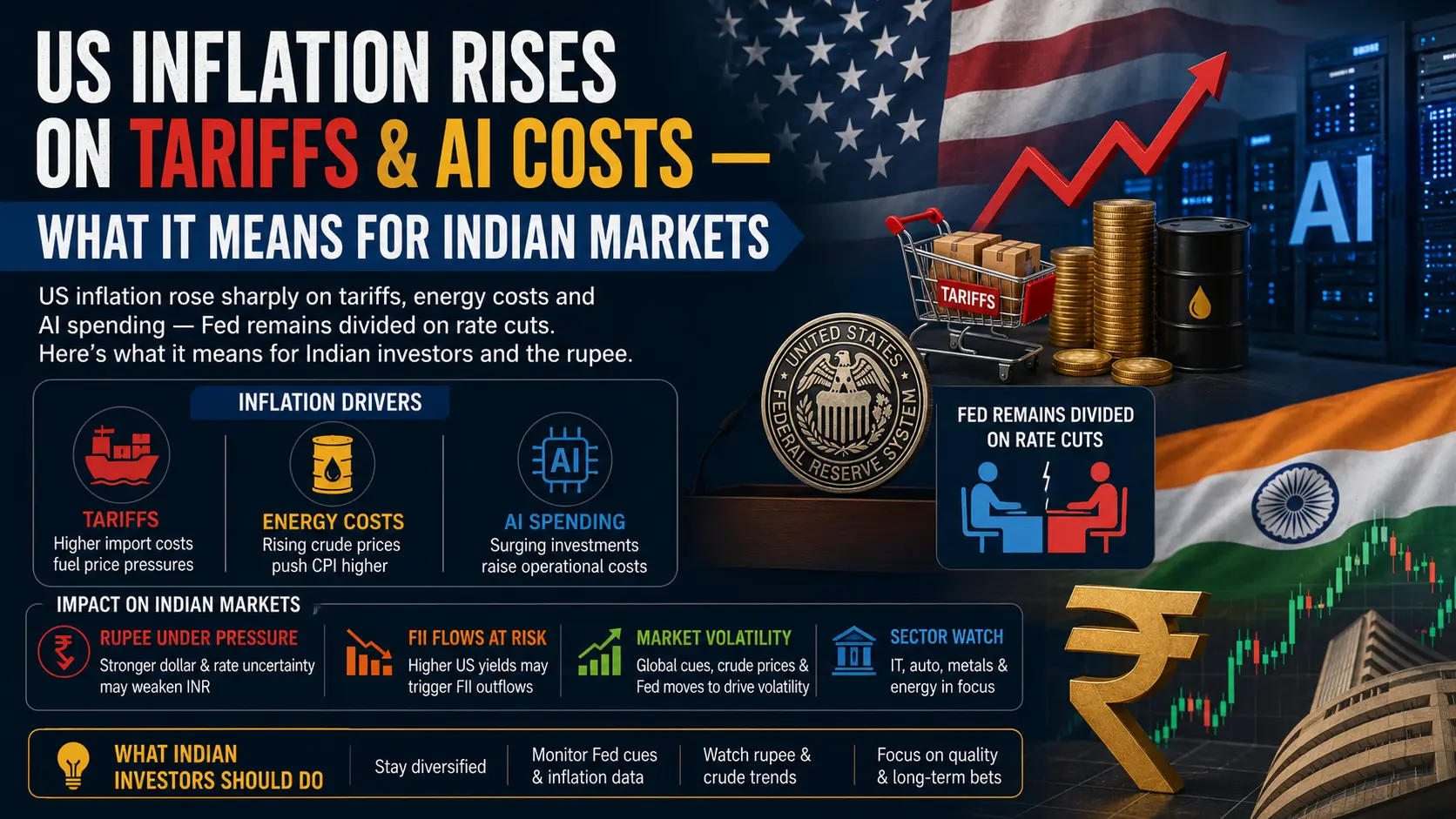
American inflation has climbed again, pushed up by tariffs on imported goods and a surge in spending on artificial intelligence infrastructure. For anyone holding Sensex-linked mutual funds, watching the rupee, or waiting on the Reserve Bank of India to cut interest rates, this isn't a distant American problem. It lands directly on your portfolio.
- US inflation has risen on the back of tariffs on imports and a jump in AI infrastructure spending.
- A divided US Federal Reserve means interest rate cuts in America are uncertain, keeping the dollar strong.
- A strong dollar puts downward pressure on the rupee, making imports more expensive for Indian businesses and consumers.
- Foreign institutional investors tend to pull money out of emerging markets like India when US rates stay high, which can weigh on the Sensex and Nifty 50.
- The RBI's room to cut rates in India depends partly on what the Fed does — a prolonged US rate hold complicates that calculation.
Why US Inflation Is Rising This Time
Two forces are driving this round of American inflation. First, tariffs — taxes the US government has placed on imported goods — are pushing up the price of everything from electronics to clothing inside America. When goods cost more to bring in, businesses pass that cost to buyers. Prices rise. That's how tariffs become inflation.
Second, the artificial intelligence boom is burning through money at a pace few people anticipated. Companies building AI data centres need enormous amounts of electricity, specialised chips, cooling equipment, and land. That spending is real, physical, and expensive. It shows up in infrastructure costs and, eventually, in prices across the economy.
Together, these two forces are keeping US inflation higher than the Federal Reserve — America's central bank — would like it to be.
The Fed Is Split. That Matters for India.
The US Federal Reserve sets American interest rates. When inflation is high, the Fed typically raises or holds rates to cool spending. When inflation falls, it cuts rates to encourage growth. Right now, per public statements from Fed officials, there's no consensus inside the institution on what to do next. Some members want to cut rates. Others want to hold. A few are open to raising them again.
This internal divide isn't a technicality. It has direct consequences for Indian markets, Indian companies borrowing in dollars, and the rupee itself.
When the Fed holds rates high, US government bonds — considered the safest investment in the world — offer attractive returns. Global investors, including the foreign institutional investors (FIIs) who pump billions into Indian equities, pull money out of riskier emerging markets and park it in American assets instead. Less foreign money flowing into India means lower demand for Indian stocks. The Sensex and Nifty 50 feel that.
What a Strong Dollar Does to the Rupee
High US rates also strengthen the dollar. A stronger dollar means a weaker rupee — it takes more rupees to buy one dollar. For India, which imports crude oil, electronics, fertilisers, and most of its edible oils in dollars, this is a direct cost increase. Indian oil marketing companies, importers, and manufacturers who depend on global supply chains all pay more when the rupee slips.
A middle-class family in Bengaluru may not track the dollar-rupee rate, but they feel it every time petrol prices go up or the cost of an imported appliance edges higher. The connection is that direct.
The rupee's trajectory also affects Indian companies with dollar-denominated debt. If the rupee weakens and they need to repay loans in dollars, their real repayment burden increases — even if the loan amount in dollars hasn't changed.
What This Means for RBI's Rate Decisions
The Reserve Bank of India sets Indian interest rates independently, but it doesn't operate in a vacuum. If the Fed keeps US rates high and the dollar stays strong, the RBI faces pressure not to cut Indian rates too aggressively. A wide gap between Indian and US rates could encourage capital outflows — money moving from India to the US chasing higher returns. That weakens the rupee further and creates the kind of currency volatility the RBI works hard to prevent.
For retail investors waiting on an RBI rate cut to see their home loan EMIs drop, a prolonged Fed hold in the US complicates that wait. The RBI will weigh domestic inflation, growth, and the global picture before acting. What the Fed does is a real input into that calculation.
What Indian Equity Investors Should Watch
For someone holding a Nifty 50 index fund or a large-cap mutual fund, the chain of events is worth understanding clearly. Rising US inflation keeps the Fed cautious. A cautious Fed keeps US rates high. High US rates attract FII money away from India. FII outflows put pressure on Indian equity valuations. That's the mechanism — not a guarantee of a crash, but a headwind that experienced fund managers are already pricing in.
Sectors most sensitive to this dynamic include IT — Indian technology companies earn a large share of their revenue in dollars and are watched closely when US corporate spending slows. Banking and real estate are also sensitive to domestic rate expectations, which the global rate environment shapes.
Investors in debt mutual funds need to watch this even more carefully. If the RBI delays rate cuts because of global pressure, long-duration debt funds — which benefit most when rates fall — may not deliver the returns some investors are counting on this year.
The AI Spending Angle India Should Not Ignore
The AI infrastructure boom driving US inflation has a separate angle for India. Indian IT companies — Tata Consultancy Services (BSE: 532540 / NSE: TCS), Infosys (BSE: 500209 / NSE: INFY), and Wipro (BSE: 507685 / NSE: WIPRO) — are positioning themselves as implementation partners for global AI projects. If US corporations continue to spend heavily on AI, some of that spending flows to Indian IT services firms as contracts. That's a potential upside, even as the broader macro creates headwinds.
The picture, in other words, isn't uniformly negative for India. It's complicated — and the complication is exactly what investors need to understand before making decisions based on headlines alone.
Frequently Asked Questions About US Inflation and Indian Markets
How does US inflation affect the Indian rupee directly?
High US inflation often keeps American interest rates elevated, which strengthens the dollar. A stronger dollar weakens the rupee because it takes more rupees to buy one dollar. This raises the cost of dollar-priced imports like crude oil and electronics for Indian businesses and consumers, pushing up domestic prices. That's a direct impact on India's economy.
Will the RBI cut interest rates if the US Fed does not cut?
The RBI sets rates based on India's domestic inflation and growth, but a prolonged US rate hold creates pressure to be cautious. Cutting Indian rates too sharply while US rates stay high could trigger capital outflows and rupee weakness, both of which the RBI actively works to prevent. It's a balancing act.
Should I be worried about my Nifty 50 mutual fund if US inflation rises?
A sustained rise in US inflation that keeps the Fed from cutting rates can trigger foreign institutional investor outflows from Indian equities, which weighs on the Sensex and Nifty 50. This is a headwind, not a certainty. Equity investing is long-term, and short-term volatility linked to global macro is normal and expected.
Which Indian sectors are most affected by US tariffs and higher inflation?
Indian IT companies with large US revenue exposure face scrutiny when US corporate spending slows. Import-heavy sectors — oil marketing, consumer electronics, and chemicals — feel the rupee impact most directly. Export-oriented sectors may benefit if the dollar stays strong and their earnings in rupees increase. Overall, it's a mixed bag.
What is the link between AI infrastructure spending and Indian IT stocks?
The global AI infrastructure boom is driving up costs in the US, but it also generates large contracts for Indian IT services firms that implement AI systems for global clients. Companies like TCS, Infosys, and Wipro are actively bidding for AI-linked work, which could offset broader macro headwinds for the sector. They're positioning for future growth.
The Fed's next policy meeting and any shift in its tone on inflation will be the single clearest signal of where this goes next. Indian markets will be watching every word.
Investment Disclaimer: This article is for informational purposes only and does not constitute investment advice. Stock market investments are subject to market risks. Past performance is not indicative of future results. Please consult a SEBI-registered financial advisor before making investment decisions.