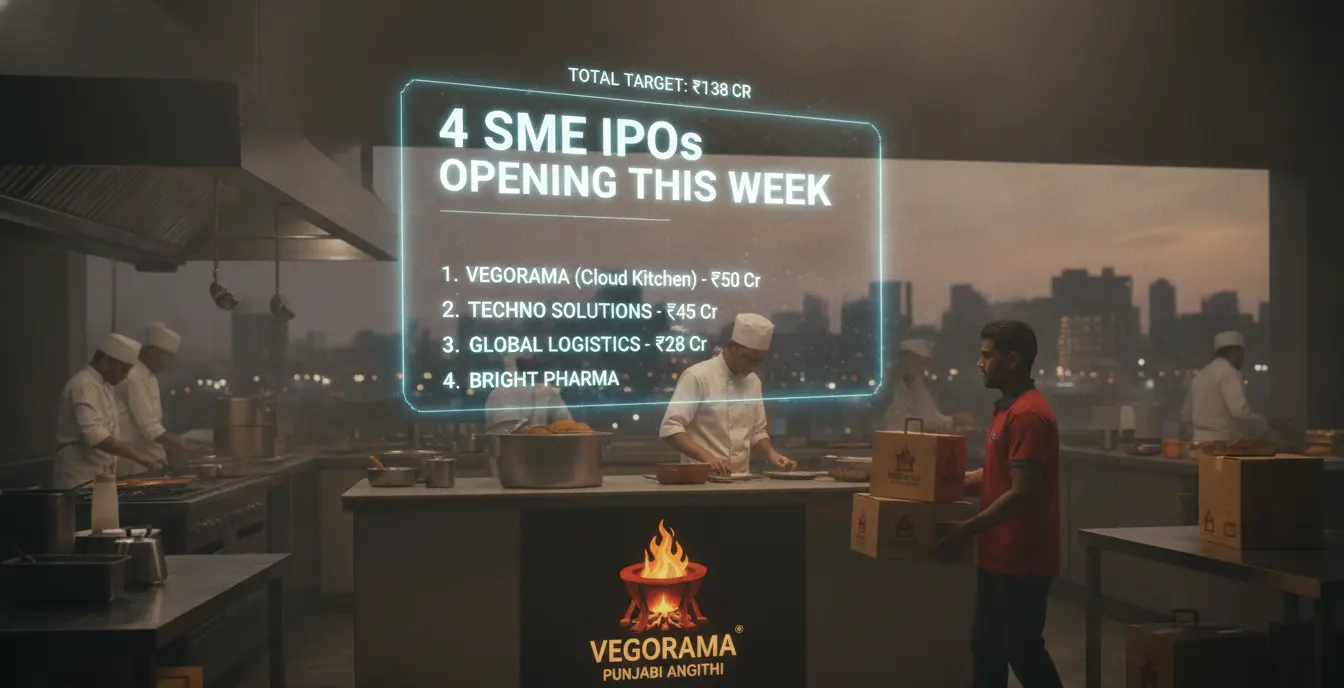
4 SME IPOs Opening This Week: Cloud Kitchen Brand Vegorama Leads the Pack
Four small companies are opening their doors to public investors this week—and one of them sells food through a cloud kitchen. That alone is enough to make people stop and pay attention. Big deal. We're talking about over Rs 138 crore being raised across four SME IPOs covering food, construction, and textiles. Think about it. The biggest surprise? A brand called Vegorama Punjabi Angithi—a cloud kitchen business—is part of this list. Cloud kitchens are restaurants you've never physically visited; you just order on your phone and the food shows up at your door. And now, everyday investors can own a piece of one. So what does this actually mean? Let's get into all of it.
- This week sees four SME IPOs hitting the market, aiming to collectively pull in over Rs 138 crore.
- A cloud kitchen brand named Vegorama Punjabi Angithi is, surprisingly, one of the four companies making a public offer.
- The sectors are diverse—food, construction, and textiles—which really shows a wide slice of India's small business world.
- While the mainboard IPO scene is quiet, SME IPOs aren't slowing down; they're still grabbing steady investor interest nationwide.
- Remember, all four are SME (Small and Medium Enterprises) listings, so you won't find them on the main BSE or NSE boards.
- For anyone tracking IPOs this week, you've got to check the specific open/close dates before you even think about applying via your broker or ASBA.
Cloud Kitchens Going Public — Why This Is Actually a Big Deal
Think about the last time you ordered biryani or rajma chawal on Swiggy or Zomato—there's a good chance the food didn't come from a restaurant you can walk into. True. It came from a cloud kitchen, a place that only makes food for delivery, with no dine-in tables, no fancy lights, no waiters. Yep. Just a kitchen, a phone number, and an app listing. How often do you see something like this?
Cloud kitchens have been growing fast in India for the last few years, but—and this is a huge point—most of them are backed by big private investors or venture capital money. That's the truth. For regular people like you and me, there's no easy way to invest in one. Not anymore. Vegorama Punjabi Angithi is changing that by going the SME IPO route, opening up ownership to retail investors.
This matters because it shows that India's food delivery model—the one that made companies like Zomato famous—is now trickling down to smaller, region-specific brands who want public money to grow. And that's big. Here's what we know: market watchers say niche food brands in the cloud kitchen space have seen consistent order volume growth, especially in Tier 1 and Tier 2 cities where eating habits shifted sharply after 2020. Big shift.
So what's really happening this week? Let that sit. And who are the other three companies joining Vegorama on the IPO calendar?
Wow.
And here's why that matters.
Here Is the Full Breakdown of All Four SME IPOs This Week
Let's go through each one clearly so you know exactly what's on the table—because all four are SME IPOs, meaning they're listed on the SME platforms of BSE or NSE, not the main big board where companies like Reliance or TCS sit. Key point. SME IPOs are smaller in size, often more risky, but also more accessible to smaller investors who don't have lakhs to put in. Worth it.
- Vegorama Punjabi Angithi (Cloud Kitchen / Food Sector): So this is the one everyone's talking about. A Punjabi food brand operating through the cloud kitchen model—meaning it delivers food directly, without a sit-down restaurant setup. The company is entering the public market to raise funds and expand its kitchen footprint. Cloud kitchens typically have much lower costs than traditional restaurants, which makes their margins more interesting to investors.
- Construction Sector Company (exact name to be confirmed per BSE SME filings): And the second company is from the construction space—a sector that has been getting serious government money through infrastructure budgets. India's government has been pushing roads, highways, and housing projects heavily, which means construction-linked businesses are in demand right now.
- Textile Sector Company — First: Look, the third IPO comes from India's textile industry, which is one of the biggest employment sectors in the country, especially in states like Gujarat, Tamil Nadu, and Maharashtra. Textile SMEs have been recovering well after the tough years of Covid and supply chain disruptions.
- Textile Sector Company — Second: And yes, there are two textile companies in this week's lineup. That's not a coincidence. India's textile exports have been picking up pace in 2025-26, helped partly by global brands looking to shift some sourcing away from China. Small Indian textile manufacturers are in a good position to benefit from that shift.
Together, these four companies plan to raise over Rs 138 crore from the public, which—to put that in perspective—is roughly the amount the government spends building about 15 to 20 kilometres of a good quality state highway. Not small. It's not massive in stock market terms, for sure. And more. But for small companies, it's the kind of capital that can genuinely change their size and scale.
On the mainboard side—where the big companies list—things have been quieter this week. Facts. That's actually normal for a period when the market is consolidating after some volatility earlier in 2026. And now? SME IPOs tend to keep moving regardless, because they serve a different kind of investor and a different kind of company.
Period.
But not for the reasons you'd expect.
What the Experts Are Actually Saying About SME IPOs Right Now
Here's the real picture: SME IPOs in India have had a mixed reputation, with some giving incredible returns—doubling or even tripling investor money within months of listing. Wow. But others have crashed badly, leaving retail investors with losses they didn't see coming. That stings. Is this really a surprise?
So the reason investor interest stays strong despite that risk is simple: people are chasing growth. Unreal. With fixed deposits giving around 6-7% returns and large-cap stocks moving slowly, SME IPOs offer the chance for much bigger gains. Right? The catch? The risk is also much bigger. But who really benefits here?
Market analysts who track BSE SME and NSE Emerge platforms have noted that subscription rates for food and lifestyle-related SME IPOs have generally been higher than those in traditional manufacturing—a trend that isn't really a surprise when you think about it. And? The reason is simple: retail investors understand food businesses. No joke. They've eaten the food. They've seen the brand. That familiarity builds confidence, even when the numbers might not fully justify it.
For cloud kitchen brands specifically, the growth story is tied to India's internet and smartphone penetration. That's real. Here's what we know from industry data: India has over 80 crore smartphone users and food delivery app usage has grown steadily year after year. Huge. Brands like Vegorama Punjabi Angithi are trying to ride that wave—and they're asking public investors to bet on it with them.
And the construction and textile companies? They come with a different pitch—they're tied to government spending and export demand, both of which are relatively stable themes in the current economic environment. Wild. The Union Budget 2025-26 had allocated a capital expenditure of Rs 11.21 lakh crore for infrastructure, which directly benefits construction-linked SMEs. Nobody talks about this. That kind of government tailwind makes construction IPOs more attractive than they might look on the surface.
The kind of thing most people miss.
What This Means for You If You're Thinking of Investing
Let's be honest with each other for a second: SME IPOs aren't for everyone, and if you're a first-time investor who has just downloaded a trading app, please don't put your savings into one without understanding what you're doing. Read that again. These are small companies. Some of them don't have the track record that big listed companies do. The result? The risks are real.
But if you're someone who already invests in stocks and understands how the market works, here's what you should look at before applying for any of these four IPOs this week—and it's absolutely critical. Think about it. First, check the DRHP (Draft Red Herring Prospectus)—that's the document every company files with SEBI before going public. Yep. It tells you everything: revenue, profits, debts, risks, and how they plan to use your money. Then, look at the Grey Market Premium (GMP)—a number that floats around in WhatsApp groups and financial forums that gives you a rough idea of how the IPO might list. It's not official and not always accurate, but it tells you about market sentiment. And? Finally, check the subscription figures once the IPO opens—if it's being subscribed heavily (meaning more people want shares than are available), that usually means there's strong demand.
For a salaried person in Delhi or Bengaluru who invests Rs 15,000-20,000 in IPOs now and then, the Vegorama IPO might look appealing simply because the cloud kitchen business model is so easy to understand. Right? You can literally order from similar brands and form your own view on whether the food quality is good. Facts. That's a kind of “ground research” you simply can't do with a steel manufacturer or a chemical company.
And for someone in Gujarat or Tamil Nadu tracking textile stocks? The two textile SME IPOs this week are worth a closer look, especially if you already understand how the textile supply chain works in your region. Big.
Here's one practical tip: SME IPOs have a minimum lot size, which is usually higher than mainboard IPOs, so you need to check that before applying. Key point. You might need Rs 1-2 lakh just to apply for one lot. Let that sit. Make sure that fits your budget without stretching you thin.
Worth paying attention to.
What to Watch for After This Week's IPOs Close
Once these four IPOs close their subscription windows, the next big moment is the allotment date—when you find out if you actually got the shares, which isn't always a guarantee. And now? After that, the listing day is when the real drama happens. No joke. Shares go live on the exchange and prices can swing sharply—up or down—within the first few hours.
Here are three things to keep an eye on after this week. Think. First—the listing performance of Vegorama Punjabi Angithi specifically. If a cloud kitchen brand lists well, it could open the door for more food-tech adjacent SMEs to go public in the coming months. Big shift. India's IPO market tends to follow successful listings very quickly. And more. Second, watch the overall SME IPO pipeline for May and June 2026. Early reports from platforms tracking upcoming offerings suggest there are over Rs 10,000 crore worth of IPOs—across dairy, hospitality, and e-commerce—expected in the May 2026 window. And third? Keep an eye on SEBI's position on SME IPO regulations. SEBI's been tightening rules around disclosures and profitability requirements for SME listings. Any new circular or guideline can change the landscape for upcoming offerings.
So, the best thing you can do right now? Subscribe to the SEBI SCORES portal alerts, check BSE SME's official page for the exact IPO timelines, and talk to your SEBI-registered financial advisor before putting money in. Period. Don't rely on random tips in Telegram groups. That's the truth. Seriously.
Really.
And that's just the beginning.
Frequently Asked Questions About SME IPOs in India 2026
What is an SME IPO and how is it different from a regular IPO?
Honestly — an SME IPO is for a small company listing on a special platform like BSE SME, not the main exchange. These have lower listing requirements but carry far higher risk for investors than regular mainboard IPOs.
How do I apply for an SME IPO in India?
Simply put, you apply just like you would for any IPO—through your broker's app or your bank's ASBA facility. The process isn't different. But here's the catch: you must check the minimum lot size first. SME IPOs often require a much larger minimum investment, sometimes over a lakh. It's also critical to make sure your demat account is active and funded before the IPO even opens.
Is investing in an SME IPO safe for a beginner investor?
Here's the short version: SME IPOs are much riskier than mainboard IPOs. These companies are small and often unproven. If you're a beginner, it's smarter to build a stable portfolio first before even considering these with a small amount of risk capital.
What is a cloud kitchen and why is Vegorama Punjabi Angithi's IPO interesting?
The thing is, a cloud kitchen is a food business built only for delivery, with no physical restaurant for customers. Think of it as a kitchen hub. Vegorama Punjabi Angithi uses this exact model, which slashes operational costs and can lead to better margins. Its IPO is getting attention because you just don't see many cloud kitchen brands go public, especially at the SME level. It’s a rare opportunity.
When will the four SME IPOs this week list on the exchange?
Look — typically, SME IPOs list about 6 days after the subscription period ends. So, for these IPOs, you're likely looking at listing dates sometime next week. But don't guess; always check the official BSE SME or NSE Emerge websites for the exact allotment and listing dates.