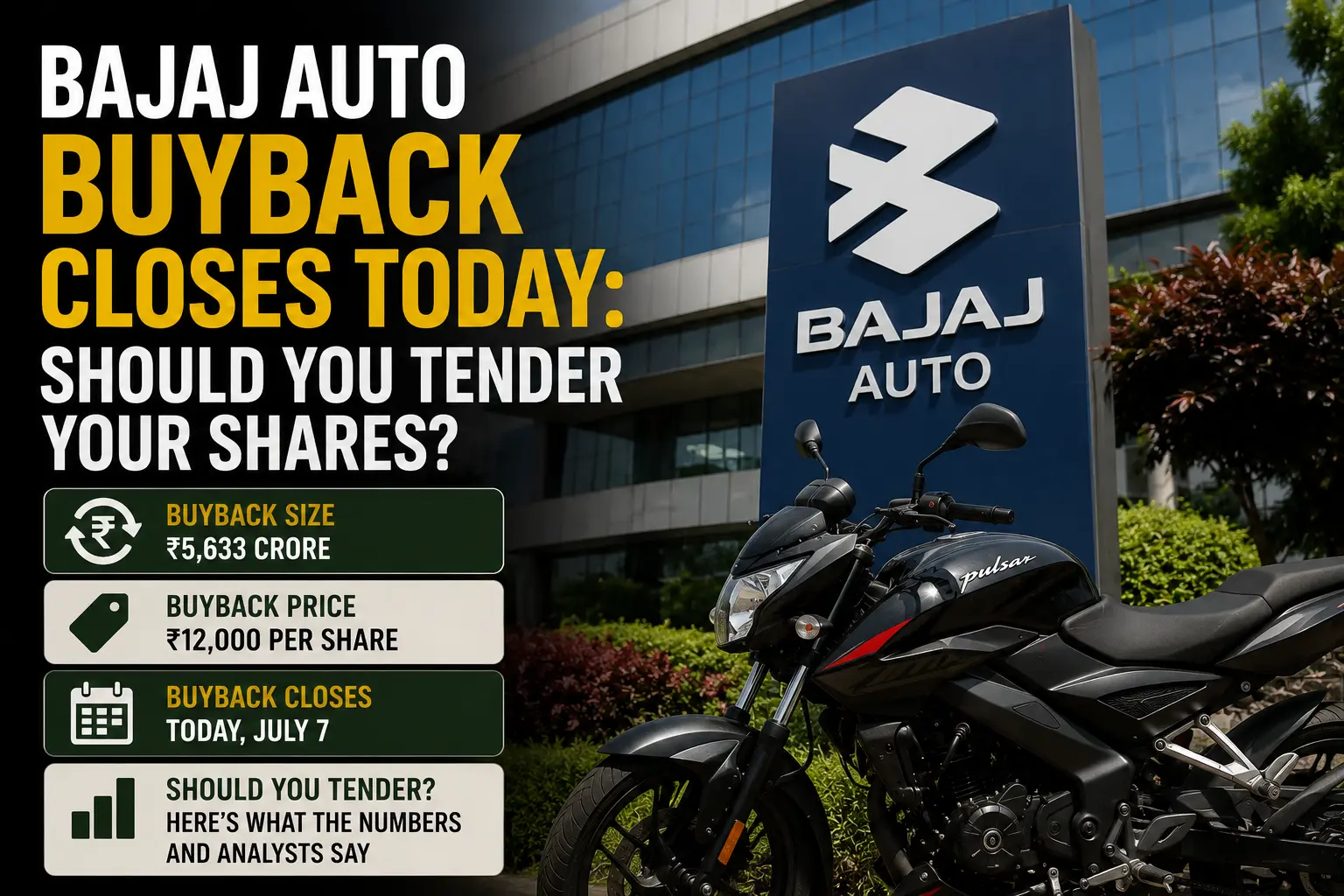
Bajaj Auto is handing back money to its shareholders today — and if you hold even one share, the clock is ticking. The company's ₹5,633 crore share buyback closes on July 7, 2025, giving eligible investors just hours left to decide whether to tender their shares at ₹12,000 apiece — a price that sits nearly 22% above where the stock was trading when the offer opened. That's not a small premium. For a retail investor sitting on Bajaj Auto shares, this is a genuine decision with real money on the table. So — should you tender, or hold?
- Bajaj Auto's ₹5,633 crore share buyback closes today, July 7, 2025 — the last day to tender shares.
- The company is buying back shares at ₹12,000 per share, well above recent market price — a premium retail investors can capture.
- Bajaj Auto plans to repurchase 46.94 lakh shares, equal to 1.68% of total paid-up share capital, according to the company's BSE filing.
- The record date for eligibility was June 24, 2025 — only shareholders on record that day can participate.
- Retail investors get a reserved quota under SEBI's buyback rules, which improves their chances of acceptance over institutional investors.
- If you're eligible and haven't tendered yet, your broker's buyback tender window closes by end of business today — check your trading platform now.
Why Bajaj Auto Is Buying Back Shares — And Why It Matters to You
Share buybacks aren't new in corporate India, but a ₹5,633 crore buyback from one of the country's most-watched two-wheeler makers is not something you scroll past. Bajaj Auto (NSE: BAJAJ-AUTO, BSE: 532977) announced this buyback on the back of a strong quarterly performance, pairing it with a final dividend of ₹150 per share — a combination that signals the company has more cash than it knows what to do with, and it's choosing to give it back rather than sit on it.
That's actually a significant statement about where the company sees itself right now. When a company like Bajaj Auto — one that competes with Hero MotoCorp and TVS Motor in India's brutally competitive two-wheeler market — decides to return over five thousand crore rupees to shareholders instead of deploying it in expansion, it's saying something about confidence in the current stock price and the state of its own balance sheet. The buyback opened on July 1, 2025, and has been running for a week with today as the final day.
Who benefits most from this? The retail investor — specifically someone who bought Bajaj Auto shares months or years ago and is now looking at a guaranteed exit at ₹12,000, which is substantially higher than what the street price has been hovering around. But there's a catch, and it's one most people don't read carefully enough.
Here Is the Full Story: What the Buyback Actually Looks Like
Bajaj Auto's board approved this buyback through a tender offer route — which is the most common method under SEBI's buyback regulations. Here's what the key numbers mean for you:
- Buyback price: ₹12,000 per share — this is a fixed price. You either tender at this price or you don't participate. There's no negotiation.
- Total buyback size: ₹5,633 crore — among the larger buybacks by an Indian two-wheeler company in recent memory.
- Shares being repurchased: 46.94 lakh shares — that's 46,94,000 individual shares across all eligible shareholders.
- Percentage of paid-up capital: 1.68% — so the company is shrinking its total share count slightly, which can, over time, lift earnings per share for continuing shareholders.
- Buyback window: July 1 to July 7, 2025 — seven trading days. Today is the last.
- Record date: June 24, 2025 — if you didn't hold Bajaj Auto shares on this date, you cannot participate, regardless of what you do today.
The mechanics work like this. You instruct your broker to tender your shares through the exchange-based buyback mechanism. Your broker submits the shares to the exchange platform. Bajaj Auto then accepts shares based on a pro-rata calculation — meaning if more shares are tendered than the company wants to buy, each shareholder gets a proportional acceptance. The unaccepted shares come back to your demat account after the process closes.
Under SEBI's buyback regulations, 15% of the total buyback is reserved for small shareholders — those who held shares worth up to ₹2 lakh on the record date. This reserved quota is crucial. It means retail investors face far less competition than institutional funds, which dramatically improves acceptance ratios for the small shareholder category. Analysts tracking this buyback say the retail acceptance ratio is likely to be meaningfully higher than the overall ratio, making this offer more attractive for smaller investors than it first appears.
What Analysts Are Actually Saying About This Buyback
The street isn't split on this. Most analysts covering Bajaj Auto have advised eligible retail shareholders to tender — but with clear conditions attached.
The math is straightforward. If Bajaj Auto's market price was trading around ₹9,800–₹10,000 in the weeks before the buyback opened, tendering at ₹12,000 locks in a gain of roughly ₹2,000 per share, or about 20%, in under two months. For a retail investor holding 10 shares, that's a potential profit of ₹20,000 — more than a month's grocery bill for most Indian families — simply by tendering. But this assumes full acceptance, which won't happen.
Here's the part that surprises most people. Because the total number of shares being bought back (46.94 lakh) is a relatively small percentage of total shares outstanding, the acceptance ratio — the fraction of your tendered shares that actually get bought — could be low for the general category. Analysts estimate the overall acceptance ratio could be somewhere between 20% and 35% for large shareholders. For retail investors in the small shareholder bucket, that ratio should be considerably higher, possibly above 50%, given the reserved quota structure.
So if you tender 10 shares and the acceptance ratio is 50%, only 5 get bought at ₹12,000. The other 5 come back to you at market price. The question then becomes: is the partial gain worth the administrative effort and the temporary blocking of your shares in the tender process? For most retail investors, the answer is yes — because the downside is limited. Your unaccepted shares simply return to your demat account, and you've lost nothing except a week's liquidity.
One important tax note. Gains from a buyback are taxed differently from open-market sales. Under current income tax rules, buyback proceeds received by individual shareholders are subject to capital gains tax — short-term if you held the shares for less than 12 months, long-term if you held for more. Shareholders who acquired these shares in a prior financial year at a much lower cost — say ₹4,000–₹5,000 per share — will see significant long-term capital gains. Consult your tax advisor to understand the net post-tax gain before deciding.
Who Gets Hit and Who Benefits from This
Think about Ramesh, a 52-year-old school principal in Nagpur who bought 15 Bajaj Auto shares at around ₹5,500 each about four years ago. His total investment was roughly ₹82,500. Today, if he tenders even 7 of those 15 shares at ₹12,000, he gets back ₹84,000 — recovering his entire original investment from just half his holding, while keeping the other 8 shares for continued upside. That's what a well-timed buyback can do for a long-term retail investor.
But for someone who bought Bajaj Auto shares recently — say at ₹11,500 in April 2025 — the ₹12,000 buyback price offers only a modest ₹500-per-share gain. After brokerage and taxes, the net benefit shrinks further. For that investor, the question is whether they'd rather have the cash now or stay invested for the longer term. And that, as any honest financial professional will tell you, depends entirely on your own financial situation.
Large institutional investors — mutual funds, FIIs, domestic insurance companies — face a much lower acceptance ratio in the general category and are largely expected to receive minimal buyback acceptance relative to their holdings. This buyback is, structurally, more generous to the small investor than to the big one. That's not an accident — SEBI's buyback rules are designed this way.
The Dates That Matter — What Happens After Today
Today is the last day. If you're eligible and want to tender, you need to log into your trading account — Zerodha, Groww, Angel One, HDFC Securities, ICICI Direct, wherever you trade — and look for the buyback tender option under the corporate actions section. Most platforms show it prominently for eligible demat accounts.
After the window closes tonight, here's what the timeline looks like. Bajaj Auto will calculate the total shares tendered across all categories. It will then determine the acceptance ratio. Settlement — meaning the money reaching your bank account for accepted shares and the return of unaccepted shares to your demat — typically happens within 10 to 12 working days after the buyback closes, as per standard SEBI timelines for tender offer buybacks.
What should you watch for after this? Bajaj Auto's Q1 FY2026 results, expected in late July, will give the next clear signal on whether the company's fundamentals justify holding the remaining shares at current market prices. The two-wheeler sector more broadly is watching rural demand recovery, fuel price movements, and the pace of EV transition. Bajaj Auto's own EV play — its Chetak electric scooter and Pulsar EV pipeline — is a separate story that long-term investors in this stock are tracking closely.
And one last thing worth noting. After a buyback, the reduced share count means the same total earnings get divided among fewer shares. That mechanically boosts earnings per share (EPS), which can support the stock price over the medium term. It's one reason why companies that complete buybacks sometimes see their stock perform well in the 6–12 months that follow — though past patterns are no guarantee of future results.
Frequently Asked Questions About the Bajaj Auto Share Buyback
What is a share buyback and how does Bajaj Auto's work?
Simply put, a share buyback is when a company uses its own cash to buy back shares from investors at a fixed price — usually higher than the market rate. Bajaj Auto is buying back 46.94 lakh shares at ₹12,000 each, totalling ₹5,633 crore. Shareholders tender their shares through their broker, and the company pays them directly. It's a way of returning cash to investors when the company has more than it needs for operations.
How do I tender shares in the Bajaj Auto buyback today?
Here's the thing: log into your trading or demat platform — Zerodha, Groww, ICICI Direct, HDFC Securities, or whichever broker you use. Look under “Corporate Actions” or “Buyback” sections. Select Bajaj Auto (BSE: 532977), choose the number of shares you want to tender, and confirm before the market closes today, July 7, 2025. Your broker will block those shares until settlement is complete — typically within 10–12 working days.
Will all my tendered shares be accepted in the Bajaj Auto buyback?
Not necessarily. Acceptance depends on how many total shares are tendered vs how many Bajaj Auto wants to buy. For retail investors — those who held shares worth up to ₹2 lakh on June 24, 2025 — 15% of the total buyback is reserved under SEBI rules, giving them a higher acceptance ratio than large investors. Unaccepted shares are simply returned to your demat account after settlement. You lose nothing except temporary liquidity.
Should I tender my Bajaj Auto shares or hold them for the long term?
Good question — and it really depends on when you bought. If you bought below ₹10,000, tendering at ₹12,000 locks in a clear gain. If you're a long-term investor who believes in Bajaj Auto's EV roadmap and rural demand recovery story, holding might make more sense. A practical middle path: tender a portion of your holding, capture the premium, and keep the rest invested. Talk to a SEBI-registered advisor about the tax angle before deciding.
What is the record date for the Bajaj Auto buyback and who is eligible?
The record date was June 24, 2025. Only shareholders who held Bajaj Auto shares in their demat accounts on that specific date are eligible to participate in this buyback. If you bought shares after June 24, you cannot tender them in this offer, even if you hold them today. Eligibility is fixed — it was determined over a week before the buyback window even opened on July 1.