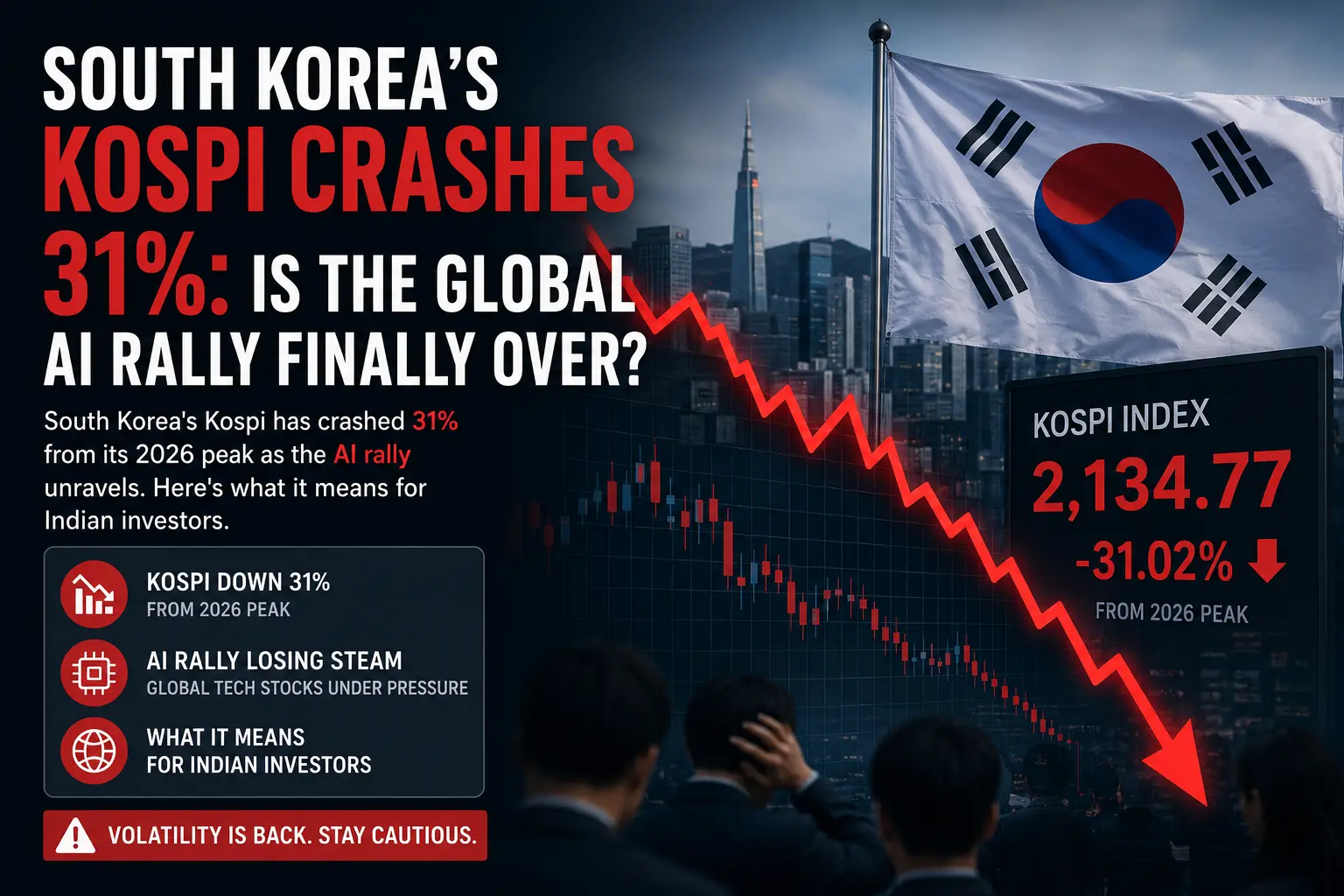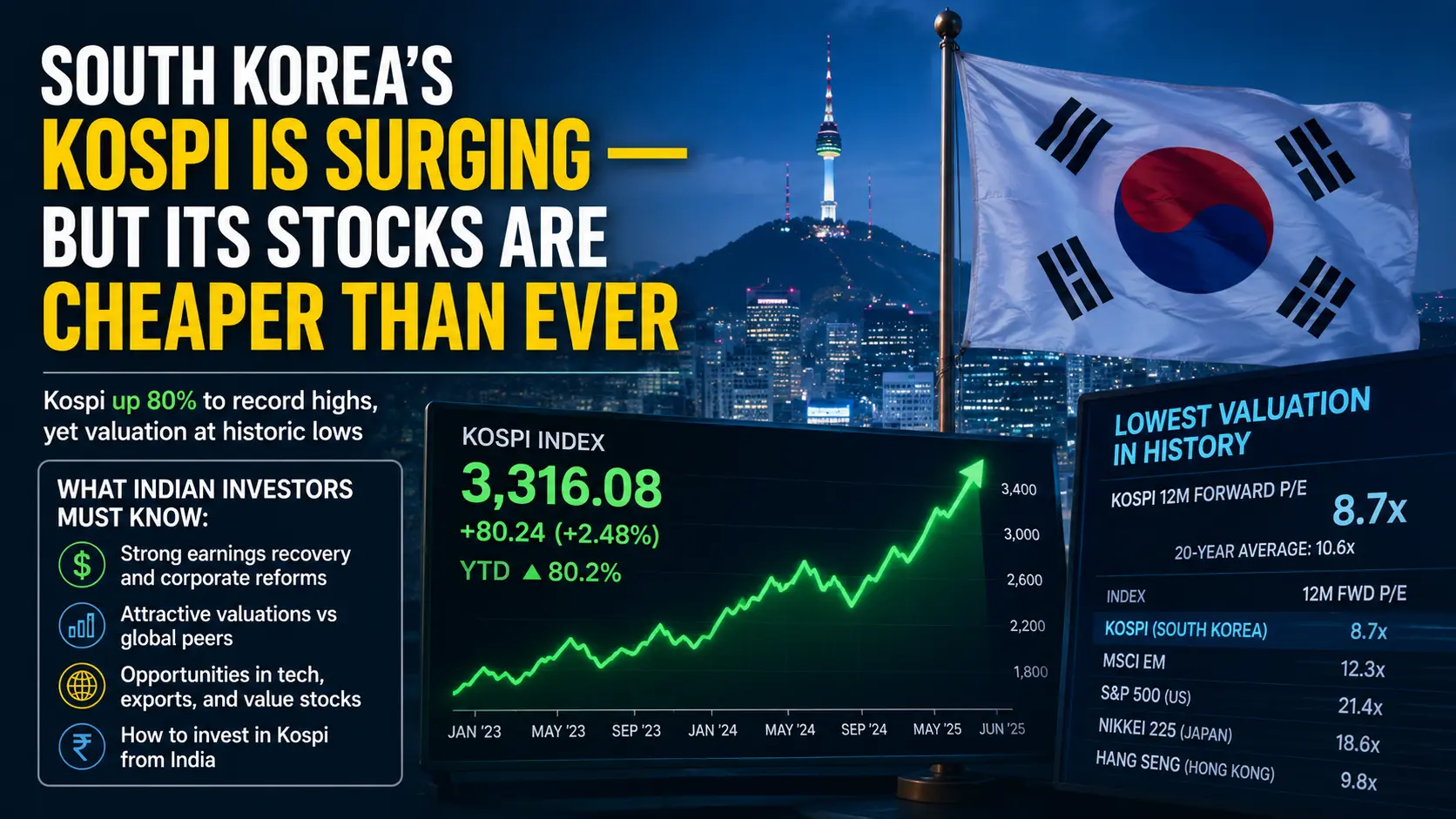
South Korea's Kospi index has surged about 80% to record highs. And yet, by standard valuation measures, South Korean stocks are trading at some of their cheapest levels in years. That contradiction is exactly the kind of signal experienced investors don't ignore, especially if you're managing savings in India and looking beyond the Sensex and Nifty for better returns.
- South Korea's Kospi has risen about 80% to reach record highs, according to market reports.
- Despite the surge in price, South Korean stocks are trading at historically low valuation levels by standard measures.
- The gap between price performance and valuation is rare — and historically significant for long-term investors.
- Indian retail investors with international mutual fund exposure or direct global investing access may want to watch this closely.
- Consult a SEBI-registered financial advisor before making any allocation decisions based on global market movements.
A Market That Went Up — But Didn't Get Expensive
Most of the time, when a stock index rises 80%, valuation multiples expand. Stocks become more expensive relative to earnings. That's how markets usually work. South Korea's Kospi has done the opposite, which is unusual enough to pay attention to.
Per market reports, even after the sharp rally, South Korean equities are trading at valuation levels that are low by historical standards. That means corporate earnings have grown fast enough — or market pricing has stayed conservative enough — that the index looks cheaper today than it did before the run-up began.
For a mutual fund investor in Pune or a stock market enthusiast in Bengaluru who holds international fund-of-funds, this isn't an abstract number. It's a signal about where global value may be sitting right now, outside of the familiar territory of the Nifty 50 or Sensex 30.
Why the Valuation Gap Matters
When an index rises sharply but valuations stay low, there are usually two explanations. The market was either severely undervalued to begin with, or earnings grew fast enough to absorb the price increase without pushing multiples higher. Both are bullish conditions for investors who haven't yet entered.
South Korea is home to some of the world's largest companies in semiconductors, consumer electronics, and shipbuilding — sectors that have seen strong global demand cycles. The Kospi's composition means its performance is tied closely to global trade volumes and technology spending, both of which are relevant to anyone tracking where the world economy is headed.
For Indian investors, this matters for a specific reason. Several Indian international mutual funds and fund-of-funds have exposure to Asian and emerging market equities that include South Korean stocks. If you hold a scheme benchmarked to the MSCI Emerging Markets index, South Korea is already part of your portfolio — whether you knew it or not.
What Indian Investors Should Know Before Acting
The Kospi's move doesn't automatically mean Indian investors should rush to buy South Korea-focused funds. Market signals like this one require context that only a qualified advisor can provide for your specific situation.
What it does mean is that the old assumption — that a market which has already risen sharply must be expensive — doesn't always hold. Data from South Korea, as reported, challenges that assumption directly. Valuation discipline matters more than price momentum when making allocation decisions.
If you invest through international or global mutual funds in India, check which markets and indices your scheme tracks. If it includes MSCI Asia ex-Japan or MSCI Emerging Markets, South Korean equities are likely already represented. Understanding that exposure is the first step before drawing any conclusions about what to do next.
The Bigger Picture for Emerging Market Investors
South Korea's situation is a reminder that emerging markets don't move in a single direction. While Indian markets have commanded premium valuations over much of the last decade, other economies in the same emerging market bracket have lagged on price even as their underlying businesses grew stronger.
That divergence — Indian markets expensive, some Asian peers cheap — is something long-term investors in diversified international funds have been navigating for years. The Kospi's current combination of strong price performance and still-low valuations is the kind of data point that shows up in fund manager commentary and analyst notes precisely because it's uncommon.
Whether it translates into a sustained re-rating of South Korean equities or a mean-reversion correction is something no one can predict with certainty. What's clear is that the signal is there, and informed investors are already looking at it.
Frequently Asked Questions About South Korea's Kospi and Indian Investors
What is the Kospi index?
The Kospi, or Korea Composite Stock Price Index, is South Korea's primary stock market benchmark. It tracks the performance of all common stocks listed on the Korea Exchange, including major companies like Samsung Electronics and Hyundai Motor. That makes it closely tied to global technology and manufacturing trends.
Why are South Korean stocks considered cheap even after an 80% rally?
Valuation is measured relative to earnings, not just price. If corporate earnings grow fast enough while prices rise, the price-to-earnings multiple stays low. Per market reports, South Korean stocks are trading at historically low valuation levels despite the Kospi's sharp rise, suggesting earnings have kept pace with or outgrown the rally. That's why they're seen as cheap.
Do Indian mutual funds invest in South Korean stocks?
Yes, several Indian international mutual funds and fund-of-funds that track indices like MSCI Emerging Markets or MSCI Asia ex-Japan have exposure to South Korean equities. If you hold such a scheme, South Korean stocks may already form part of your portfolio. Always check your fund's factsheet or scheme information document for details.
Should I invest in South Korea-focused funds right now?
Market data alone isn't enough to make an investment decision. Factors like your risk appetite, investment horizon, existing portfolio allocation, and currency risk all matter. A SEBI-registered financial advisor can help you assess whether adding emerging market or South Korea-specific exposure makes sense for your specific financial goals.
How does South Korea's market performance affect my Nifty or Sensex investments?
Directly, it doesn't — the Kospi and Indian benchmark indices are separate. Indirectly, global fund flows between emerging markets can shift allocations between countries. Strong performance in South Korea may attract capital that could otherwise flow into Indian equities, which is a dynamic worth monitoring over the medium term.
Investment Disclaimer: This article is for informational purposes only and does not constitute investment advice. Stock market investments are subject to market risks. Past performance is not indicative of future results. Please consult a SEBI-registered financial advisor before making investment decisions.