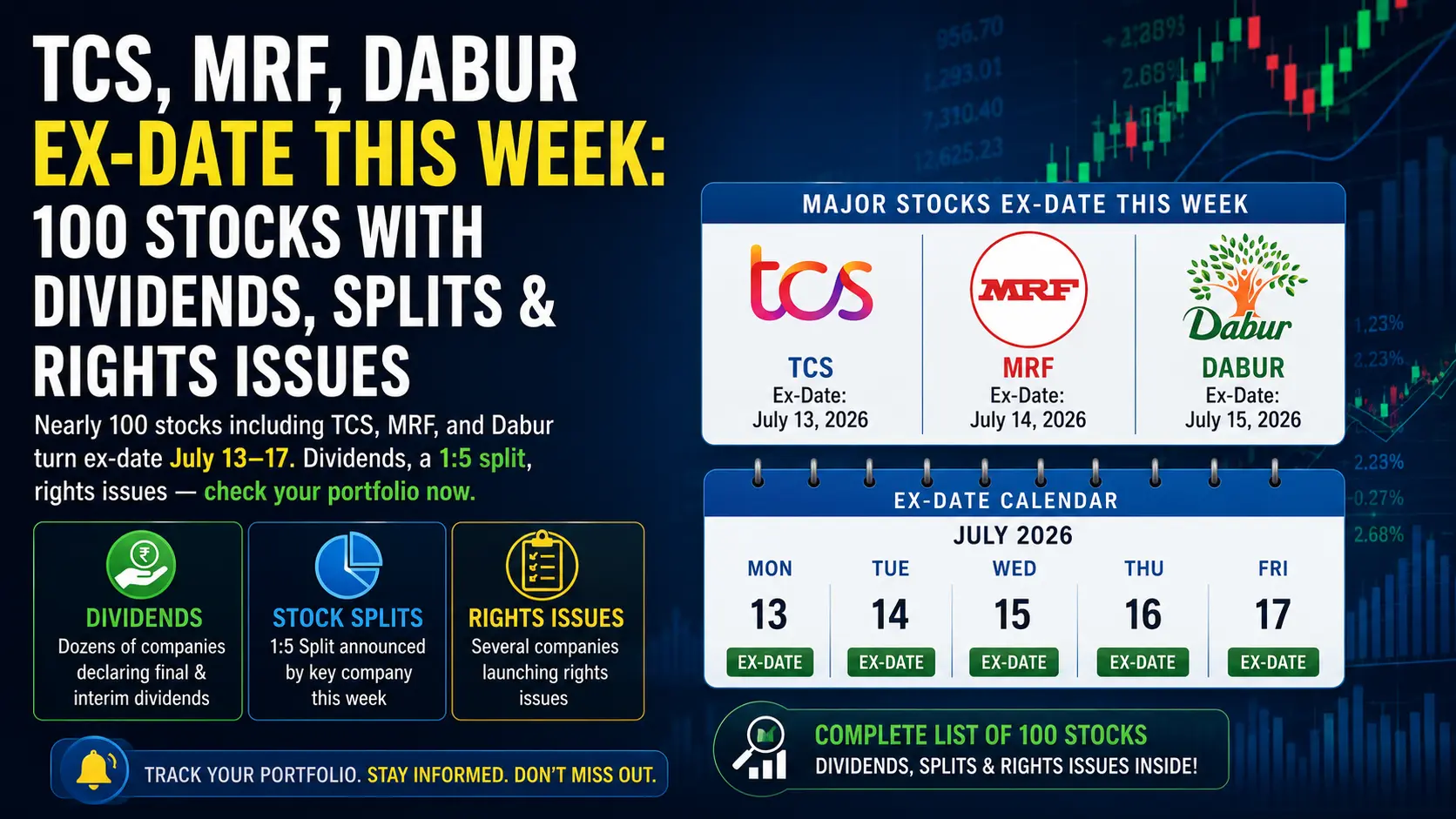
Nearly 100 stocks are hitting their ex-dates between July 13 and July 17. If you hold any of them — or are thinking of buying — the next few trading sessions will directly decide what lands in your demat account.
Tata Consultancy Services (NSE: TCS), MRF (NSE: MRF), and Dabur India (NSE: DABUR) are among the most closely watched names on the list. There's also a 1:5 stock split and active rights issues.
- Nearly 100 stocks have ex-dates falling between July 13 and July 17.
- TCS (NSE: TCS), MRF (NSE: MRF), and Dabur India (NSE: DABUR) are among the blue-chip names on the list.
- A 1:5 stock split is also active this week — existing shareholders get five shares for every one they hold.
- To qualify for a dividend or a split benefit, you must own the stock before its ex-date — buying on or after the ex-date means you miss out.
- Rights issues on the list give eligible shareholders the option to buy new shares, usually at a discount to the market price.
What Is an Ex-Date and Why Does It Matter for Your Portfolio?
An ex-date is the cut-off date a company sets for a corporate action — a dividend payout, a stock split, or a rights issue. If you own the stock before the ex-date, you qualify. If you buy on the ex-date or after, you don't, even if you hold the shares the very next morning.
For a retail investor, this isn't a technicality. It's the difference between receiving a dividend cheque and watching it go to the seller you just bought from. With nearly 100 stocks hitting their ex-dates this week alone, the window is narrow. The stakes are real.
Think of it this way: if TCS declares a dividend of ₹76 per share and you hold 100 shares, that's ₹7,600 credited to your bank account — roughly the cost of a domestic flight ticket. Miss the ex-date by one day, and that money belongs to whoever sold you the shares.
The Big Names: TCS, MRF, and Dabur
Tata Consultancy Services (NSE: TCS), India's largest IT services company by market capitalisation, is among the headline names with an ex-date this week. TCS has a long track record of consistent dividend payouts, making it a regular fixture in dividend-focused portfolios across the country.
MRF (NSE: MRF), the tyre maker whose share price is the highest of any listed stock in India, is another name on the list. At a price that runs into lakhs per share, even a modest dividend yield translates to a meaningful absolute amount for shareholders.
Rounding out the most-watched trio this week is Dabur India (NSE: DABUR). Dabur, one of India's oldest FMCG companies, makes brands like Hajmola, Chyawanprash, and Real juices.
All three are large-cap, dividend-paying businesses with broad retail shareholder bases. That's exactly why their ex-dates draw attention from small investors and institutional funds alike.
The 1:5 Stock Split Explained
One stock on this week's list is undergoing a 1:5 split. This means every single share you hold gets converted into five shares. The total value of your holding stays the same on the day of the split — if you owned one share worth ₹500, you now own five shares worth ₹100 each.
The practical effect kicks in over time. A lower face value per share makes the stock more accessible to smaller investors. It increases liquidity in the market, and often brings in fresh buying interest. For existing shareholders, there's no immediate gain or loss, but the split does increase the number of shares sitting in your demat account.
If you want to participate in this split, you need to own the stock before its ex-date. Buying on or after the ex-date means you get the post-split shares at the adjusted price. You don't receive the extra shares from the split itself.
Rights Issues: A Discounted Offer You Can Accept or Walk Away From
Rights issues work differently from dividends and splits. A company offering a rights issue gives its existing shareholders the right — not the obligation — to buy additional shares. This is usually at a price below the current market rate.
If you're eligible for a rights issue this week, you'll receive a Rights Entitlement (RE) credited to your demat account. You can then choose to apply for new shares, renounce the entitlement (sell it in the market if it's listed and tradeable), or let it lapse. Each option has a different financial outcome, so eligible shareholders should check their demat accounts and the specific terms of each rights issue before the subscription window closes.
How to Check If Any of These Stocks Are in Your Portfolio
Log in to your brokerage app or demat platform — Zerodha, Groww, Upstox, HDFC Securities, or whichever broker you use — and look at your current holdings. Cross-reference those holdings against the full list of stocks with ex-dates between July 13 and July 17. The BSE and NSE both publish daily corporate action calendars on their official websites, where you can search by company name or date range.
If you're planning to buy any of these stocks specifically to capture a dividend, factor in the record date and the T+1 settlement cycle. Under the current T+1 system, shares bought today settle in your demat account the next trading day. So if a stock's ex-date is Wednesday, you need to have bought it by Tuesday's trading session to be on the books as a shareholder of record.
A Note for the Dividend-Hunting Investor
Chasing dividends without understanding the price adjustment is a common trap for newer investors. On the ex-date, a stock's opening price typically drops by roughly the dividend amount — the exchange adjusts for it. So if MRF declares a ₹3 per share dividend and you buy it the day before the ex-date just for that ₹3, the stock price may fall by approximately that amount on the ex-date morning. This leaves your overall position neutral or slightly negative after brokerage and taxes.
This doesn't mean dividend investing is pointless — far from it. Long-term shareholders who hold quality businesses like TCS or Dabur through multiple dividend cycles genuinely benefit from the compounding of both share price appreciation and regular payouts. But buying a stock two days before an ex-date purely to grab the dividend, then selling immediately after, rarely makes financial sense once you account for short-term capital gains tax and transaction costs.
The real utility of tracking this week's ex-date calendar is simpler: know what you already own, know what you're entitled to, and don't accidentally sell a stock the day before it pays you.
Frequently Asked Questions About Ex-Dates, Dividends, and Stock Splits
What is the ex-date for a stock dividend?
The ex-date is the first trading day a stock trades without the right to an upcoming dividend. To qualify for the dividend, you must own the stock before this date. If you buy on the ex-date, you don't receive the dividend; the previous seller does.
How does a 1:5 stock split affect my demat account?
After a 1:5 split, every share you hold becomes five shares. Your total investment value stays the same, but each share is priced at one-fifth of the pre-split price. The extra shares appear automatically in your demat account, so no action is required from you.
If I buy TCS or Dabur today, will I get the dividend?
That depends on whether you buy before the ex-date. Under India's T+1 settlement system, shares settle the next trading day. Buy before the ex-date and your name appears in the shareholder register in time; buy on or after, and you miss this payout entirely.
What should I do if I'm eligible for a rights issue this week?
Check your demat account for a Rights Entitlement credit. Then decide whether to apply for new shares, sell the entitlement in the secondary market if it's tradable, or let it lapse. Read the offer document carefully for the subscription price, lot size, and deadline.
Where can I find the full list of stocks with ex-dates this week?
The BSE and NSE official websites publish corporate action calendars updated daily. Search under the “Corporate Actions” section on either exchange's site. Filter by date range — July 13 to 17 — and select action types such as dividend, split, or rights issue for the complete list.
With nearly 100 corporate actions compressed into five trading sessions, this is one of the busier weeks on the equity calendar. Check your holdings tonight — not on Friday afternoon.
Investment Disclaimer: This article is for informational purposes only and does not constitute investment advice. Stock market investments are subject to market risks. Past performance is not indicative of future results. Please consult a SEBI-registered financial advisor before making investment decisions.