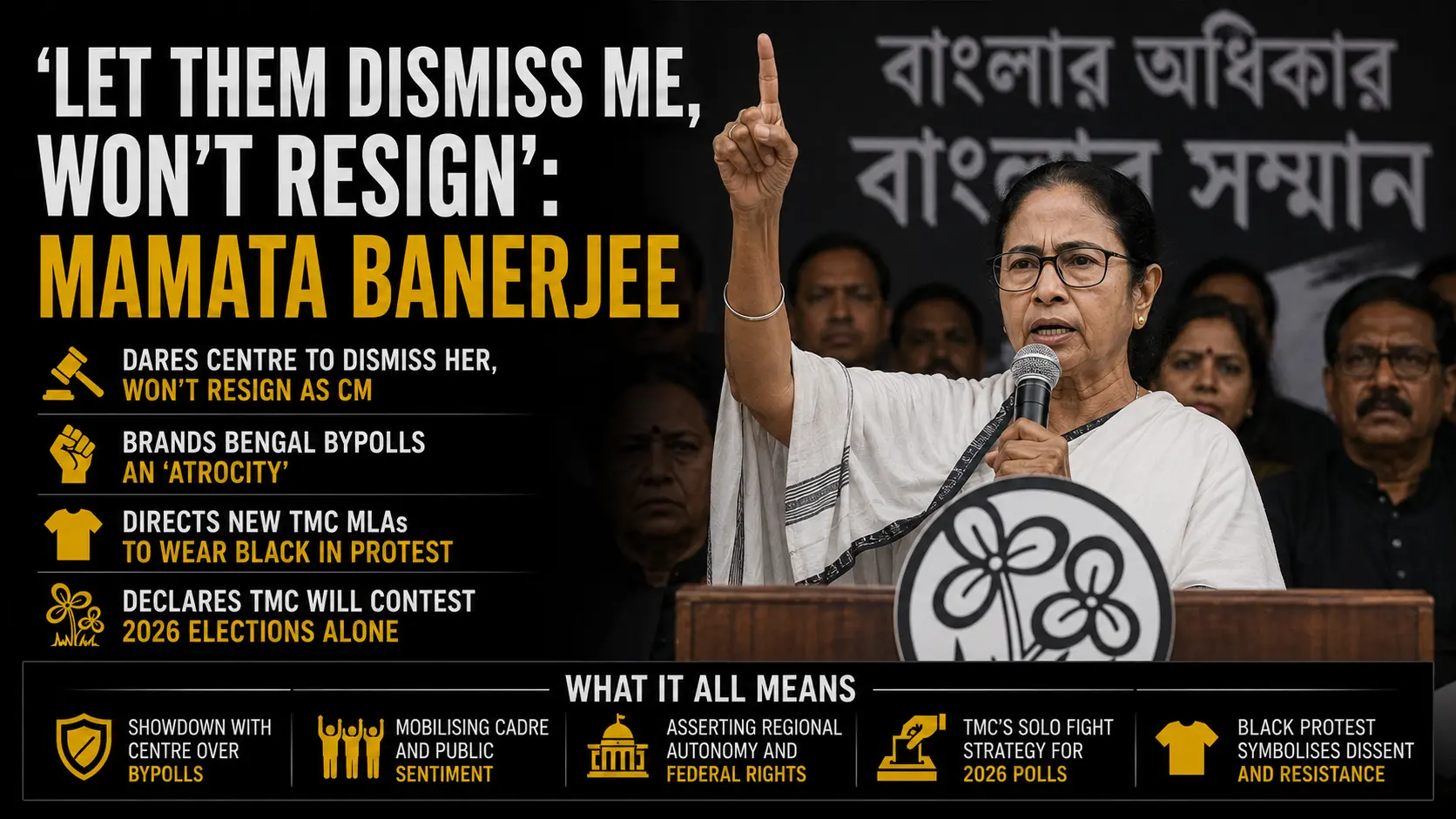
Mamata Banerjee's defiant declaration — "let them dismiss me, I won't resign" — sent shockwaves through Bengal's political corridors this week, as the Trinamool Congress supremo publicly branded the recent bypoll process an outright "atrocity" and instructed her newly elected MLAs to wear black armbands as a mark of protest. It was a theatrical, calculated move, vintage Mamata. But beneath the symbolism lies something far more consequential: a Chief Minister openly challenging constitutional norms, daring the Centre to act against her, and simultaneously rallying her legislative troops ahead of the high-stakes 2026 West Bengal Assembly elections.
Why Mamata Banerjee's 'Atrocity' Charge Against Bengal Bypolls Matters for Indian Democracy
West Bengal's bypoll episodes have never been quiet affairs. But when a sitting Chief Minister publicly labels the electoral process in her own state an "atrocity," it demands serious attention. Mamata Banerjee's remarks are not just political theatre — they reflect a deep, festering tension between the state government and central institutions, particularly the Election Commission of India. Whether her critique holds evidentiary water or is strategic posturing ahead of 2026, the optics are explosive and the implications for democratic discourse are profound.
The broader context cannot be ignored. West Bengal has consistently ranked among India's most politically volatile states, with bypolls frequently marred by allegations of booth capturing, voter intimidation, and administrative partiality. Mamata's intervention this time goes several steps further — she is not merely complaining about irregularities but framing the entire electoral exercise as institutionally compromised. For millions of Bengali voters, that is a serious charge that demands accountability, regardless of which side of the political divide they stand on.
Key Developments: Mamata's Black Armband Order and Her Direct Challenge to Dismissal
At a meeting of Trinamool Congress MLAs convened ahead of the Bengal Assembly's budget session, Mamata Banerjee made a series of pointed announcements that quickly dominated national headlines. She told the gathering of newly elected legislators to don black armbands — a traditional sign of mourning and protest in Indian political culture — essentially asking her own winners to grieve the process that got them there. It is a deeply unusual move, one that underscores just how aggressively Mamata is framing the opposition narrative entering 2026.
Her "let them dismiss me" remark carried obvious undertones directed at the BJP-led central government, with whom she has had a prolonged, bitter standoff over everything from the Governor's office to central agency investigations against TMC leaders. By daring the Centre to remove her, she is playing a well-worn but effective script — casting herself as an embattled defender of Bengal's autonomy against an overreaching Delhi establishment. Her base tends to respond powerfully to this framing, and she knows it.
Here is a breakdown of the key developments from Mamata's TMC MLAs meeting:
- Black armband directive: Newly elected TMC MLAs were instructed to wear black armbands to symbolise protest against what Mamata called electoral "atrocities" during the bypoll process.
- Resignation refusal: Mamata categorically stated she would not resign under any pressure, daring authorities to dismiss her instead — a direct provocation aimed at the BJP-led Centre.
- Solo 2026 strategy: She confirmed TMC would contest the 2026 Bengal Assembly elections alone, explicitly ruling out any pre-poll alliance with the Congress or other INDIA bloc parties.
- Two-thirds majority confidence: Mamata reportedly told MLAs that TMC would win at least 226 out of 294 seats in the 2026 polls, projecting an overwhelming mandate.
- 74 sitting MLAs denied tickets: TMC's candidate announcement signalled a performance-based purge — nearly one-third of sitting legislators were dropped, indicating significant internal restructuring.
- Budget session backdrop: The meeting took place ahead of the Bengal Assembly budget session, suggesting Mamata is synchronising her political messaging with legislative strategy.
The cumulative effect of these announcements is a TMC that looks inward-focused, ideologically sharpened, and fully battle-ready — even if there is still over a year to go before the election. Mamata is not waiting for the campaign season. She is already in campaign mode, and she wants everyone to know it.
Political Impact and Strategic Analysis: What Mamata's Moves Signal for 2026
The decision to go it alone in 2026 is arguably Mamata's most consequential strategic call this election cycle. By formally severing any alliance possibility with the Congress, she is betting entirely on TMC's organisational machinery and her own personal brand equity in Bengal. It is a high-risk, high-reward gambit. The INDIA bloc's fragmentation at the national level has clearly influenced her calculation — if Congress cannot deliver cohesive electoral arithmetic even in opposition-friendly terrain, why share seats and credit? Bengal's specific voter psychology, which has historically rewarded strong regional identity over national alliance logic, arguably supports her instinct here.
The "atrocity" framing around the bypolls, however, cuts both ways analytically. On one hand, it energises TMC's base and puts the Election Commission on notice that any perceived administrative favouritism will face fierce public pushback. On the other hand, it risks normalising the delegitimisation of electoral outcomes — a dangerous precedent when deployed by a ruling party that has itself faced credible accusations of electoral misconduct. The dropping of 74 sitting MLAs is perhaps the more substantive reform signal embedded in this political noise: it tells voters that TMC is not immune to accountability, that underperformance has consequences, and that the party is serious about projecting a fresher, more responsive face to the electorate. Whether that message lands convincingly will depend on whether those replaced candidates were genuinely dropped for performance reasons or for internal factional calculations.
What's Next for Bengal Politics and the Road to the 2026 Assembly Elections
The next twelve to fifteen months in West Bengal will be defined by intensifying political warfare. With TMC formally declaring a solo run, opposition parties — particularly the BJP and the Left-Congress combine — will need to recalibrate their alliance strategies. The BJP, which made dramatic inroads in 2021 before losing considerable ground since, will be watching TMC's internal restructuring closely for vulnerabilities. Any significant dissent from the 74 dropped MLAs could become fodder for BJP recruitment drives. Meanwhile, the Congress faces the uncomfortable reality of being explicitly rejected as an ally by the dominant regional force in a state it once ruled.
For ordinary Bengal voters, the most immediate question is whether Mamata's protest politics will translate into governance improvements or whether the "atrocity" rhetoric becomes a convenient shield against accountability. The budget session will offer the first real legislative test of the new MLAs Mamata has invested her political capital in. How they perform in the Assembly — and how the state budget addresses issues like unemployment, rural welfare, and civic infrastructure — will matter far more to swing voters than black armbands and defiant sound bites. Watch this space closely.
Frequently Asked Questions
Why did Mamata Banerjee ask TMC MLAs to wear black armbands after winning the bypolls?
Mamata Banerjee directed newly elected TMC MLAs to wear black armbands as a symbolic protest against what she described as "atrocities" committed during the bypoll process. Despite TMC winning the seats, she argued the conduct of the elections was fundamentally compromised, using the gesture to frame a broader anti-Centre and pro-democracy narrative ahead of the 2026 Assembly elections.
Will TMC ally with Congress for the 2026 West Bengal Assembly elections?
No. Mamata Banerjee has explicitly ruled out any pre-poll alliance with the Indian National Congress or any other party for the 2026 Bengal Assembly elections. She stated TMC is "enough on its own" and expressed confidence in winning a two-thirds majority without coalition support, marking a clear departure from the INDIA bloc cooperative framework at the national level.
What did Mamata Banerjee mean when she said 'let them dismiss me, I won't resign'?
Mamata's remark was a direct challenge to the BJP-led central government, signalling she will not step down regardless of political or institutional pressure. It reflects the ongoing tension between Bengal's state government and central agencies, and is widely seen as a strategic move to reinforce her image as a defiant protector of Bengal's regional autonomy against perceived central overreach.