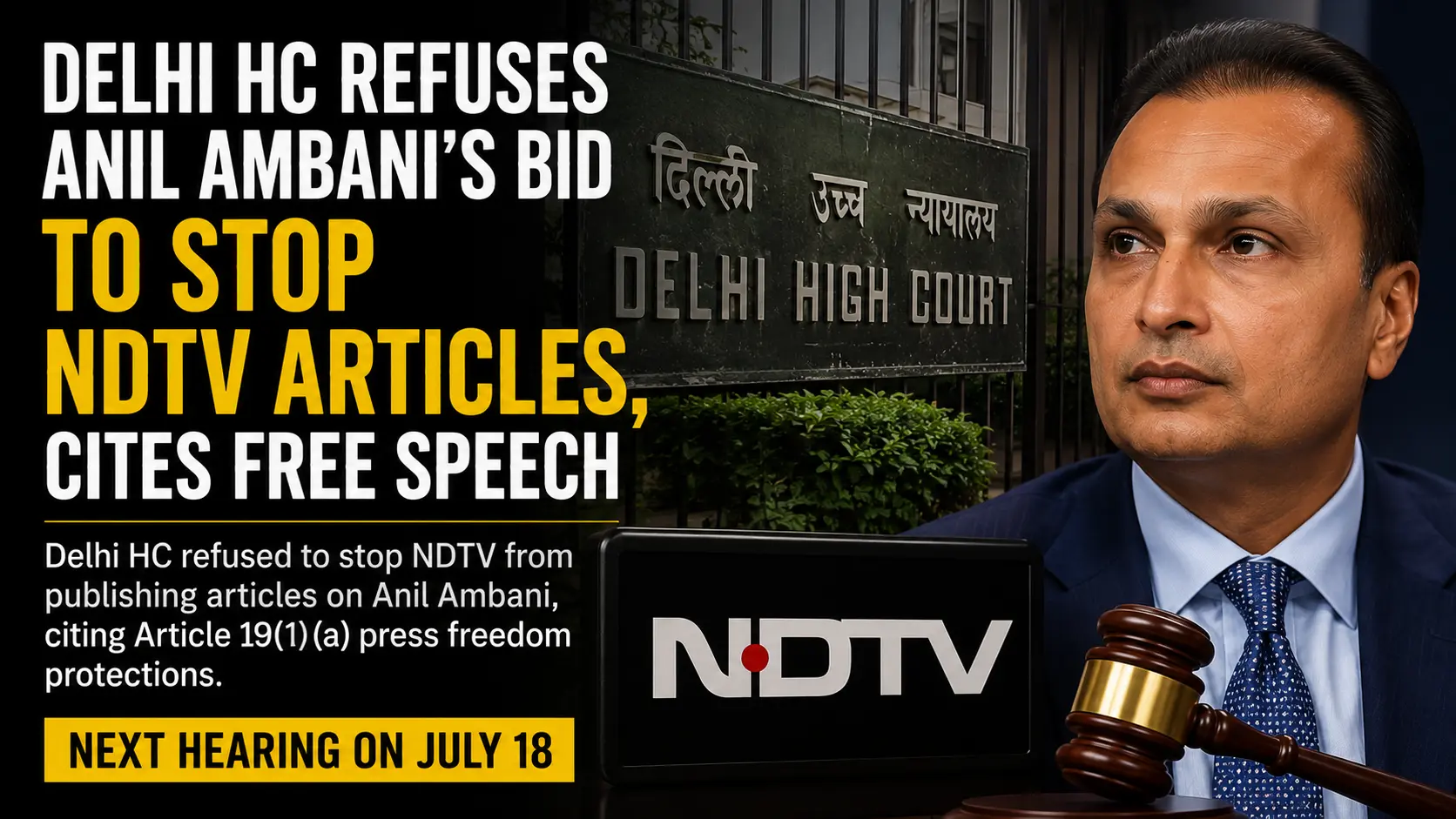
Anil Ambani's defamation case against NDTV hit a wall on Thursday when the Delhi High Court refused to immediately stop the media outlet from publishing articles about him. And the court said that blocking news stories — even ones a powerful person considers harmful — needs a very careful look at Article 19(1)(a) of the Indian Constitution, which gives every citizen the right to speak and express themselves freely. That is a big deal. But this isn't just a fight between a businessman and a news channel — it is one of those cases that touches something much bigger: can money and legal power silence the press in India, and what happens to every journalist watching from the sidelines when the verdict finally lands? And it is that serious. So the next hearing in this matter is scheduled for July 18. This article walks you through everything — what happened, why it matters, and what could come next.
- Delhi High Court declined to grant immediate interim relief to Anil Ambani against NDTV's published articles.
- And the court cited Article 19(1)(a) — India's constitutional protection for freedom of speech and expression.
- Ambani filed a defamation suit against NDTV over its coverage of CBI and ED cases against him, calling the articles defamatory and based on "predatory strategies."
- So the court has issued a notice to NDTV and will next hear the case on July 18.
- Restricting publication mid-case requires detailed judicial consideration — the court made this point very clearly, and no one in that courtroom missed what it meant.
- And this case could set a precedent for how Indian courts balance reputational harm claims against press freedom rights for years to come.
Why the Anil Ambani vs NDTV Defamation Case Matters: The Full Context Explained
Let's go back a little bit. Here is the thing — Anil Ambani, once one of India's richest men and the younger brother of Mukesh Ambani, has been at the centre of multiple financial and legal controversies over the last several years. Big shift. Companies under the Reliance ADAG (Anil Dhirubhai Ambani Group) have faced debt defaults, insolvency proceedings, and investigations — a cascade of legal and financial pressure that has fundamentally reshaped how the market, the public, and now the courts see him. So the Central Bureau of Investigation (CBI) and the Enforcement Directorate (ED) — India's two most powerful investigation agencies — have looked into matters connected to him and his group. Nobody saw this coming a decade ago. And NDTV, which is now owned by the Adani Group after a major acquisition, has reported extensively on these developments.
And here is where it gets interesting. Ambani's legal team approached the Delhi High Court claiming that NDTV's coverage went beyond reporting facts. Yes, really. And they called the articles defamatory — meaning the articles supposedly hurt his reputation by spreading false or misleading things. So the court did issue a notice to NDTV, meaning NDTV has to respond. But the court stopped short of ordering NDTV to pull down or stop publishing articles — a decision that legal observers watching press freedom cases say is consistent with decades of Indian judicial reluctance to gag reporting mid-case. Here is the truth. So what exactly does this case look like up close?
What Happened in the Anil Ambani vs NDTV Case: A Complete Breakdown
Look, the lawsuit was filed by Anil Ambani in the Delhi High Court sometime in early May 2026. And his team argued that NDTV published a series of articles that painted him in a bad light — specifically around the ongoing CBI and ED investigations. That alone is huge. The articles, according to Ambani's side, were not just reporting but were built on what they called "predatory strategies" — basically, a way of using journalism to damage his image and business reputation unfairly, a framing that his legal team clearly believes distinguishes this from standard aggressive reporting. Here is a clean breakdown of the key facts in this case:
- Defamation suit filed in May 2026: Anil Ambani moved the Delhi High Court seeking legal action against NDTV for publishing articles he says are false and damaging.
- The specific complaint — CBI and ED coverage: And the articles in question reportedly dealt with investigations by the CBI and ED into Ambani and his group companies.
- "Predatory strategies" allegation: Ambani's team used this phrase to describe what they believe was NDTV's deliberate intent to harm — not just neutral news reporting.
- Court issues notice to NDTV: So the Delhi High Court formally sent a notice to NDTV, asking it to respond to the defamation claims. And this means the case is very much alive.
- No interim restraint granted: And this is the big one. Look, the court did not tell NDTV to stop publishing. But it said any such order would need a detailed review of Article 19(1)(a) protections first.
- Next hearing set for July 18: Both sides will come back to court on that date for the next round of arguments.
So the judge's observation was pointed and important. Restraining a media outlet from publishing stories — even while a defamation case is going on — is not something courts do lightly. Think about that. And this is called a pre-publication or publication injunction, and Indian courts have historically been very reluctant to grant such orders — a consistent judicial stance rooted in the understanding that silenced speech, unlike published speech, cannot be reviewed, corrected, or undone once the moment passes. Simple as that. So courts prefer to wait, hear both sides fully, and then decide if any damage actually happened — rather than assume it will and shut down reporting in advance.
Ambani's legal team made their arguments. And NDTV's lawyers will now respond. Right? Between the two, it is the court that has to figure out where the line sits between someone's right to protect their name and a free press's right to report on powerful people without fear — a question that does not get easier just because one side has more lawyers or more money. That is genuinely a hard question. And one that Indian courts have wrestled with for decades.
The Free Speech vs Reputation Debate: What Legal Experts and History Reveal
Here's something a lot of people miss. And Indian courts have a long track record of being careful — almost cautious — when it comes to gagging the media. Wow. Look, the landmark Romesh Thappar vs State of Madras (1950) case was one of the first times the Supreme Court stood up strongly for press freedom right after Independence — a ruling that set the tone for how Indian constitutional law would treat free expression for generations, long before social media or 24-hour news cycles existed. Since then, courts have repeatedly said that freedom of expression under Article 19(1)(a) is not just a nice idea. And it's a core right that can only be restricted under very specific, very narrow conditions mentioned in Article 19(2).
Defamation — meaning writing something false that hurts someone's reputation — is one of those conditions. So legally speaking, Ambani is not wrong to approach the court. That is worth knowing. And he has every right to. But the question is whether the articles crossed the line from aggressive journalism into actual falsehood — and that distinction, subtle as it sounds, is everything in a defamation case of this scale. That is not nothing. Multiple legal observers who have tracked high-profile defamation cases say that courts almost never stop publication before a full hearing. And they point to cases like R. Rajagopal vs State of Tamil Nadu (1994), where the Supreme Court held that the press has the right to publish anything based on public records — even if the subject doesn't like it.
And there is another layer here too. So NDTV is now owned by the Adani Group, which itself has had a complicated relationship with the broader Indian business and political landscape. Surprising? Yes. Some media watchers find it notable that a channel now connected to one major conglomerate is being sued by another. And that doesn't change the legal facts of this case, but it adds a layer of context that is worth keeping in mind.
How This Case Affects Press Freedom and Public Interest in India: Real-World Impact
You might be wondering — okay, this is between two powerful parties, what does it have to do with me? Quite a lot, actually. And every time a court decides how to handle a defamation case against a media outlet, it draws a line — a line that every editor, every journalist, and every newsroom in the country quietly watches being drawn, because it tells them exactly how far they can go next time. And that line affects what every journalist in India can write about every powerful person — not just today, but for years to come.
Right now, Indian journalists covering business fraud, corporate scams, or political misconduct often face legal threats. No one expected this to become so routine. Now, a lawsuit — even one that eventually goes nowhere — costs money, time, and energy to fight. And smaller outlets don't always have the resources. And this is sometimes called a SLAPP suit (Strategic Lawsuit Against Public Participation) — a lawsuit filed not necessarily to win, but to pressure, exhaust, and silence. Courts in many countries have started recognising this pattern and pushing back. And India does not yet have a specific anti-SLAPP law, though there have been calls for one.
So the Delhi HC's refusal to grant immediate restraint is, in that sense, a small but real signal. And that matters. But it says: the press doesn't get shut down just because someone important doesn't like the coverage. Look, the full trial will still happen. And NDTV still has to answer for the content it published — but the channel gets to keep publishing in the meantime, which is exactly how it should work in a functioning democracy where the press is not an accessory to power but a check on it. And that is just the beginning. For readers like you, this matters because the kind of journalism that holds powerful people accountable only survives if courts protect the space for it to exist.
What Happens Next: Anil Ambani vs NDTV Outlook and Key Dates to Watch
So the most important date right now is July 18, when both sides return to the Delhi High Court. And there is more. By then, NDTV's legal team will have filed a formal response to the notice — a document that legal watchers say will likely challenge both the characterisation of its coverage as defamatory and the framing of "predatory strategies" that Ambani's team introduced. So the court will likely hear preliminary arguments on whether Ambani's claims are even strong enough to merit a detailed trial. But if the judge finds that the articles were based on public information — court records, official filings, agency statements — NDTV's position becomes quite strong. And if Ambani's team can show specific factual errors that caused measurable harm, the case moves forward more seriously.
Three things could happen from here. Honestly, that is a lot to keep track of. Best case for Ambani: the court finds enough merit to order NDTV to pull down specific articles or be careful about future coverage. Most likely outcome: the case drags on through the courts for months, possibly years, with no dramatic orders either way — this is how most defamation cases in India play out. Risk case: if the court dismisses the suit early, it sends a strong signal to other powerful figures thinking about suing media outlets. And that matters. Keep watching the July 18 hearing closely. That date will tell us a lot about which direction this is heading. So if you follow media freedom issues in India, this is one case you won't want to lose track of.
Frequently Asked Questions About Anil Ambani NDTV Defamation Case
What is the Anil Ambani vs NDTV defamation case about?
Anil Ambani filed a defamation suit in the Delhi High Court against NDTV, claiming the channel published false and damaging articles about CBI and ED investigations against him. His legal team called the coverage based on "predatory strategies." So the court issued notice to NDTV but refused to immediately stop publication of the articles, citing free speech protections.
Why did the Delhi High Court refuse to stop NDTV from publishing articles?
So the Delhi High Court said blocking a media outlet from publishing stories needs a detailed review of Article 19(1)(a), India's constitutional right to free speech. And courts do not grant publication injunctions easily because silencing reporting — even temporarily — is seen as a serious restriction on press freedom that cannot simply be undone once the moment has passed in a democratic society.
How does this case affect press freedom in India?
And this case tests where Indian courts draw the line between protecting someone's reputation and protecting the press's right to report on matters of public interest. But if courts regularly allowed rich or powerful people to stop unflattering stories mid-case, it would seriously weaken investigative journalism across India and discourage reporters from covering financial or legal cases involving influential individuals.
What is Article 19(1)(a) of the Indian Constitution and why does it matter here?
Article 19(1)(a) gives every Indian citizen the right to freedom of speech and expression, which includes the freedom of the press. And in this case, the Delhi High Court said this right cannot be casually suspended just because someone files a defamation suit — any restriction needs very careful, detailed judicial consideration backed by strong and specific evidence of actual harm caused.
What is the next date of hearing in the Anil Ambani vs NDTV case?
So the Delhi High Court has scheduled the next hearing in the Anil Ambani versus NDTV defamation case for July 18. By that date, NDTV is expected to file a formal response to the court's notice. And the hearing will decide whether the case proceeds to a full trial or faces early dismissal on merits and legal grounds.