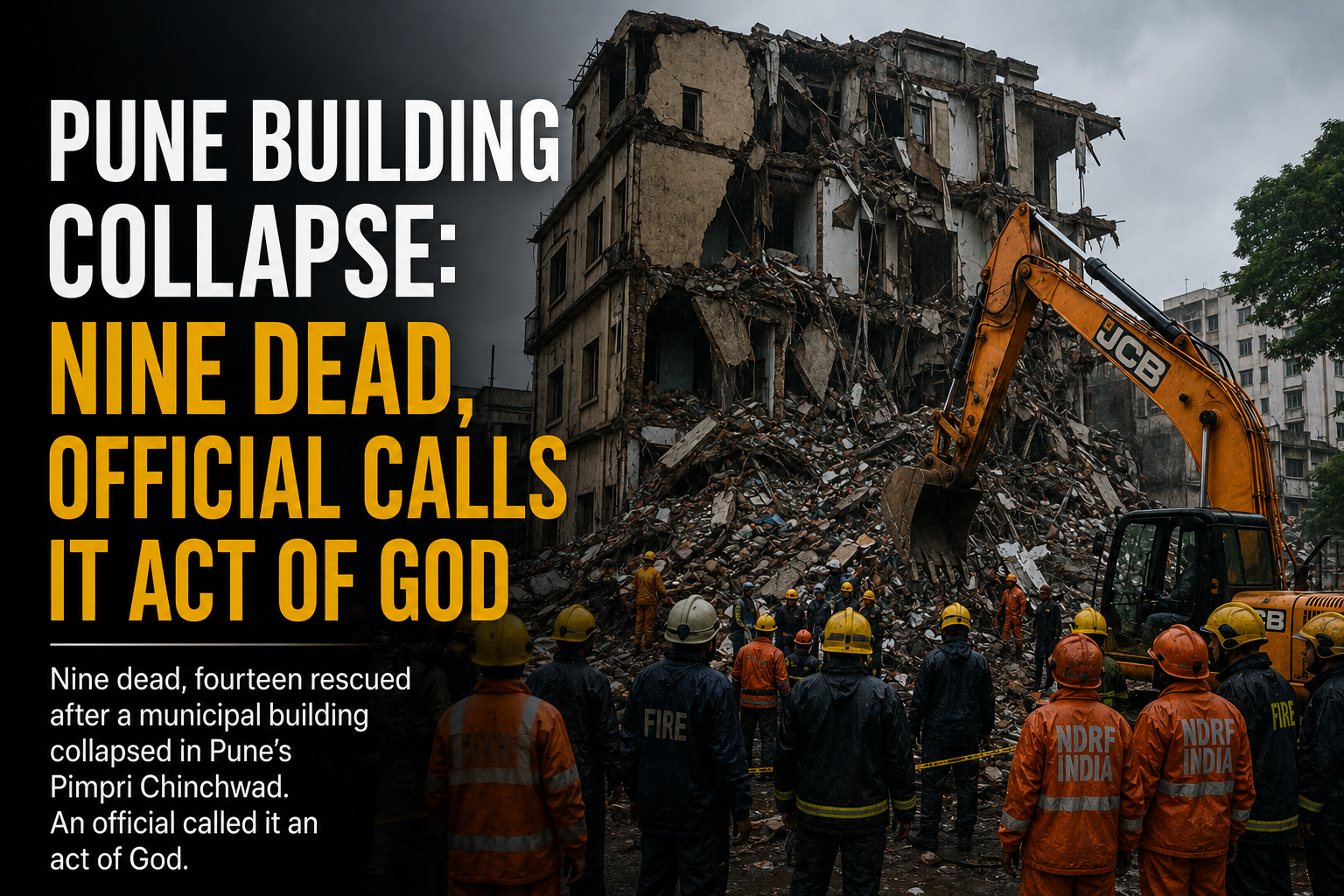
Nine people are dead. Fourteen others made it out alive. A three-storey building at a municipal waste-to-energy plant in Pimpri Chinchwad has collapsed — taking not just lives, but also whatever credibility remained for the official who looked at the rubble and called it an act of God.
- Nine people were killed after a three-storey building collapsed at a municipal waste-to-energy plant in Pimpri Chinchwad, Pune.
- Fourteen people were rescued alive from the debris.
- The body of Waman Kasbe, the last person unaccounted for, was pulled from the rubble in the early hours of Sunday.
- A local official described the collapse as an “act of God” — a remark that drew immediate and sharp public backlash.
What Happened at the Pimpri Chinchwad Plant
The building that came down was part of a waste-to-energy facility run by the Pimpri Chinchwad Municipal Corporation. Workers inside had no warning when the structure gave way. Rescue teams moved in fast, pulling fourteen people out alive from the collapsed floors.
But one person remained missing long after the others were accounted for: Waman Kasbe. His body was recovered in the early hours of Sunday, officials say, closing a search that had stretched through the night. The final toll? Nine dead.
For the families of the workers who died inside that building — most of them daily-wage employees doing shift work at a municipal facility — the word “act of God” isn't an explanation. It's an insult.
The Phrase That Sparked a Storm
Municipal buildings don't collapse because of God. They collapse because of bad construction, deferred maintenance, ignored inspections, or all three at once. That's what makes an official's decision to use the phrase “act of God” so politically explosive.
The remark drew immediate criticism. In India, the phrase has a specific legal meaning — it refers to events caused entirely by natural forces, with no human negligence involved. A storm. A flood. An earthquake. A building falling on workers at a government-run plant doesn't fit that definition, and observers were quick to say so.
The backlash wasn't merely semantic. Using “act of God” is, in practice, a way of saying: no one is responsible. That framing — at a municipal facility, with municipal workers, maintained by a municipal corporation — didn't hold up to a single question.
Who Bears Responsibility
The Pimpri Chinchwad Municipal Corporation owns and operates the waste-to-energy plant where the collapse occurred. That makes questions of building safety, maintenance records, and structural inspections a matter of direct municipal accountability — not divine intervention.
Workers inside were employed at a government facility. Their families will now navigate the bureaucratic process of compensation claims, official inquiries, and, if the past is any guide, years of waiting. For a daily-wage worker's family in an industrial township like Pimpri Chinchwad, that wait isn't an abstraction. It's the difference between keeping the children in school and pulling them out.
Whether a formal inquiry has been ordered, and who specifically will be held accountable, hasn't been confirmed in official statements reviewed for this article.
A Pattern India Knows Too Well
Building collapses at government and municipal facilities aren't rare in India. The pattern is consistent: a structure fails, workers die, an official makes a statement that deflects blame, an inquiry is announced, and the inquiry proceeds slowly or not at all. Families of the dead receive compensation — sometimes — and the building's maintenance records are rarely made public.
Pimpri Chinchwad is one of Maharashtra's wealthiest and most industrialised municipal zones. The resources to maintain public infrastructure exist. The question being asked loudly now is whether they were used for that purpose.
Note: Any legal or judicial matters referenced in this article are sub-judice and should not be treated as final. All persons are presumed innocent unless convicted by a competent court.
Frequently Asked Questions About the Pune Building Collapse
How many people died in the Pimpri Chinchwad building collapse?
Nine people died after a three-storey building collapsed at a waste-to-energy plant run by the Pimpri Chinchwad Municipal Corporation in Pune. Fourteen others were rescued alive. The body of the last missing person, Waman Kasbe, was recovered in the early hours of Sunday, officials confirmed. This closed a search that had stretched through the night.
Why did an official call the Pune building collapse an act of God?
A local official used the phrase “act of God” to describe the collapse, drawing sharp public and political criticism. In Indian law, the term applies to purely natural events with no human negligence. Critics argue the phrase was used to deflect accountability for what happened at a government-owned and maintained facility, especially since the incident involved a man-made structure.
Who owned the building that collapsed in Pimpri Chinchwad?
The building was part of a waste-to-energy plant owned and operated by the Pimpri Chinchwad Municipal Corporation. As a municipal facility, questions of structural safety, maintenance, and inspection responsibility fall directly on the corporation and its officials. Therefore, the corporation bears the ultimate responsibility for the incident.
What happens to the families of workers killed in the collapse?
Families of workers killed at municipal facilities in India are typically entitled to compensation under labour and municipal laws. However, the exact amounts and timelines depend on the inquiry process and official orders. Whether compensation has been announced in this case hasn't been confirmed in official statements, leaving families in an uncertain position.
Has an inquiry been ordered into the Pune building collapse?
As of the information available, no official confirmation of a formal inquiry order or the names of officials responsible for the investigation has been made public. Authorities haven't disclosed specific figures on inspection history or maintenance records for the collapsed structure. This lack of transparency has fueled public concern regarding accountability.
The official called it an act of God. The nine families burying their dead this week have a different word for it.