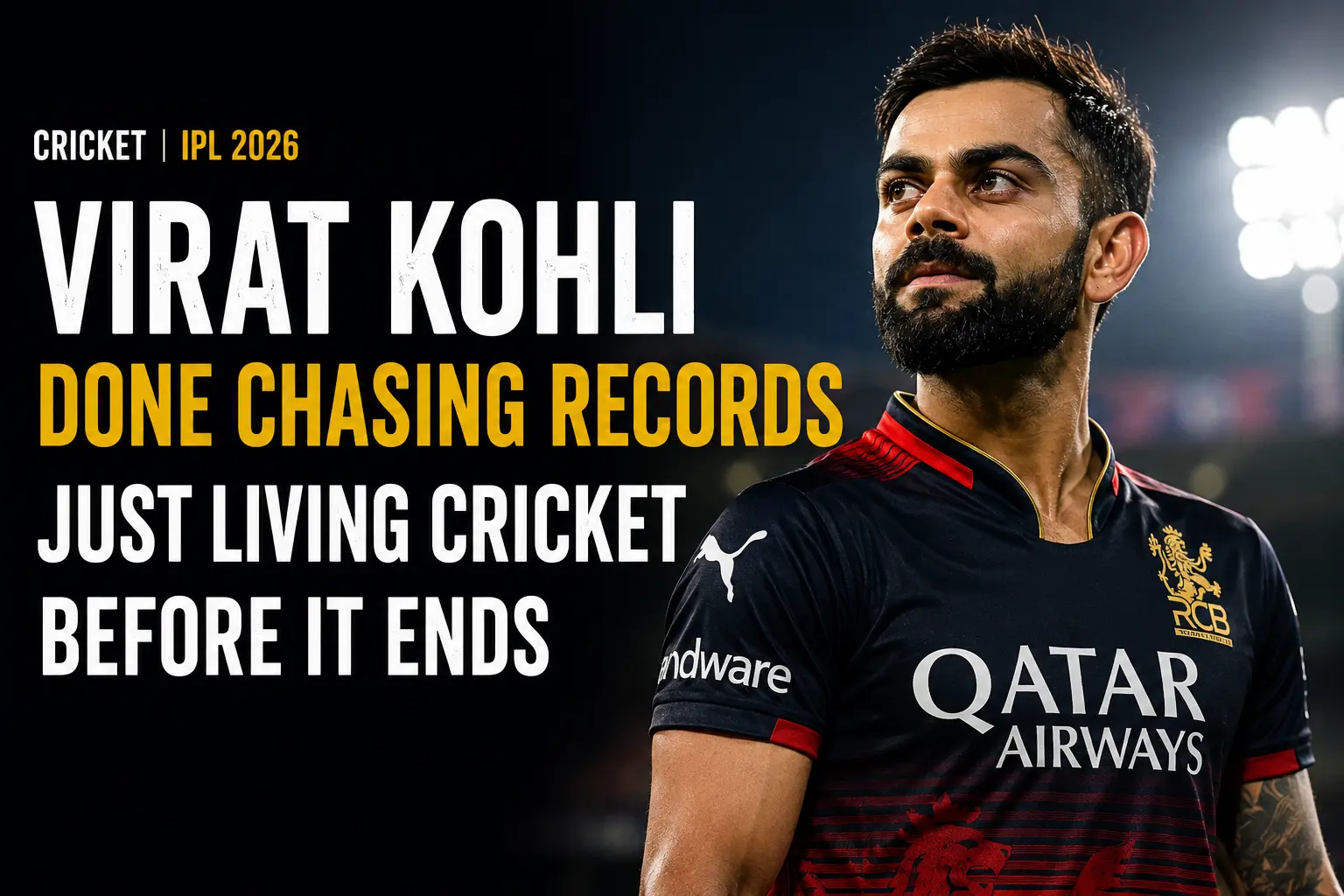
Virat Kohli isn't running after centuries and milestones anymore. After two decades of chasing every record in sight, something shifted. The man who made batting into an obsession now sounds like he just wants to play cricket and soak in every moment before the curtain falls. This isn't the aggressive Kohli we knew. This is a player at peace with letting go.
Listen to what he's saying in interviews lately — and you'll hear a man who's stopped keeping score of his own story. For someone who turned centuries into a lifestyle and records into fuel, this is actually shocking. But here's why it matters to you: it shows what happens when ambition finally meets acceptance. When hunger becomes gratitude.
- Kohli's mindset shift is real — he no longer chases individual records, focusing instead on enjoying the game itself
- IPL 2026 shows mixed form — golden duck against Mumbai Indians, but 105 not out against Kolkata Knight Riders in same season
- Third in Orange Cap race — 484 runs in 12 matches, still performing at elite level despite personal struggles
- Chase master streak ended — first golden duck while chasing in 9 years, breaking a historic pattern
- India's World Cup chases depend on him — India has never chased 160+ in World Cup without Kohli making runs
- The real story isn't the stats — it's that Kohli now plays for the love of the game, not for the next record
How a Record-Breaking Machine Learned to Let Go
For 17 years, Virat Kohli was India's obsession because he was obsessed. Every run. Every milestone. Every ranking. He turned the batting order into a personal kingdom and made records look easy. International cricket had never seen hunger like this — a player who treated each match like his last.
Then something happened. Maybe it was age. Maybe it was having everything already. Maybe it was simply understanding that one day, this would end anyway.
The numbers used to be his proof. Look at him now — they're just numbers. He still wants to win. He still plays hard. But the desperation? That's gone. And for a player who built his entire identity on chasing the next milestone, that's actually the biggest transformation cricket has seen from him.
The IPL 2026 Reality Check
So what does this look like in real cricket? Messy. Beautiful. Human.
- Golden duck against Mumbai Indians — It happened. After nine straight years of never getting out for a duck while chasing, Kohli failed in a moment that would have crushed the old version of him. The 2024 Kohli would have spiraled. The 2026 Kohli? He moved on.
- 105 not out vs Kolkata Knight Riders — Three matches later, he walked in and played exactly the kind of cricket that used to come naturally. Not trying too hard. Just playing cricket. Getting the runs because he knew how.
- 484 runs in 12 matches — Third in the Orange Cap race. Not first. Not fighting desperately for the top spot. Just there. Playing his game. That's the shift.
- The pressure lifted — When you stop chasing something, it stops chasing you back. For the first time in his career, Kohli looks free.
- Two sides of the same coin — Ducks and centuries in the same season. The old Kohli would use the duck as fuel for 10 matches of anger. This one used it as a reminder that cricket is a game, not a test of his worth.
- A player discovering maturity late — Most athletes learn this at 35. Kohli's learning it now, and it's rewriting how we think about ambition.
Here's the thing: this isn't decline. This is graduation.
Why This Matters More Than You Think
You might think this is just one player's personal journey. You'd be wrong.
What Kohli is doing right now — this shift from chasing to enjoying — it's happening at exactly the moment when Indian cricket needs to see it most. Young players watch him. They model themselves on his hunger. And for years, the message was clear: winning isn't enough. Records are the real game. Achievement is the only language that matters.
Now he's sending a different message. One that young cricketers desperately need to hear.
Compare this to what we saw just last season: a player still fighting for position, still measuring himself against his own ghost. Compare that Kohli to this one, and you see someone who finally understands something fundamental. Records are temporary. Memories last. And the only thing worth chasing in the end is the love of the game itself.
For India, there's another angle here. Kohli's never chased a target of 160+ in World Cup cricket without scoring big runs. India has never won that chase without him. That fact used to keep him awake. Now? He knows that pressure was self-imposed. He can still deliver when it matters. But he won't destroy himself to do it.
What This Means for You as a Fan
If you've been watching Kohli since 2008, this is bittersweet. You're watching a genius player transition from being driven by hunger to being driven by joy. That sounds poetic. But in practical terms, here's what it means:
First — he'll probably still score runs. Maybe not 70+ international centuries. Maybe not 50+ in every format like he used to. But solid performances? Those will keep coming because he still knows how to bat better than almost everyone alive.
Second — you'll see him enjoy cricket again. Watch his celebrations. Listen to his interviews. The exhaustion that came from chasing everything? It's lifting. And honestly, for a viewer, that makes cricket more fun to watch. A player who's playing for love looks different than a player playing for a legacy.
Third — and this is the one that hits hard — his time is shorter now. He knows it. We know it. When a 35-year-old player stops fighting and starts enjoying, you're watching the final chapters being written. Soak in them. Because once Kohli walks away from international cricket, Indian batting will be fundamentally different. There won't be another Kohli. Not in our lifetime.
The Chase Master Gets Chased Down by Time
Nine years. That's how long Kohli went without getting out for a golden duck while chasing. Nine years. Think about how many matches that is. How many pressure moments. How many times he had to deliver.
Then he got out. Deepak Chahar got him early. No heroic fourth-innings chase. No last-ball boundary. Just out. And instead of seeing rage or desperation, cricket fans saw something stranger: acceptance.
That's the story. Not the duck itself. The fact that it didn't break him.
For most of his career, Kohli's superpower wasn't just batting. It was using failure as fuel. Every bad performance was a personal insult he had to avenge. Every dropped catch became a mission. He turned anger into runs in a way nobody else could.
But anger has an expiration date. It burns too hot. You can't sustain it for 17 years. Eventually, you either burn out completely or you learn to transform it into something quieter. Kohli chose the second path.
What Experts Are Actually Saying
Cricket analysts are split on this. Some see it as the natural arc of every great player — peak, plateau, decline. Kohli's in the decline phase. The numbers support this view. His average across formats has dipped. His consistency, once sacred, now has gaps.
But others see something different. They look at his choice of shots. His field placement awareness. His ability to read bowling. The technical skills haven't vanished. Only the desperation has. And desperation was actually holding him back.
Here's what's interesting: when Kohli plays without pressure, he plays better cricket. More elegant. More correct. The 105 he just scored looked different than centuries he made five years ago. Less angry. More complete.
The real question cricket's asking now: will the absence of pressure cost him runs, or gain them?
The World Cup Equation Nobody's Talking About
Here's a stat that should terrify opposition teams: India has never chased 160 or more in a World Cup without Virat Kohli making significant runs.
Never.
That's not just a player statistic. That's a player being the difference between winning and losing at the biggest stage. And with a World Cup coming, this shift in Kohli's mindset is crucial.
Does a relaxed Kohli perform better under World Cup pressure? Or does he need that hunger to deliver when everything's on the line? This is what cricket will find out in the next 18 months.
Most experts think he'll be fine. The skills don't disappear just because the hunger does. But there's a small voice in cricket that wonders: what if Kohli's edge was actually that obsession? What if removing it costs him exactly when India needs him most?
We'll find out soon enough.
Frequently Asked Questions About Virat Kohli's Changing Approach
What exactly has changed in Virat Kohli's approach to cricket?
Simply put, Kohli has stopped treating every run as a personal record to chase and started treating cricket as a game to enjoy. In IPL 2026, he's had both golden ducks and centuries without spiraling into obsessive recovery mode like he used to. The technical skill remains elite, but the emotional desperation that fueled him for 17 years has transformed into something quieter — professional excellence mixed with genuine enjoyment of playing.
How is Kohli's IPL 2026 form actually looking?
Here's the thing: it's mixed but solid. He's sitting third in the Orange Cap race with 484 runs in 12 matches. He got out for a golden duck against Mumbai Indians, which broke his nine-year streak of never getting out for a duck while chasing. But then he scored 105 not out against Kolkata Knight Riders. The difference? He's not letting one bad performance dictate 10 matches of recovery mode anymore.
Does Kohli still care about winning and performing well?
Absolutely. Caring and obsessing are different things. Kohli still wants to win. He still plays every match seriously. But he's separated winning from his sense of self-worth. The pressure that used to fuel him was actually burning him out. Now he performs because he wants to perform, not because he's running from the ghost of his previous performance.
Why does Kohli's mindset matter for India's World Cup chances?
Because India has never chased 160+ in a World Cup without Kohli scoring big runs. That's not coincidence — that's dependency. World Cup pressure used to activate Kohli's hunger. The question now is whether this new, relaxed version of him performs equally well when everything's on the line. We won't know until the tournament happens.
Will this change in mindset make Kohli play better or worse cricket?
Experts lean toward better. When Kohli plays without the weight of proving something, his batting looks more elegant and technically complete. His recent 105 not out had a quality different from desperate centuries made five years ago — more flowing, more confident in the shot selection. The real test comes when pressure is maximum, which is the World Cup itself.
What to Watch For Next
Three things matter in the coming months.
First — the World Cup is the real test. IPL form is great for confidence, but World Cup pressure is different. If Kohli maintains this relaxed approach while still delivering when India needs him most, then this shift is actually genius. If the absence of hunger costs him at the biggest stage, well — that changes everything we think about what drives elite athletes.
Second — watch how young Indian batters respond. They've spent years modeling themselves on Kohli's obsession. Now they're seeing a different message. Some will understand it as wisdom. Others will see it as a decline and double down on hunger instead. That split will shape Indian cricket for the next decade.
Third — keep an eye on his next golden duck, if one comes. It's coming eventually — nobody averages forever. When it happens, watch how he responds. Does he use it as motivation to fix something? Or does he genuinely just move on to the next match? That single moment will tell you whether this transformation is real or just a performance we're watching.
For now, just enjoy it. You're watching Virat Kohli discover something most athletes never do — how to separate excellence from desperation. How to still win without needing to destroy yourself in the process. That's a rarer gift than any record.