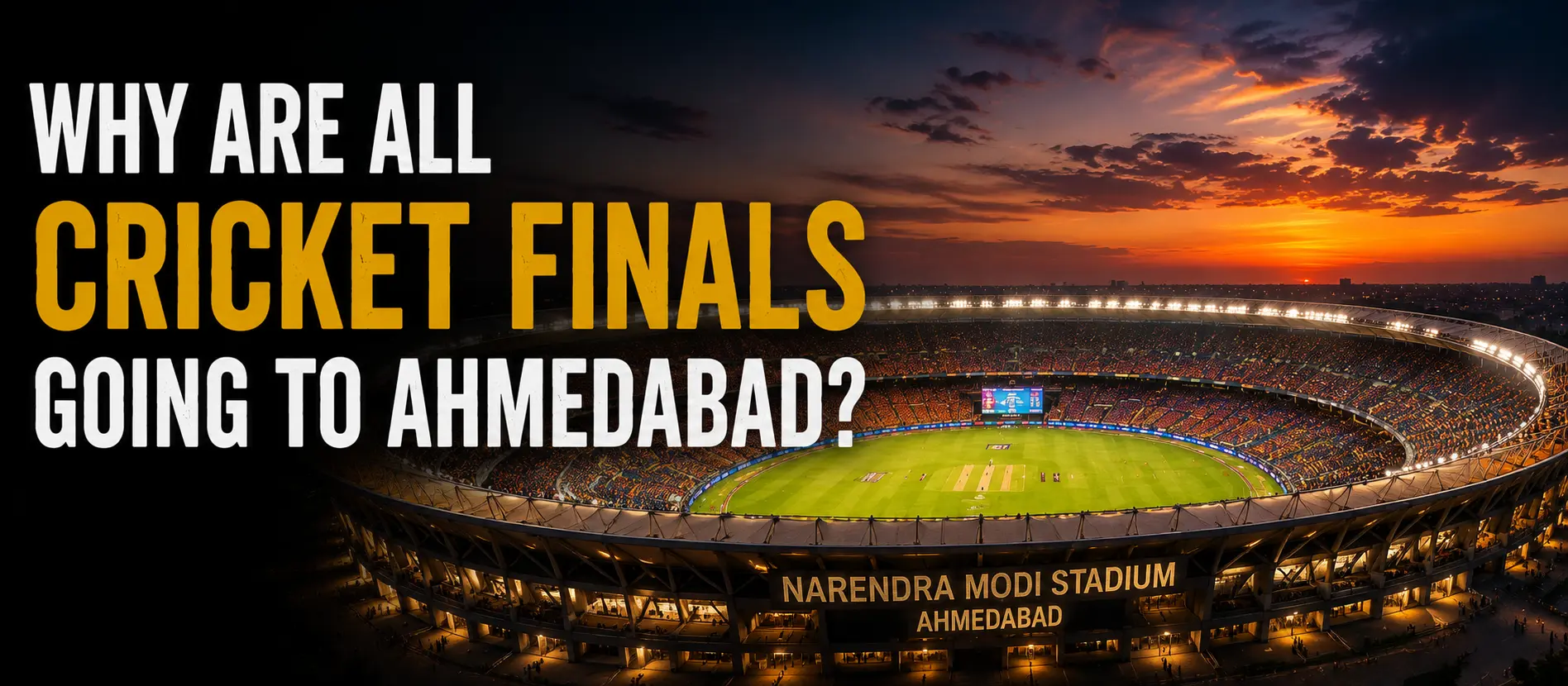
If you have been watching Indian cricket lately, you might have noticed something strange. Every big final — IPL, World Cup, ODI World Cup — seems to end up in one city. Ahmedabad. The Narendra Modi Stadium there has become the permanent home of Indian cricket's biggest moments. But why? What makes this one city so special that tournament organizers keep picking it over every other stadium in India?
The answer is not just about a fancy new stadium. It is about power, money, and a very deliberate plan to make Ahmedabad the cricket capital of India. And if you are a cricket fan, a student curious about how India works, or just someone who wonders why decisions get made the way they do — this story matters to you.
- Narendra Modi Stadium in Ahmedabad hosted the 2023 IPL final, 2023 ODI World Cup final, and will host the 2026 T20 World Cup final — three of India's biggest cricket events in three years
- The stadium is brand new, massive, and state-of-the-art — it can hold over 130,000 people and cost thousands of crores to build
- Ahmedabad also got a disproportionately high number of group stage matches in both the 2023 and 2026 World Cups — way more games than other cities with older, established stadiums
- This decision has angered other cricket cities like Bengaluru, Mumbai, and Kolkata — which have hosted finals and top matches for decades but are being sidelined
- The decision appears to be political, not purely cricket-based — Ahmedabad is the home state of India's current Prime Minister Narendra Modi, for whom the stadium is named
- Fans and experts are asking whether cricket decisions should be based on politics or pure sporting merit — and whether this helps or hurts Indian cricket in the long run
How Did Ahmedabad Suddenly Become Cricket’s Favorite City?
Until 2022, Ahmedabad had no major international cricket stadium. Zero. The city had never hosted a World Cup match, never hosted an IPL final, never hosted anything that made cricket fans sit up and pay attention. Then, almost overnight, everything changed.
The Narendra Modi Stadium was built in a rush. The government spent enormous amounts of money — we are talking thousands of crores — to construct this massive venue in Gujarat. And the moment it opened, the big tournaments started arriving. First the IPL final in 2023. Then the ODI World Cup final that same year. Then the announcement came that the 2026 T20 World Cup final would also be held there.
Think about that for a second. One stadium. Three of India’s biggest cricket tournaments. In just three years. That is not normal. That is not how these things usually work.
Why Other Cities Are Angry (And Why They Have Every Right to Be)
If you lived in Bengaluru, you would be furious right now. The city has the M. Chinnaswamy Stadium — one of India’s most famous cricket venues. Players love playing there. Fans love watching there. It has hosted hundreds of international matches. But when the IPL final was moved from Bengaluru to Ahmedabad in 2023, the city lost its chance to host cricket’s biggest night.
The same story happened in Mumbai. The Wankhede Stadium there is legendary. Every cricket fan in India knows that name. Mumbai has been the heart of Indian cricket forever. But even Mumbai did not get the World Cup final.
Kolkata, Delhi, Pune — all these cities have world-class stadiums with long histories of hosting international cricket. Yet Ahmedabad, a city with zero cricket history until two years ago, suddenly got the choicest tournaments. How? Why?
The Real Reason: One Name, One City, One Stadium
Here is what nobody says out loud, but everybody is thinking. The stadium is named after Narendra Modi, India’s Prime Minister. Modi is from Gujarat. Ahmedabad is Gujarat’s biggest city. And Gujarat’s Chief Minister answers to Modi.
This is not a wild conspiracy theory. This is just how Indian politics and sports administration work. When the top leader of a country wants something, the sports bodies find ways to make it happen. The BCCI (Board of Control for Cricket in India) — which makes all cricket decisions in India — suddenly decided that Ahmedabad was the perfect place for finals.
Was it the best decision for Indian cricket? That is a different question. But it was the decision that got made.
Here is what makes this even more interesting. Ahmedabad got not just the finals. The city also got a crazy number of group-stage matches in both the 2023 and 2026 World Cups. Other cities got maybe 2 or 3 group games. Ahmedabad got far more. Why give one city so many matches? Because the stadium is new? Because fans there love cricket? Or because the person who makes the final decisions happens to be from that city?
What This Means for You (Even If You Don’t Follow Cricket)
If you are a cricket fan in Bengaluru or Mumbai or Kolkata, this means your city — a city that has given India some of its greatest cricketers and most passionate fans — is being treated like it does not matter anymore. Your stadium might be older, but it is still great. Your fans might be just as passionate, but suddenly they don’t count. That hurts.
But here is the bigger picture. This story teaches you something important about how power works in India. When big decisions get made — about stadiums, about tournaments, about where money goes — they are not always made based on merit or fairness. Sometimes they are made based on who has power and where that person is from.
This matters because it shows you that even in sports — something that should be about pure competition and fairness — politics creeps in. And when politics creeps in, not everyone gets treated equally.
For students studying government or civics, this is a real-world example of how power works. For fans, it is a reminder that cricket decisions are sometimes made in boardrooms by politicians, not by people thinking purely about what is best for the game.
Is This Good or Bad for Indian Cricket?
Here is where experts actually disagree. Some say: “Look, Ahmedabad has a brand new stadium with world-class facilities. Let it host finals. The infrastructure is amazing.” That is fair.
But others say: “Cricket decisions should not be based on politics. They should be based on which city has the best stadium, the best fans, and the best cricket culture.” And by that measure, Mumbai, Bengaluru, and Kolkata still win hands down.
The truth is probably this: Ahmedabad will get the finals whether it is the best choice or not. That decision has already been made at the highest levels. What matters now is whether Indian cricket still stays strong, whether fans still love the game, and whether other cities feel so ignored that they stop caring about cricket altogether.
What to Watch For Next
The 2026 T20 World Cup final in Ahmedabad is already set in stone. Nothing will change that now. But here is what you should watch for:
First, will the BCCI give other cities important tournaments in the future? Will Bengaluru, Mumbai, or Kolkata get their turn to host something big again? Or is Ahmedabad permanently the favorite now?
Second, how will fans react? If other cities feel completely sidelined, will that hurt the passion for cricket in those places? Will young players from Bengaluru or Mumbai feel less motivated to work hard for cricket?
Third, will this become a pattern? If Ahmedabad gets finals because of politics, what about other sports? Will other cities start demanding their share of tournaments too?
The bigger question nobody is asking: Is this what Indian sports administration should look like? Based on merit and fairness? Or based on where power happens to live?
Frequently Asked Questions About Cricket Finals and Ahmedabad
Why was the Narendra Modi Stadium built so quickly?
The stadium was built with government funding and became a priority project because of its importance to state leadership. Construction accelerated specifically to prepare it for hosting major tournaments. The investment was enormous — worth thousands of crores — but the government decided it was worth spending that much money to create a world-class venue in Ahmedabad.
Did Bengaluru lose the IPL final unfairly?
The M. Chinnaswamy Stadium in Bengaluru had hosted the IPL final before, but in 2023, the BCCI moved the final to Ahmedabad’s new stadium instead. Bengaluru fans felt hurt by this decision since their stadium is modern and their city has a huge cricket following. Whether it was unfair is still debated among cricket experts and fans.
Will other cities get big tournaments in the future?
That is unclear right now. The BCCI has not announced a long-term plan for distributing tournaments fairly among Indian cities. For now, Ahmedabad seems to have the biggest tournaments locked in for the next few years, leaving other cricket cities waiting to see if their turn will ever come again.
How much money did Ahmedabad spend on the new stadium?
The exact amount varies depending on who you ask, but the Narendra Modi Stadium cost thousands of crores of rupees to build. To put that in perspective, that money could have built hundreds of schools or hospitals in poorer parts of India. It shows how much priority was given to building this one venue.
Is it wrong to give one city all the big cricket finals?
That depends on your perspective. If you believe tournaments should go to the city with the best stadium, most passionate fans, and strongest cricket culture, then concentrating everything in one new stadium seems wrong. But if you think new world-class infrastructure matters most, then Ahmedabad makes sense. Most cricket experts think spreading tournaments among multiple cities is healthier for Indian cricket overall.