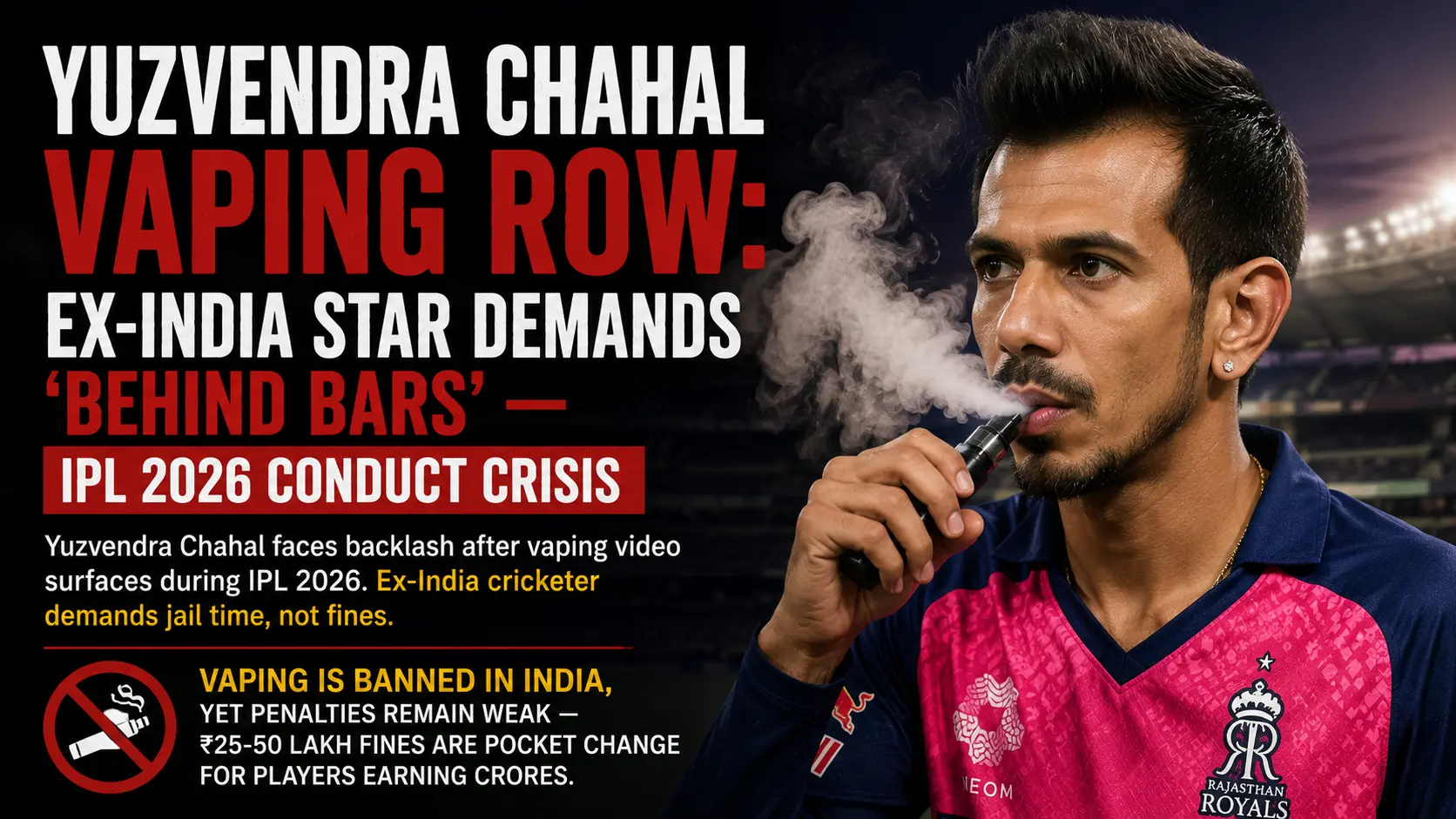
A viral video has landed Indian Premier League spinner Yuzvendra Chahal in serious trouble. The footage allegedly shows him vaping inside a flight with his Punjab Kings teammates. But here is what is making cricketers and experts genuinely furious — vaping products are completely banned in India, yet the penalties being handed out feel like pocket change.
Former India cricketer Sivaramakrishnan did not hold back. He erupted on social media, saying players caught breaking the law should face jail time, not just a small fine. This comes just weeks after Rajasthan Royals captain Riyan Parag was caught vaping in the team dressing room during a match and got away with losing just 25% of his match fees. A few thousand rupees. That is it.
For anyone following IPL 2026, this is becoming a real problem. The league promised to clean things up. The BCCI sent out strict directives to all franchises. Yet here we are, watching another player break Indian law while cameras roll.
- Viral video shows Punjab Kings spinner Yuzvendra Chahal allegedly vaping on a team flight — the second major vaping incident in IPL 2026 within weeks
- Vaping products are completely banned in India — yet IPL penalties are only 25% of match fees, which experts say is too weak
- Ex-India cricketer Sivaramakrishnan demanded jail time for players breaking Indian law, calling out the soft punishment system
- Rajasthan Royals captain Riyan Parag faced the same penalty earlier after being caught vaping in the dressing room during Match 40
- BCCI recently issued detailed conduct directives to all IPL franchises but enforcement appears weak and inconsistent
- Penalty amounts are a fraction of player earnings — meaning wealthy cricketers can afford to break the law repeatedly
How Did We Get Here? The IPL's Growing Discipline Problem
The Indian Premier League is meant to be the gold standard of professional cricket. World-class players, high stakes, global audience. But in 2026, it is also becoming a place where law-breaking seems to have small consequences.
The vaping issue did not start with Yuzvendra Chahal. Back in Match 40, during an IPL 2026 clash at Jaipur, Riyan Parag was caught vaping red-handed inside the Rajasthan Royals dressing room. Not on a flight. Not away from cameras. In the team room during an active match. The BCCI response was quick but gentle — 25% of his match fees plus one Demerit Point under the Code of Conduct for Players.
Think about that number for a moment. A professional cricketer in the IPL typically earns between ₹1 crore to ₹15 crore per season, depending on their auction price. Losing 25% of match fees means losing maybe ₹25 to ₹50 lakh per incident. For a player earning crores, that is like a salaried employee in Delhi getting a ₹5,000 fine for speeding.
Now Chahal is in the exact same spot. And nobody knows what the actual punishment will be yet.
The Video That Broke the Internet — And Why Everyone Is Angry
The video circulating on Instagram and Twitter shows what appears to be Yuzvendra Chahal on a Punjab Kings team flight, vaping. Nobody disputes what the footage shows. The conversation is about what it means that a professional cricketer representing India is openly breaking Indian law.
- Vaping is legally banned in India since 2019 — the government classified it as an illegal substance under the Cigarettes and Other Tobacco Products Act (COTPA). Penalties for possession or use can include jail time and fines up to ₹1 lakh.
- Sivaramakrishnan's response was blunt — he said players breaking Indian law “should be behind bars,” not just fined. He publicly questioned whether the BCCI was actually serious about enforcement.
- This is not a private mistake that leaked — this happened on a team flight with multiple witnesses. Other players could see it. Staff could see it. And it was recorded and posted to millions of people.
- The timing is terrible for the IPL's image — the BCCI just sent out tough-sounding directives about tournament conduct to all franchises, promising stricter rules and more accountability.
- Player culture matters here — when star players like Chahal and Parag face minimal consequences, it sends a message to younger cricketers that rules are not serious.
- Public trust is eroding — fans and experts are now questioning whether the IPL is genuinely interested in discipline or just managing PR when videos go viral.
What makes this particularly frustrating is that Yuzvendra Chahal is not some fringe player. He is a top-tier spinner for India, a consistent performer in international cricket. Fans expect better.
What the Experts Are Actually Saying — And Why They Sound Angry
Sivaramakrishnan is not alone in his criticism. Across cricket circles, the response has been sharp.
His core argument is simple: Indian law treats vaping as illegal. The BCCI penalty system treats it as a minor breach. That disconnect is the real problem. When a player breaks Indian law and faces a financial penalty that barely dents his income, what message does that send? That you can break the law if you are famous enough and rich enough?
The ex-India cricketer also pointed out that the BCCI keeps issuing conduct directives and talking about stricter enforcement, but the actual penalties suggest otherwise. A 25% fine for vaping, a Demerit Point that has no teeth, and no criminal referral? Compare that to what would happen if you or I were caught vaping — police action, legal consequences, actual punishment.
Some cricket analysts have gone further, saying the problem is structural. IPL franchises make massive money. Individual players earn crores. A fine of ₹25-50 lakh is an inconvenience, not a deterrent. Until penalties actually hurt, or until players face real legal action, nothing will change.
What makes this different from past controversies is the speed and scale of the video's spread. This is not a rumor or a claim — millions of people watched the footage within hours. The BCCI cannot claim they did not know or that they need more information.
What This Actually Means for You — And Why It Matters
Here is where this story gets real. You might be thinking: “Why should I care about what a cricketer does on a flight?”
Fair question. Here are three reasons it actually matters.
First, it is about rule of law in India. Vaping is banned. Not just by the BCCI — by India's government. When famous people break the law and get tiny fines while ordinary Indians would face actual legal action, it erodes trust in the system. It says the law applies differently depending on who you are. If you are a student or a young professional caught vaping, you could face real consequences. Chahal and Parag face what — a fraction of their monthly income?
Second, it sets an example for younger cricketers and athletes. Kids in cricket academies across India look up to IPL players. They see Riyan Parag vape, get caught, lose a small amount of money, and play the next match. They see Yuzvendra Chahal do the same. The message is clear: if you are talented enough and famous enough, consequences do not really apply. That is a dangerous lesson.
Third, it undermines the BCCI's credibility. Every time the board issues a conduct directive and then fails to enforce it meaningfully, fewer people take those directives seriously. That weakens the entire system of accountability across Indian cricket, from domestic leagues to the national team.
So what should the actual response be? Sivaramakrishnan's answer is that criminal law should apply equally. If vaping is banned in India, then Indian law should handle it, not just the BCCI. That would mean police involvement, potential jail time, and actual consequences — not just financial penalties.
That is a bigger step than most are calling for. But it highlights how weak the current system feels to people watching.
What Happens Next — The Dates and Decisions to Watch
Right now, the BCCI is under pressure to respond to the Chahal video. They have not released an official statement as of our reporting. That response will tell us everything about whether things are actually changing in IPL 2026 or whether the pattern continues.
There are three possible scenarios:
Scenario 1 — Repeat of Parag's punishment: Chahal gets fined 25% of match fees, gets a Demerit Point, and plays the next match. This would confirm that the board is not serious, and the outrage would likely grow. Media pressure would intensify, and questions about BCCI's leadership would follow.
Scenario 2 — A slightly tougher penalty: Maybe a 50% fine, or a match suspension. This would look like the board listened to the backlash. But it would still fall short of what Sivaramakrishnan and others are demanding — actual legal action or a serious deterrent.
Scenario 3 — Referral to law enforcement: The BCCI could actually hand the matter over to police or authorities, letting Indian law take its course. This is unlikely because it would set a precedent. But if they did, it would signal a real change in how the board handles law-breaking.
Watch for two things: What the BCCI says in their official statement (if they release one), and whether any other incidents emerge during the rest of IPL 2026. If more vaping videos surface, it means the first incident did not deter anyone. That would be the clearest proof that the current system is broken.
Frequently Asked Questions About IPL 2026 Vaping Row
Is vaping actually illegal in India?
Yes — India banned vaping and e-cigarettes in 2019 under the Cigarettes and Other Tobacco Products Act. Possession, sale, and use can mean jail time up to six months and fines up to ₹1 lakh. So yes, what Chahal allegedly did was breaking Indian law, not just IPL rules. That is why experts are frustrated.
What exactly is the BCCI penalty for vaping?
According to the Code of Conduct for IPL players, vaping breaches Level 1 conduct rules. The penalty is 25% match fee fine plus one Demerit Point. Riyan Parag faced exactly this after being caught in Match 40. A typical IPL match fee ranges from ₹5-20 lakh depending on the player, so 25% means losing ₹1.25 to ₹5 lakh per incident — a fraction of what these players earn.
Has Yuzvendra Chahal been officially punished yet?
No official BCCI statement has been released yet confirming what Chahal's punishment will be. The video went viral, Sivaramakrishnan criticized the situation publicly, and now the board is under pressure to respond. We should expect an official ruling within days, but nothing has been announced as of now.
Why is Sivaramakrishnan calling for jail time?
Because vaping is illegal in India, not just against IPL rules. His argument is straightforward — if you break Indian law, you should face Indian law's consequences, not a small fine. Allowing famous athletes to break laws with minimal punishment creates two systems of justice: one for ordinary people, one for celebrities. He is saying that is wrong.
Could this affect Chahal's career — like his selection for India matches?
That is the real question nobody has asked yet. The BCCI governs both the IPL and India's national teams. If they want to send a serious message, they could suspend him from international selection. But so far, they have shown they prefer keeping controversy away from the national team. Expect the IPL to handle it quietly unless public pressure forces a bigger response.