Title: Indians Fleeing US Tech Jobs Face Brutal Reality Back Home: Survey Reveals Competitive Nightmare
They came back expecting relief. They are finding the opposite instead. Wow. A survey of 1,276 Indian tech professionals reveals a troubling paradox — more Indians are returning from the United States, but the job market they are coming home to has turned ruthlessly competitive. Big shift. The dream of returning to India's booming tech sector is running headlong into a hiring landscape so crowded that coming back no longer feels like coming home.
And this matters because it upends the narrative that dominated headlines for years: that India's growing Global Capability Centers (GCCs) and tech job growth would automatically welcome returning talent with open arms. Unreal. Instead, what's emerging is a market where supply has exploded, demand has stalled, and even experienced professionals are struggling. That stings.
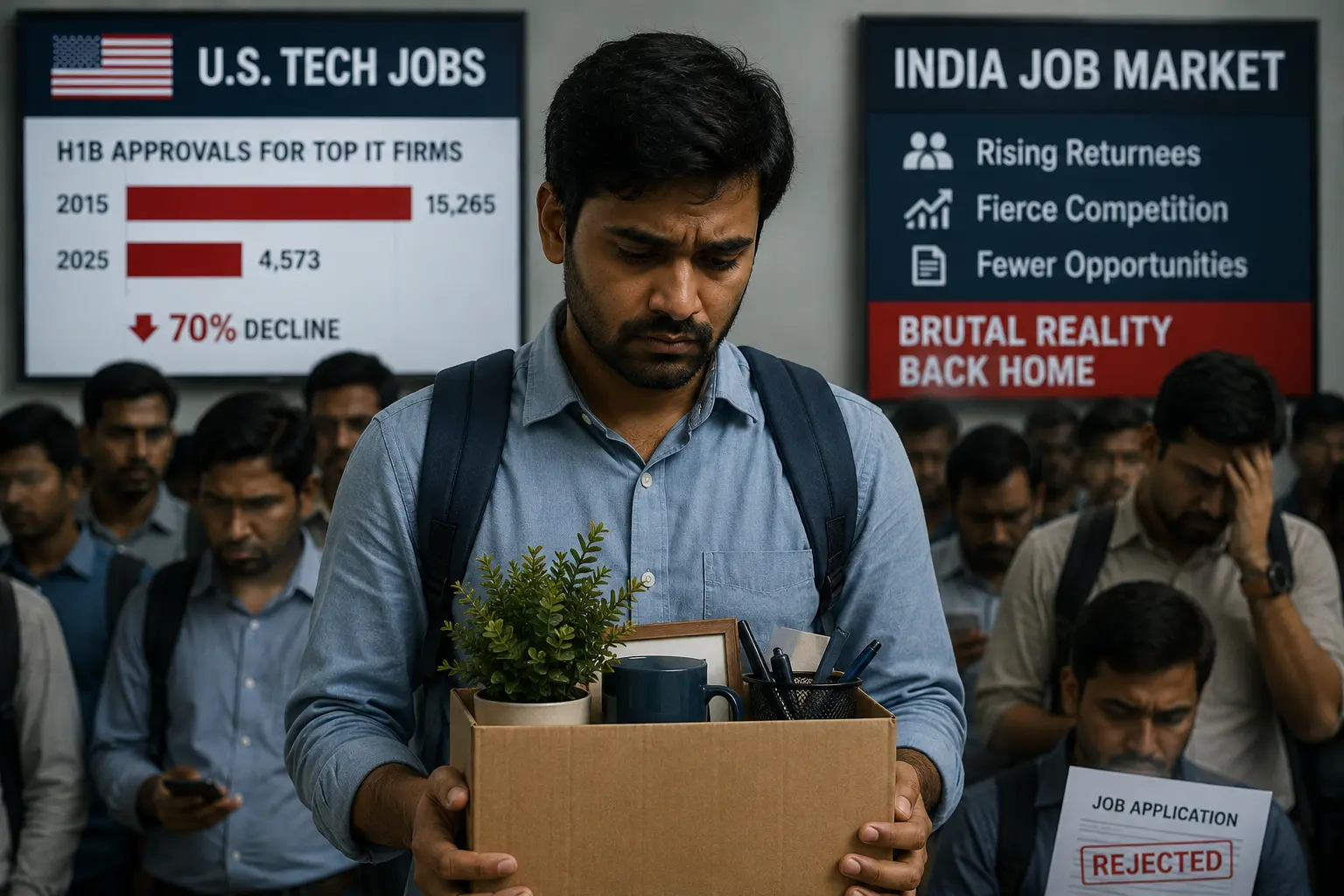
- India's top IT firms secured just 4,573 H1B approvals in FY 2025 — a 70% collapse from 2015 and down 37% from last year, signaling a shrinking pipeline of US opportunities
- More Indians are choosing to return home — but the domestic tech job market is now more crowded than it has been in years, making competition fierce even for experienced workers
- GCC ecosystem expansion is a double-edged sword — while it's created jobs, it's also flooded the market with talent, making hiring more selective and demanding
- Returning professionals face salary expectations mismatch — many expect US-level compensation but Indian employers are offering rates 40-60% lower, creating friction in negotiations
- Job openings are becoming more specialized — employers increasingly want niche skills (AI/ML, cloud, cybersecurity) rather than general tech skills, leaving mid-career generalists vulnerable
- Timeline uncertainty persists — H1B visa lottery outcomes remain unpredictable, forcing Indians into return decisions without clear long-term clarity on US options
And here's why that matters.
Why Indians Started Coming Back in the First Place
For years, the story was simple. Indian tech workers went to America, got paid in dollars, built careers, and rarely looked back. Right? The H1B visa lottery became India's version of a lottery ticket — get picked, move to San Francisco or Seattle, retire rich. Not anymore.
But that story started cracking around 2020. US immigration tightened. Tech layoffs hit hard in 2023-24. And simultaneously, something unexpected happened at home — India's tech sector exploded. Not just Infosys and TCS anymore. Hundreds of multinationals opened GCCs in Bangalore, Hyderabad, Pune. Startups raised billions. Cloud computing jobs materialized. The AI boom created new roles that didn't exist five years earlier.
For the first time, returning to India didn't feel like defeat. It felt like opportunity. Wild.
But here is what the survey reveals: that optimism was premature. Period.
The kind of thing most people miss.
The H1B Collapse and What It Forced
Let's look at the numbers directly. In FY 2015, India's biggest IT firms secured approximately 72,000 H1B approvals. By FY 2025, that number had crashed to just 4,573. That's not a decline. That is a collapse. Huge.
- 70% drop over a decade — from roughly 72,000 (2015) to 4,573 (FY 2025)
- 37% drop year-on-year — from the previous year's figure to FY 2025
- Immigration policy tightened — both under Trump-era restrictions and continued under Biden administration skepticism of H1B dependence by Indian firms
- US companies shifted hiring strategy — instead of sponsoring Indians for H1B visas, they opened GCCs in India to hire local talent directly
- Return migration accelerated — with fewer H1B spots available and fewer reasons to stay, Indians began actively planning returns
- Timing pressure increased — the uncertainty forced early return decisions rather than the old model of working 10+ years in the US and then coming back as a senior executive
The H1B collapse didn't kill opportunity in America. It killed the pathway that Indian professionals had relied on for three decades. And it created a forced return migration right when India's tech market was becoming more selective about who it hired. Let that sit.
Worth paying attention to.
What The Survey Actually Found
The Blind survey of 1,276 professionals (conducted among Indian tech workers with US experience) uncovered three distinct anxieties. And more.
First, the competition. Respondents reported that while more of their peers were returning home, job openings hadn't kept pace. Nobody talks about this. One professional put it plainly in the survey: “You're competing against people who stayed, people who are coming back, and fresh graduates — all for the same role.” That creates a three-way competition that doesn't exist in the US tech market, where worker shortage is still the dominant complaint. Think about it.
Second, the specialization trap. Indian employers, especially in GCCs, want very specific skills now. They aren't hiring general software engineers. They're hiring Machine Learning engineers with production experience. Cloud architects with multi-cloud certifications. Cybersecurity experts with incident response background. Generalists — even experienced ones — are finding doors closed. Big deal.
Third, the compensation shock. Many returning professionals were earning $150,000-$200,000+ in the US. They expected to come back and earn ₹20-30 lakh annually (roughly $24,000-$36,000). The mental math doesn't work. A seasoned engineer might be offered ₹12-15 lakh instead. That is a 60% pay cut. The survey shows frustration on this point is sharp. And that's big.
The GCC Boom and Its Hidden Cost
Here is the paradox nobody talks about. India's GCC ecosystem is growing rapidly. Companies like Google, Meta, Microsoft, Amazon, Apple, and dozens more have massive Indian operations now. On paper, this is good — it's creating job opportunities. Not small.
But it is also creating a glut. These GCCs hire hundreds of people per quarter. They also retain very few. Attrition rates in GCCs average 18-22% annually. That means they're constantly hiring. From the supply side, this is saturating the market. From the employer side, this is creating a buyer's market where hiring managers can be extremely selective because replacements are always available. Facts.
Returning professionals are learning this the hard way. They expected to walk into a job market hungry for their experience. Instead, they're finding a market that says: “Nice resume. We have 200 other candidates. Why should we take you?” And now?
Nobody is talking about this enough.
How This Actually Affects You
If you're a software engineer in your mid-to-late 30s in the US right now, thinking about returning to India — this matters immediately. Your timeline just got shorter and your options narrower. Read that again.
Consider this scenario: You're a tech lead earning $180,000 in California. You've been thinking about moving back to Bangalore to be close to parents, buy property, and enjoy a lower cost of living. The survey suggests you should expect one of three outcomes. First, you get hired at your current level but for ₹18-22 lakh annually (about 50% of your US buying power even accounting for cost-of-living differences). Second, you take a step back — from a tech lead role to a senior engineer role — to get closer to what you were earning. Third, you don't find a suitable role for 3-6 months and eventually take something below your experience level. That's real.
For fresher graduates or junior engineers returning, the picture is different but equally challenging. They're competing against Indian tech graduates who stayed home. Those local candidates cost less, know the company culture already, and have proven they aren't flight risks. A returning junior engineer has none of those advantages. Key point.
The practical implication: If you're returning to India, you need specialized skills (AI/ML, cloud architecture, product management, cybersecurity), not general experience. And you need to be flexible on compensation expectations. True.
The Blind Survey's Biggest Reveal
The most interesting question in the survey asked: “Who do you think benefits most from India's GCC growth?” The result?
Most respondents didn't say returning professionals. They said employers and companies. One quote from the survey stands out: “The ecosystem grew, but the growth went to the companies, not the workers.” No joke.
This suggests a shift in power dynamics. For 20 years, Indian tech professionals — especially those with US experience — could negotiate aggressively. They had leverage. The labor shortage was real. The shortage is still there in the US. But in India, the calculation has changed. Now employers have leverage. They can afford to be selective. They can push back on salary expectations. They can wait for the right candidate rather than settling. Big.
The numbers don't lie.
What Happens Next and What to Watch
Here is what the next 12-18 months will show us. First, H1B visa outcomes for 2026 will come in April 2026. If approvals stay in the 4,000-5,000 range, more returns are inevitable. Second, major tech layoffs in the US (which have already happened at Meta, Google, Amazon, and others) may slow down. If hiring picks up, some professionals might decide to stay rather than return. Third, India's startup and GCC job market will likely become even more skills-specific — the generalist job is dying. Yep.
The key metric to watch: Indian tech worker salary inflation in specialized fields (AI/ML, cybersecurity, cloud) versus stagnation in general roles. If specialized skills command premium while general skills remain commoditized, we will know the market has officially bifurcated. And?
One more thing — company retention rates in GCCs matter enormously. If attrition stays at 20%+, hiring will remain frenetic but temporary. If companies figure out retention and stabilize hiring, the job market will tighten and actually become harder for newcomers. Worth it.
Think.
Frequently Asked Questions About Indian Tech Jobs and Return Migration
Are more Indians actually returning from the US right now?
Honestly — Yes, the trend is real. H1B visa approvals have crashed 70% in a decade, forcing many professionals to reconsider staying in the US. This combination has created a net return migration, though exact numbers aren't officially tracked. The Blind survey confirms this anecdotally.
What skills are most in demand for returning professionals in India?
Simply put, specialized skills dominate: Machine Learning engineers, Cloud architects, DevOps specialists, Cybersecurity experts, and Product Managers. General software engineers face tougher competition. Employers want production-level experience, not just certification. AI/ML skills command premiums of 20-30% above standard software engineer salaries currently in India. This is a critical point that many don't grasp when planning their return.
How much salary can a returning professional expect in India?
Here's the short version: A mid-level professional earning $150,000 in the US might expect ₹15-18 lakh in India (roughly $18,000-$21,600). This accounts for cost-of-living differences but still represents a significant pay cut in absolute terms. Senior roles (engineering managers, architects) command ₹25-35 lakh. Specialized roles (ML, security) can reach ₹30-40 lakh.
Is it still a good time to return to India for a tech career?
The thing is, it depends on your situation. If you have rare, specialized skills (AI/ML, cloud, cybersecurity) and are flexible on compensation, returning can work. But if you're a generalist expecting US-level pay, the timing is poor. The job market has shifted from “hire everyone who is available” to “hire only the specialists we desperately need.” You need to make sure you fall in the second category before returning, or you're likely to face disappointment.
When will the H1B visa situation change and become easier for Indian professionals again?
Good question. No clear timeline exists. H1B approvals depend on US immigration policy, which shifts with administrations. Current trend suggests approvals will stay low for 2-3 more years minimum. The 2026 H1B lottery results (announced April 2026) will give clearer signals. For now, assume the pathway back to the US is harder, not easier. Plan your return assuming the US option isn't available.