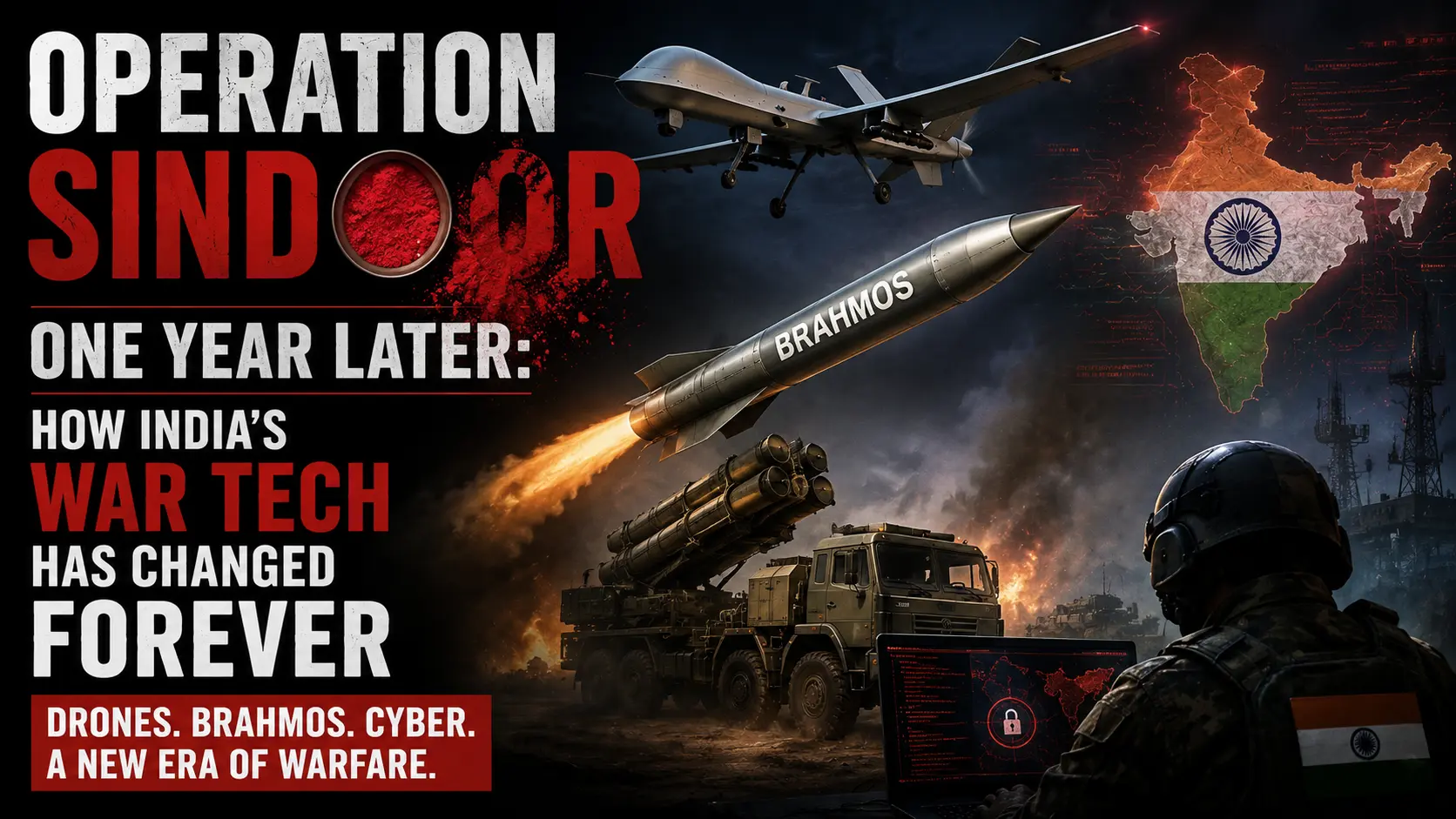
One year ago, India launched Operation Sindoor — and nothing about how this country thinks about war has been the same since. And this operation, carried out in May 2024, wasn't just a military strike. It was a loud message to the world: India now fights differently. Drones, smart missiles, layered air defence systems, and real-time cyber tools did the heavy lifting — not just soldiers on the ground. That is a big deal. A full year later, defence analysts, government insiders, and military planners are saying the same thing: Operation Sindoor rewrote India's war strategy from scratch. This article breaks down what actually changed, which technologies were used, and why every Indian should understand what happened that day and what comes next.
- Operation Sindoor was carried out in May 2024 as a precisely targeted military response, blending live firepower with sharp diplomatic signalling that left little room for misreading India's intent.
- India used drones, layered air defence systems, and cyber tools together for the first time in a coordinated live operation — a historic first by any measure.
- Defence experts say the operation revealed India's decisive shift away from traditional ground-heavy warfare and firmly toward technology-led precision strikes.
- The Ministry of Defence has since fast-tracked domestic drone production under the Make in India defence programme, pushing orders to Indian manufacturers almost overnight.
- India's military budget for technology upgrades crossed ₹1.72 lakh crore in the 2024-25 Union Budget — a record high that signals serious intent.
- Analysts say Operation Sindoor proved India can control escalation — hitting hard while choosing exactly how far to go, a capability most nations don't possess.
Why Operation Sindoor Matters: The Full Context Explained
Let's go back a bit. For decades, India's military strategy was built around large armies, heavy tanks, and long standoffs. The thinking was simple — more soldiers, more firepower, win the war. But modern conflicts don't work like that anymore. Think about that. Look at what happened in Ukraine, or even in smaller conflicts across the Middle East — wars today are won with speed, precision, and information, not just numbers, and the countries that haven't adapted are the ones paying the highest price. India watched all of this closely.
Then came the terror attack that triggered Operation Sindoor. Indian intelligence had tracked cross-border terror networks operating from Pakistani soil for years. When a deadly attack took place in early May 2024, the government decided enough was enough. And here's what made this moment different from past responses — India didn't just bomb and hope for the best. The Indian Armed Forces, working with the Research and Analysis Wing (RAW) and the Defence Research and Development Organisation (DRDO), put together a strike plan that was precise, controlled, and built around technology. So where does that leave everyone else watching from the outside? So the real question is: what exactly did that technology look like?
That is the part nobody is talking about.
What Happened During Operation Sindoor: A Complete Breakdown
On the night of 7 May 2024, India launched a series of coordinated strikes targeting terror infrastructure across the Line of Control. Look — the operation was described by the Ministry of Defence as "measured, non-escalatory, and proportionate." But under that careful language was something remarkable — a display of military technology that India hadn't ever used together in a live operation before. Yes, really.
- Loitering munitions (suicide drones): India used domestically developed and imported loitering drones that can circle a target area, identify the right moment, and then strike with pinpoint accuracy — all without risking a single pilot's life.
- BrahMos supersonic cruise missiles: Developed jointly by India and Russia, BrahMos missiles travel at nearly three times the speed of sound. They hit specific buildings without damaging surrounding areas. That level of precision was critical here.
- Layered air defence activation: India activated its S-400 Triumf air defence system (bought from Russia for about ₹35,000 crore) alongside homegrown Akash missile batteries to protect Indian airspace during the operation.
- Cyber operations running in the background: Here's what we know. According to multiple defence journalists covering the story, Indian cyber units disrupted enemy radar and communication networks before the physical strikes even began.
- Real-time satellite surveillance: ISRO (the Indian Space Research Organisation) and the Defence Space Agency provided live satellite feeds to commanders on the ground, allowing strike teams to adjust targeting in real time.
- Electronic warfare jamming: Specialised aircraft jammed enemy radar frequencies so that Pakistani air defence systems had a delayed and confused picture of what was happening.
The man overseeing the operation's execution was Chief of Defence Staff General Anil Chauhan, who later told reporters that the operation was designed to "stay below the nuclear threshold while still delivering a decisive message." That phrase — stay below the nuclear threshold — is really the key to understanding why this operation was so carefully built around technology rather than brute force. And what happens if nothing changes and future operations aren't built with the same discipline? That's a question worth sitting with.
What followed the strikes was equally calculated. India immediately briefed foreign governments including the United States, Russia, and the Gulf nations. And the Ministry of External Affairs made it clear that this wasn't a war declaration — it was a targeted counter-terror action. That diplomatic signalling, done in the hours right after the strikes, helped prevent the situation from spiralling — and that, say analysts, was part of the plan from day one, baked into every phase of the operation before a single drone left the ground.
This decision will be felt for years.
The Operation Sindoor Tech Analysis: What Experts and Data Reveal
So what does all of this tell us about India's military future? Quite a lot, actually. Brigadier (Retired) Rahul Bhonsle, founder of the Security Risks Asia think tank, told journalists that Operation Sindoor showed India has developed what he called a "new strategic DNA." Big shift. That's a way of saying India now has a clear, consistent playbook — hit precisely, control the story, and don't let a crisis get out of hand. Is this really a surprise, though, given how much investment has quietly gone in over the last decade?
From a technology angle, the operation exposed something interesting. And India's defence industry, which was once heavily dependent on foreign weapons, has been quietly building its own capabilities — a shift so gradual that most people outside the sector simply didn't notice it happening. DRDO's homegrown drones — including the Tapas UAV and the combat-capable Ghatak UCAV (Unmanned Combat Air Vehicle) — were reportedly involved in surveillance roles during the operation. Private Indian companies like Ideaforge Technology and Alpha Design Technologies have been supplying smaller drones to the armed forces. And the government's iDEX (Innovations for Defence Excellence) programme has funded over 300 defence startups since 2018 — and their products are now actually being used. Not a small number.
Compare this to where India stood in 2016, during the surgical strikes. Back then, India had almost no drone fleet, relied almost entirely on imported missiles, and had no active cyber warfare unit at the scale it has today. In less than eight years, that picture has completely flipped. Read that again. Global defence analysis firm Janes Defence ranked India as the fourth-largest military spender in Asia-Pacific in 2024 — up from seventh place in 2018 — a leap that reflects years of budget commitment and institutional will finally translating into real capability on the ground. That kind of jump doesn't happen by accident.
And this is not a small thing.
How Operation Sindoor Affects India's Defence Sector: Real-World Impact
Here's where it gets very real for regular Indians — not just for generals and ministers. So after the operation, the Ministry of Defence fast-tracked a ₹22,000 crore drone procurement plan that had been sitting in files for two years. Honestly, that is a lot. Domestic drone makers got new orders almost overnight, and the government also announced it would ban imports of over 100 defence components — forcing the armed forces to buy Indian-made parts instead, which means more factories, more jobs, and more investment flowing into Indian states like Uttar Pradesh, Tamil Nadu, and Karnataka, where most of the new defence manufacturing zones are being built. And that matters more than most people realise.
For India's cybersecurity world, the operation was a wake-up call too. Look — the National Cyber Security Coordinator's office has since expanded its budget and is working with private tech companies to build better threat detection tools. Think about it — how often does a military operation directly reshape the civilian digital security landscape in real time? Every time India improves its military cyber systems, those same skills and technologies eventually trickle down into protecting banks, hospitals, and government websites from hackers. Operation Sindoor proved that cyber warfare isn't a future problem. It's happening right now, and India is in it. Young engineers and coders working in cybersecurity firms in Bengaluru and Hyderabad are, in a very real way, part of this new defence ecosystem — even if they never wear a uniform.
That number tells the whole story.
What Happens Next: Operation Sindoor's Aftermath and Key Dates to Watch
The Indian government has been clear about its direction. By 2027, the Ministry of Defence wants at least 25% of all military equipment to be made in India — up from about 12% in 2020. And the Integrated Theatre Commands reform, which merges Army, Navy, and Air Force units under single regional commanders, is expected to be fully operational by late 2025 — a structural overhaul that has been debated for decades but is finally moving. General Chauhan has said this will allow faster, more coordinated responses — exactly the kind of speed that made Operation Sindoor work. And there is more.
There are three possible scenarios ahead. Best case: India's domestic defence industry takes off, the country becomes a net weapons exporter (it already sells BrahMos missiles to the Philippines and Vietnam), and the deterrence signal sent by Operation Sindoor holds for years. Likely case: India makes solid progress on tech upgrades but faces delays in the Theatre Commands reform due to inter-service disagreements — a problem that hasn't gone away in decades and won't vanish overnight. Risk case: a new terror incident pushes India into another response before it has fully absorbed the lessons of Operation Sindoor, potentially under more pressure and with less preparation than last time. Surprising? Yes. Most analysts currently think the "likely case" is the most probable path. But what comes next — that's what everyone wants to know. What you should watch for in the coming months: Parliament's defence budget session in February 2025, the rollout of the first Integrated Theatre Command, and DRDO's scheduled test of the Ghatak UCAV. These will tell you a lot about how seriously India is following through.
Frequently Asked Questions About Operation Sindoor
What was Operation Sindoor and why did India launch it?
Honestly, Operation Sindoor was a targeted military strike launched by India on 7 May 2024 against terror infrastructure across the Line of Control. India carried it out in response to a deadly cross-border terror attack. The operation combined drone strikes, cruise missiles, and cyber tools to hit specific targets without triggering a full-scale war — a precise, deliberate response that wasn't accidental.
How did India use drones in Operation Sindoor?
Simply put, India used loitering munitions — drones that circle a target and strike at the right moment — along with surveillance UAVs for real-time battlefield intelligence. Domestic drone makers like Ideaforge supplied smaller units to the operation. This wasn't a partial test — it was the first time India deployed drones at this scale in a live, coordinated cross-border military operation.
How does Operation Sindoor affect India's defence manufacturing sector?
Here's the short answer: after the operation, the Ministry of Defence fast-tracked a ₹22,000 crore drone procurement plan and expanded import bans on over 100 defence components. This pushed orders toward Indian manufacturers in states like Uttar Pradesh, Tamil Nadu, and Karnataka, creating thousands of jobs in the growing defence tech industry and reshaping domestic supply chains.
What should young Indians know about careers in defence technology?
The thing is, Operation Sindoor showed that modern warfare needs engineers, coders, data analysts, and cybersecurity experts — not just soldiers. India's iDEX programme has funded over 300 defence startups. Students with skills in artificial intelligence, cybersecurity, and drone engineering now have real, well-funded career paths directly inside India's rapidly expanding defence ecosystem — and demand isn't slowing.
What is India's defence technology plan for 2025 and beyond?
In plain words, India wants 25% of all military equipment made domestically by 2027. The Integrated Theatre Commands reform is expected to be fully operational by late 2025. DRDO's Ghatak UCAV combat drone is scheduled for key tests soon. These developments will shape whether India can sustain and sharpen the strategic edge that Operation Sindoor so clearly demonstrated to the world.