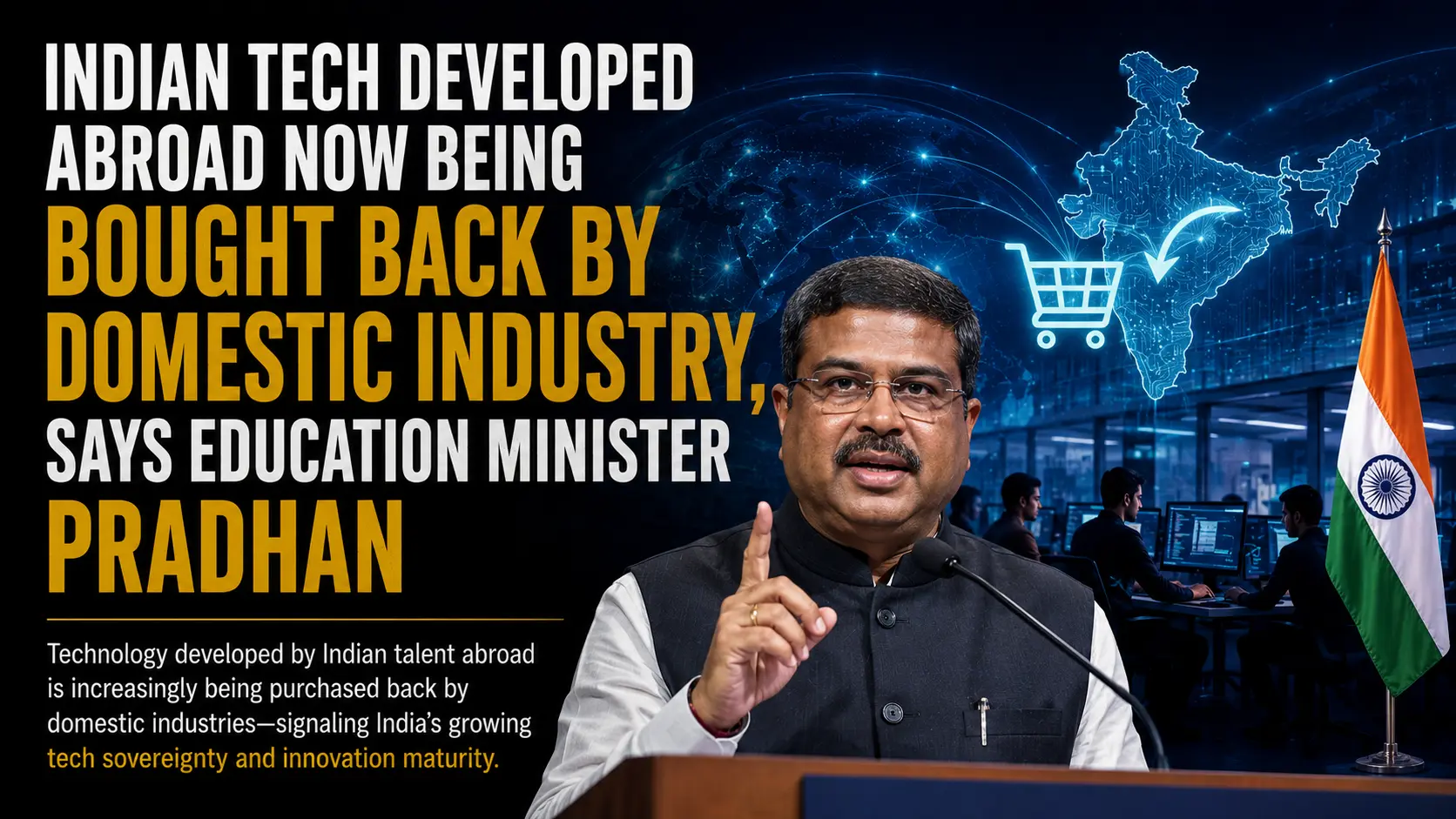
Technology developed by Indian talent working overseas is increasingly being purchased back by domestic Indian industries from foreign markets, according to Union Education Minister Dharmendra Pradhan—a striking reversal that signals India's growing technological sovereignty and economic maturity. This phenomenon reflects not just the brain drain phenomenon that once plagued the nation, but rather a brain circulation model where Indian innovation flows back home through commercial channels. Pradhan's statement underscores a critical transformation in India's position within the global technology ecosystem, where the country is no longer merely consuming foreign technology but actively reclaiming innovations created by its own talent.
Why India's Technology Homecoming Matters Now
For decades, the standard narrative was straightforward and deeply troubling: India's brightest minds left for Silicon Valley, Seattle, and other tech hubs, rarely contributing back to domestic innovation. Parents worried. Policymakers fretted. The loss felt permanent and unidirectional. Today, that storyline has fundamentally shifted. When Indian companies in fintech, artificial intelligence, cloud computing, and software development now purchase cutting-edge solutions developed by Indian engineers abroad, it reveals something profound about global markets recognizing Indian innovation—regardless of where geographically the work happens.
The economic implications cut deeper than nostalgia or national pride. Indian domestic industries are spending significant capital on these technologies rather than developing them from scratch internally. This suggests the quality and sophistication of Indian-origin tech is competitive enough to command premium pricing in international markets. Simultaneously, it indicates that India's domestic market—valued at over $300 billion in the technology sector—has matured enough that companies are willing to invest in best-in-class solutions wherever they originate, even if created by diaspora talent.
How India's Technology Ecosystem Is Transforming
The statement from Pradhan comes amid a broader strategic push by the Indian government to position the nation as a deep tech powerhouse. The government has proposed investing ₹1 lakh crore into research and innovation infrastructure, signaling serious intent to reduce dependence on foreign technology while accelerating domestic capabilities. This investment framework creates conditions where companies no longer need to choose between foreign and Indian solutions based on availability alone—they're increasingly choosing based on merit and cost-effectiveness.
Several key developments illustrate this transformation:
- Indian software companies and startups are now major customers for AI and machine learning platforms developed by Indian engineers in Silicon Valley and other global tech centers
- Cybersecurity solutions created by Indian technologists abroad are being integrated into Indian corporate and government infrastructure
- Cloud computing architectures designed by Indian teams in the US are being adopted by Indian enterprises to reduce costs and improve localization
- Mobile technology innovations from Indian diaspora engineers are being licensed back to Indian smartphone manufacturers and telecom operators
- Semiconductor design expertise developed by Indians in global tech corporations is being tapped by India's emerging chip manufacturing ecosystem
- The government's push toward ₹1 lakh crore in R&D spending is creating financial incentives for Indian companies to source from proven Indian talent, wherever located
Pradhan's comments also hint at a strategic geopolitical dimension. India is positioning itself to meet the technology needs of the Global South—nations that cannot or will not adopt Western technology standards and seek alternative solutions. Indian-origin technology, developed globally but now being commercialized domestically, represents a middle path: world-class capability without the geopolitical baggage of Western tech dependence.
Real Impact: What This Means for Indian Workers and Companies
For Indian technology professionals working abroad, this shift validates a different career trajectory than previous generations experienced. Rather than feeling compelled to choose between contributing to India or achieving international success, today's Indian engineers can develop world-class solutions overseas and see them adopted back home—creating a virtuous cycle of innovation and economic return. Companies like Flipkart, Infosys, TCS, and newer unicorns in fintech and AI are increasingly comfortable licensing or acquiring technology from Indian diaspora founders and teams, recognizing the quality and understanding of India-specific market nuances these teams possess.
The numbers tell a compelling story. Indian technologists created companies and technologies now valued at billions of dollars globally—from payment solutions to AI platforms to cloud infrastructure. When even a fraction of these innovations flow back into the Indian market through commercial transactions, the multiplier effect on India's technology GDP becomes significant. Additionally, this creates a talent feedback loop: successful Indian engineers abroad inspire peers to pursue entrepreneurship and innovation in their original fields, knowing there's a receptive domestic market willing to invest in Indian-origin solutions.
What's Next: The Future of India's Technology Sovereignty
Looking ahead, Pradhan's statement appears to be setting groundwork for increased government emphasis on establishing India as a technology destination not just for manufacturing or services, but for original research and innovation. The ₹1 lakh crore investment in R&D infrastructure suggests the government expects this trend to accelerate significantly. Private sector participation will be crucial—and Pradhan has explicitly called for higher private investment in research innovation, indicating that government funding alone won't drive the transformation India seeks.
Indian readers and technology professionals should watch for several developments: increased licensing agreements between Indian companies and diaspora-founded tech ventures, government incentives for technology repatriation through tax breaks or expedited procurement processes, and expansion of India's domestic semiconductor and deep tech manufacturing capabilities. For job seekers, this creates unprecedented opportunities—Indian engineers no longer face an either-or choice between international career growth and contributing to India's technology ecosystem. The ecosystem is becoming sophisticated enough to value both simultaneously.
Frequently Asked Questions
What does it mean when technology developed by Indian talent abroad is bought back by Indian companies?
It means Indian engineers working in foreign countries create innovative technologies, products, or solutions that Indian domestic companies purchase or license for use. This reverses the traditional brain drain pattern, showing India's economy now values and can afford to acquire world-class Indian-origin innovations, indicating both market maturity and competitive technology creation by diaspora talent.
Why is this important for India's economy and technology sector?
This signals India's growing technological sovereignty, reduced dependence on Western technology, and validation that Indian talent creates globally competitive solutions. It creates economic returns from diaspora innovation, establishes India as a technology destination, and strengthens domestic industry capabilities through access to world-class Indian-origin solutions without geopolitical constraints.
How does this affect Indian technology professionals and startups?
Indian tech professionals can now build international careers while contributing to India's tech ecosystem through their innovations. For startups, it means access to proven, world-class technologies created by people who understand Indian market nuances. It also legitimizes technology entrepreneurship as a career path that benefits both international growth and national development.