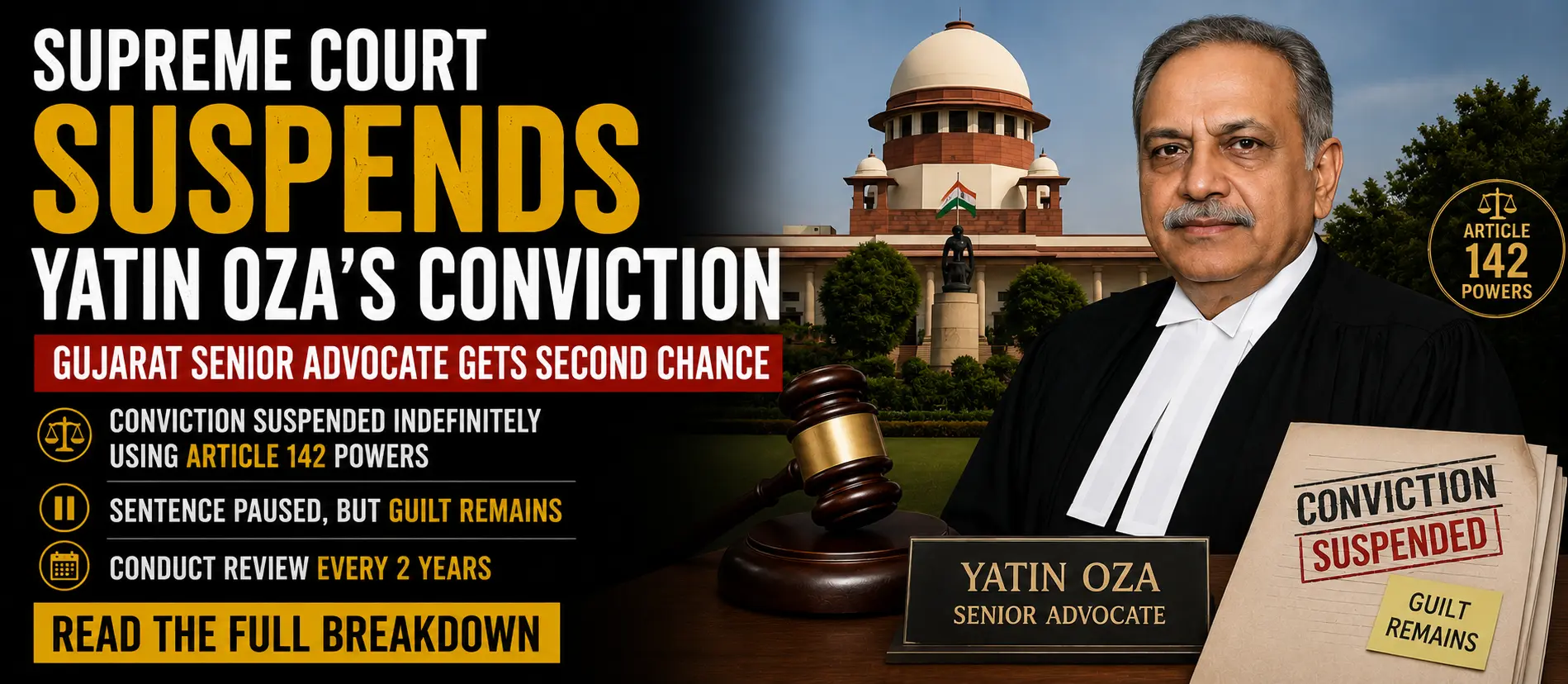
A senior lawyer from Gujarat just got a gift from India's highest court. Not freedom — but something close. The Supreme Court kept the conviction of Yatin Oza in abeyance indefinitely. That means the punishment is paused. It can come back. But for now, it is frozen. Oza, who is the president of the Gujarat High Court Advocates Association (GHCAA), had been convicted of criminal contempt for making harsh remarks against judges. But on Monday, the Supreme Court's full bench decided something unusual — they used their emergency powers under Article 142 of the Constitution to suspend his sentence completely.
So what does this mean? For a lawyer in Gujarat fighting a contempt case, this is massive. For the ordinary Indian watching the courts battle each other, this signals something deeper — that even the strictest punishment can be paused if the highest court believes mercy is needed.
- Conviction kept in abeyance indefinitely — Yatin Oza's punishment is paused, not cancelled, by the Supreme Court
- Article 142 powers invoked — The Supreme Court used extraordinary constitutional authority to suspend the sentence
- Conduct review every 2 years — The Gujarat High Court will check on Oza's behavior every 24 months
- Senior advocate status under review — The Supreme Court asked the Gujarat High Court to reconsider removing Oza's senior advocate designation
- Contempt charges still stand — The Supreme Court refused to overturn the conviction itself, only suspended the sentence
- Objectionable remarks against judiciary — Oza was convicted for making critical statements about state judges in 2024
What Led to This Moment — The Background Nobody Talks About
Yatin Oza is not just any lawyer. He runs the Gujarat High Court Advocates Association. That means he represents hundreds of lawyers in that state. On top of that, he holds the rank of senior advocate — the highest title a lawyer can earn in India short of becoming a judge. When someone of his status gets into trouble with the judiciary, it becomes a bigger story than it first looks.
The trouble started when Oza made some comments about the state judiciary. These were not gentle critiques. He made objectionable remarks that crossed a line according to the judges. Under Indian law, criticizing courts in certain ways is contempt of court — a serious crime that can land you in jail. The Gujarat High Court took this seriously and convicted him. But more than that, they revoked his senior advocate status. That is like removing a doctor's license. It does not just hurt — it destroys a career.
Here is where the story gets interesting. Many lawyers rallied behind Oza. They asked the top court to step in. They argued that removing his senior advocate rank was too harsh. The Supreme Court listened.
What the Supreme Court Actually Did — Breaking Down the Decision
On Monday, the Supreme Court bench made a decision that surprised legal experts across India. Instead of saying “the conviction is wrong, forget it,” they did something more creative. They said “the conviction stays. But the punishment stops. For now.”
Think of it like this — imagine you got caught breaking a school rule and got suspended. The Supreme Court is saying: yes, you broke the rule. But we are not going to enforce the suspension yet. Come back to school. But behave yourself, or we will activate that suspension.
- Conviction stays on record — The Supreme Court did NOT say Oza did nothing wrong. The guilt remains. The crime stays in the books.
- Sentence is suspended indefinitely — Any jail time or fine goes into limbo. It exists, but it is not active.
- Article 142 power used — This is a special power that lets the top court do things that are “just and equitable.” It is like an emergency button for fairness when ordinary rules feel too harsh.
- Conduct must be reviewed every 2 years — The Gujarat High Court will examine Oza's behavior every 24 months. If he stays clean, good for him. If he misbehaves, the punishment can wake up and come down on him.
- Senior advocate status reconsidered — The Supreme Court also told the Gujarat High Court to think again about whether they should have stripped him of this honor. This is a hint that the top court thinks revoking it might have been too harsh.
- Not a clean slate — This is not forgiveness. This is postponement. The sword stays over his head.
The Supreme Court, in its order, spoke about “a final act of forgiveness.” But forgiveness with conditions. Forgiveness with a timer. Forgiveness that can be taken back.
What This Really Means — The Bigger Picture
Okay, so why should you care about one senior lawyer's court case? Because this touches something every Indian should understand — the balance of power between courts.
India has multiple courts. The district courts are at the bottom. Above them are high courts (one in each state). And at the very top sits the Supreme Court in Delhi. When a high court punishes someone, the Supreme Court can step in and soften the blow. That is what happened here.
But here is the tension. The Supreme Court did NOT say the Gujarat High Court was wrong. They said the punishment was too harsh for the crime. That is different. It means judges agree that Oza misbehaved. Judges agree he should face consequences. But some judges think those consequences should wait.
Legal experts are split on this. Some say the Supreme Court is protecting judicial independence — stopping one court from crushing a lawyer too harshly. Others worry that it is sending a message: you can criticize judges, face conviction, and still keep your career if you know the right people or have enough influence.
The numbers matter here too. In 2024, there was a clash between the bar (lawyers) and the bench (judges) in Gujarat. This decision might cool things down. Or it might inflame them further. Nobody is quite sure yet.
How This Affects You — What Changes Right Now
If you are a lawyer in Gujarat, this is your signal. You can criticize judges. But be careful. Do it too harshly, and you will face contempt charges. The conviction will stick forever. But you might not go to jail immediately. That is small comfort, but it is something.
If you are someone who thinks judges should be questioned and held accountable, this is a win. It says the Supreme Court won't let one court destroy a lawyer's life for speaking out. But it is a limited win. The conviction remains. The threat remains. You are just not in immediate danger.
If you are a judge, this is complicated. It says the Supreme Court respects your verdict. But it also says the Supreme Court might override your punishments if they seem too extreme. That reduces your power slightly. But not completely.
For ordinary Indians — the people who use courts to settle property disputes, marriage cases, business conflicts — this changes almost nothing in your daily life. Your cases move forward the same way. Your judges work the same way. This is a story about the system fighting itself, not about the system failing you.
But here is what matters most. If you are involved in any case where judges are unhappy with you — a businessman, a politician, an activist, anyone — watch this decision closely. It shows you that even harsh court punishments can be paused if the Supreme Court thinks mercy is warranted. That is hope. Or a warning. Depending on where you stand.
What Happens Next — The Dates to Watch
This is not the end of the story. It is a pause. Here is what comes next.
First — the conduct review. The Gujarat High Court will check on Yatin Oza's behavior every 2 years. The next check is in 2026. If he stays silent about judges and follows the rules, no problem. If he speaks out again, the punishment wakes up and comes down on him. So in a way, Oza is on probation. For life. Unless the Supreme Court changes its mind again.
Second — the senior advocate decision. The Gujarat High Court now has to reconsider whether to give back Oza's senior advocate status. This might take months. Or it might be quick. If they return it, his career gets back on track. If they don't, he remains a convicted lawyer without the highest professional honor. Either way, look for this decision in the next 3-4 months.
Third — the ripple effect. Other lawyers in similar situations will now file appeals. They will cite the Yatin Oza case and ask for the same treatment — conviction but no immediate punishment. The courts will get busier. The system will feel the impact.
Watch for any statements from Oza himself. If he stays quiet and humble, the story dies. If he goes back to criticizing judges, everything changes. The Supreme Court gave him a chance. Will he take it, or will he throw it away?
Frequently Asked Questions About Yatin Oza's Conviction
What exactly did Yatin Oza do that got him convicted?
Simply put, Yatin Oza made harsh and objectionable remarks about judges of the Gujarat High Court. These were not polite criticism. They crossed into contempt of court — which means disrespecting the judiciary in a way that the law considers a crime. The Gujarat High Court found him guilty of criminal contempt for these statements made in 2024.
What does “conviction kept in abeyance” actually mean?
In plain words, it means the guilty verdict stands, but the punishment stops. Imagine a teacher marks you wrong on an exam, but does not give you a failing grade yet. The wrong answer is still there. But the consequence is paused. Oza remains convicted, but he won't go to jail right now. The punishment can be activated later if he misbehaves.
How does this decision affect ordinary lawyers and ordinary Indians?
For lawyers, it shows that criticizing judges leads to conviction, even if jail time is paused. For ordinary Indians using courts, nothing changes. Your cases move forward normally. This is about power struggles between courts, not about how the justice system serves regular people.
What should Yatin Oza do now to protect himself?
He should stay silent about the judiciary. Follow all court orders. Cooperate with the conduct review process every 2 years. Keep his behavior spotless. The Supreme Court gave him a second chance, but it is conditional. One more misstep, and the punishment activates. His only safety is in silence and obedience.
When will we know if Oza gets his senior advocate status back?
The Gujarat High Court is reconsidering this decision right now. Expect a ruling in the next 2-4 months. If he gets it back, his career is restored. If not, he remains a convicted lawyer. This will be a key date to watch in 2026.