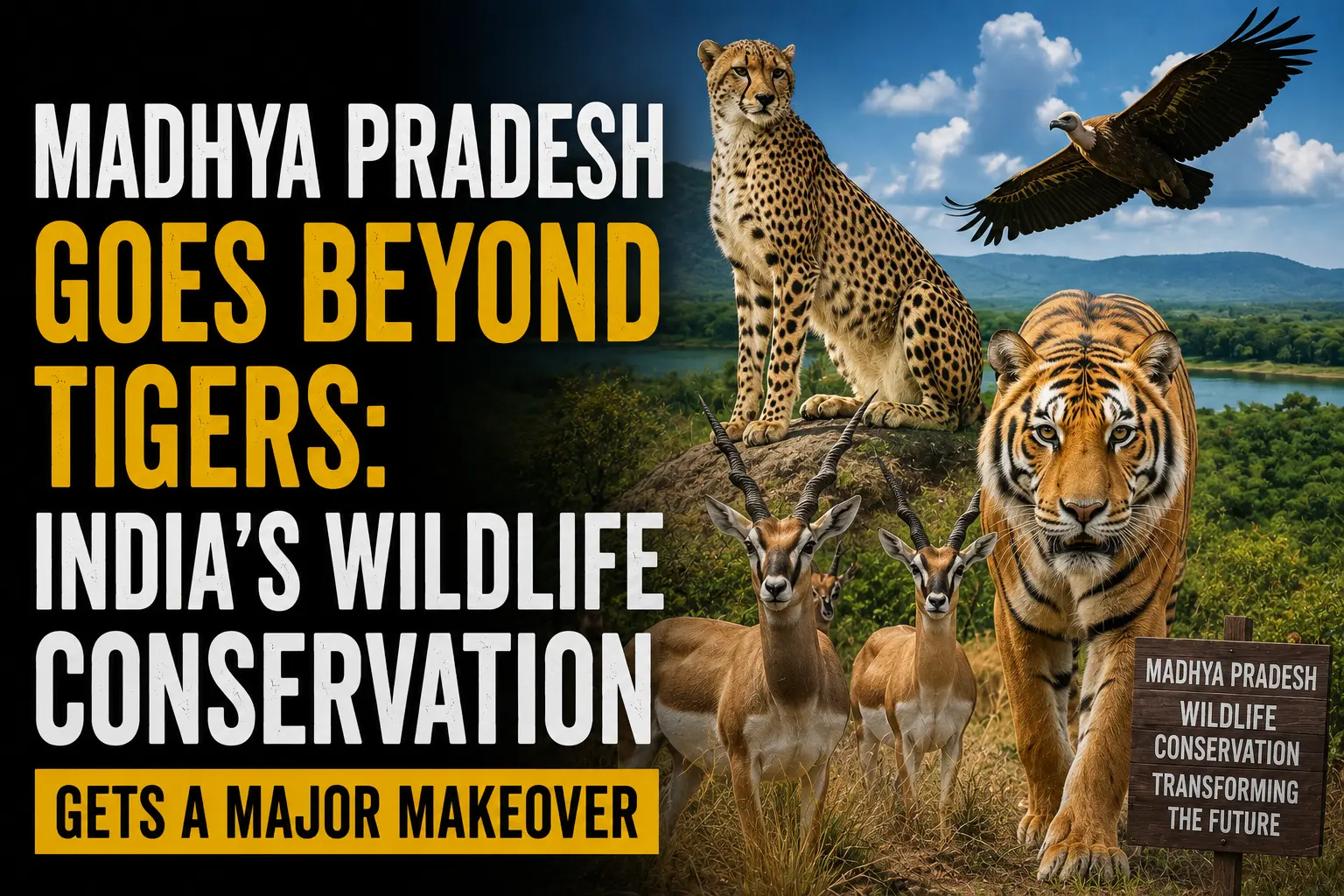
Madhya Pradesh isn't just India's Tiger State anymore. Something bigger is happening right now in the forests of central India — and most people haven't even noticed.
In May 2026, Chief Minister Mohan Yadav released two female cheetahs from Botswana into Kuno National Park. But here's what matters: this isn't just about cheetahs. This is about Madhya Pradesh completely rewiring how India protects wildlife. Tigers, cheetahs, vultures, crocodiles, wild elephants, gharials, turtles — the state is now building a protection system for entire ecosystems, not just one animal.
Think of it this way. For years, wildlife conservation in India meant one thing: save the tiger. Madhya Pradesh is saying — that's not enough anymore.
- 57 cheetahs now live in Madhya Pradesh — making it the biggest cheetah habitat outside Africa
- Three new cheetah habitats are being developed — Kuno, Gandhi Sagar Wildlife Sanctuary, and Nauradehi (part of Rani Durgavati landscape)
- Madhya Pradesh is protecting 20+ wildlife species — not just tigers, but vultures, crocodiles, wild buffaloes, gharials, and turtles
- The state's tiger map has expanded — Madhav National Park in Shivpuri became a new tiger reserve
- This shift is happening while maintaining tiger numbers — proving you don't have to choose between protecting one species and protecting an entire ecosystem
- What this signals: India's next big wildlife battle isn't about increasing numbers — it's about creating balanced, healthy forests where multiple species can thrive together
Why Madhya Pradesh Was Already the Tiger King
Let's be clear about the numbers first. Madhya Pradesh has 674 tigers — more than any other state in India. That's roughly one out of every four tigers in the entire country. For two decades, this number alone made the state famous.
But here's what wildlife experts started realizing about five years ago: protecting just tigers wasn't protecting the forest. A forest with only tigers and no vultures, no crocodiles, no healthy prey populations — that's not really a forest. That's an empty box with one animal in it.
So the state government made a quiet decision. Keep the tigers. But build something bigger around them.
The Shift: From Tiger State to Ecosystem State
This is where the real story starts. In 2022-2023, Madhya Pradesh began a massive conservation expansion. The goal? Stop thinking about animals in isolation. Start thinking about forests.
- Cheetah reintroduction program: After 70 years of extinction in India, cheetahs are back. Kuno National Park became the main site in 2022. Now 57 cheetahs live across multiple habitats in Madhya Pradesh
- Gandhi Sagar Wildlife Sanctuary transformation: Being developed as a second cheetah habitat to spread the population and reduce risk
- Nauradehi landscape approval: Part of the Rani Durgavati landscape, now approved as a third cheetah habitat — this creates a corridor system where animals can move safely between protected areas
- Vulture conservation center launch: Vultures were dying off due to a veterinary drug. The state built a captive breeding and care center — the first real push to bring back birds that were nearly extinct
- Crocodile and gharial programs: Expanding across rivers and water bodies, creating habitat corridors instead of isolated ponds
- Elephant corridor protection: Working with neighboring states to ensure wild elephants can move freely without hitting villages or roads
When CM Mohan Yadav visited Kuno on Mother's Day, the park released a video showing cheetah Veera with her two cubs. The message was simple but powerful — this isn't about releasing animals and forgetting them. This is about building families, populations, and stable ecosystems.
What Wildlife Experts Are Actually Saying
Here's where the conversation gets interesting. Most wildlife conservation work in India follows the same old pattern: Pick one endangered species. Pour money into it. Count the numbers every year. When the numbers go up, celebrate. When they go down, panic.
Madhya Pradesh is saying something different. “The larger story is not merely about the release itself, but about building a system-based conservation model,” state officials explained in recent interviews.
What does that mean in plain words? Stop thinking about tigers, cheetahs, and vultures as separate problems. Start thinking about them as interconnected parts of one healthy forest system.
Here's a practical example: A healthy tiger population needs enough deer and wild boar to hunt. Those animals need grasslands and water holes. Vultures need healthy prey carcasses. When vultures eat meat, they clean up disease. A sick ecosystem fails all the animals at once. A healthy ecosystem succeeds for all of them together.
This approach is actually backed by science. The International Union for Conservation of Nature (IUCN) — the world's authority on endangered species — now pushes what it calls “landscape conservation.” That's exactly what Madhya Pradesh is doing.
What This Means for You and Your Family
You might be thinking — this is nice, but how does it affect me? I don't live in Madhya Pradesh. I don't see tigers every day.
Fair question. Here's the answer.
First, your taxes pay for this. India spends roughly ₹1,500-2,000 crore annually on wildlife conservation. When Madhya Pradesh builds a better system, other states notice. They copy what works. So the effectiveness of every rupee you pay goes up.
Second, if you're a student studying environmental science or biology, this is your training ground. Kuno National Park is now the world's largest cheetah reintroduction program outside Africa. Scientists from universities across India come here to study and learn. Your school curriculum will eventually teach this case study.
Third, eco-tourism. Kuno and Gandhi Sagar now attract visitors from across India and abroad. Hotels, guides, jeep operators, cooks, security staff — thousands of jobs are being created in villages near these sanctuaries. A farmer in Shivpuri district can now earn money by protecting forests instead of clearing them.
Fourth, and this matters most: it's proof that India doesn't have to choose between development and nature. For 50 years, the story was — either you build factories, dams, and roads (and destroy forests), or you keep forests (and stay poor). Madhya Pradesh is showing a third path. Keep forests. Create jobs. Protect endangered species. All at the same time.
What Happens Next — The Timeline That Matters
This isn't a one-time announcement. There are real dates and milestones coming.
2026-2027: The cheetah population at Kuno is expected to reach 100 — a symbolic milestone showing the program can sustain itself without constant human help.
2027: Gandhi Sagar Wildlife Sanctuary is scheduled to receive its first batch of cheetahs — spreading the population and creating backup if something goes wrong at Kuno.
2028: The Rani Durgavati landscape (which includes Nauradehi) is expected to be ready for a third cheetah population — creating a network of three protected areas instead of just one.
Vulture breeding center: Currently breeding 200+ vultures per year. The goal is to release back into the wild once numbers are stable — expected by 2027-2028.
Here's what to watch: Will other states copy this model? Gujarat has lions. Karnataka has elephants. Assam has rhinos. If Madhya Pradesh proves that ecosystem-based conservation works, every state might shift its entire approach. That would be genuinely transformative for Indian wildlife.
The bigger question nobody is asking yet: Can this succeed long-term? Cheetahs need huge territories. Elephants migrate across state borders. The real test isn't whether Madhya Pradesh can protect wildlife in one location. It's whether India can build wildlife corridors across state borders, where animals roam freely and states cooperate instead of competing.
Frequently Asked Questions About Madhya Pradesh's Wildlife Shift
What does it mean for Madhya Pradesh to move from “Tiger State” to “Wildlife State”?
Simply put: The state isn't abandoning tigers. Instead, it's building protection for an entire ecosystem. Tigers need healthy forests with diverse prey. Forests with only tigers and no vultures, crocodiles, or other species aren't actually healthy. This shift means Madhya Pradesh now protects 20+ species across interconnected habitats instead of focusing on just one animal.
Why are cheetahs being released in Madhya Pradesh specifically?
Good question — there's a reason. Kuno National Park has the right habitat (grasslands, prey animals, space), the right climate, and trained staff. Cheetahs had been extinct in India for 70 years. Kuno had the best conditions to restart the population. Now it's the largest cheetah reintroduction program outside Africa, with 57 animals thriving.
How does protecting cheetahs and vultures actually help farmers and ordinary people?
In plain words: It creates jobs. Sanctuary work, eco-tourism, guide services, hospitality — villages near protected areas see economic growth. Plus, healthy forests prevent soil erosion, regulate water flow, and reduce flooding — benefits that reach farming communities downstream. A healthy ecosystem is good business for rural India.
What should I do if I want to support this conservation work?
Here's what you can do right now: Visit these sanctuaries if you can — tourism money directly funds protection. Support local NGOs working in Madhya Pradesh (search “Kuno National Park conservation NGOs”). Spread awareness that wildlife conservation isn't just about animals — it's about healthy forests that benefit humans too. Share this story.
When will we know if this ecosystem conservation model actually works?
The short answer: 2027-2028. That's when all three cheetah habitats should be functioning, vultures should be breeding successfully, and Madhya Pradesh will have concrete data showing whether protecting one ecosystem actually helps multiple species. If the numbers stay strong and the model spreads to other states, it works.
The Real Question India Should Be Asking
Here's what's actually happening beneath all the wildlife releases and habitat development. India is experimenting with a new answer to an old problem.
For 75 years, we've treated nature like a museum piece. You protect it. You keep humans out. You count the animals. You hope they don't die.
Madhya Pradesh is trying something different. What if forests aren't museums? What if they're systems that work with human communities? What if protecting an ecosystem means protecting jobs, water, soil, and climate and protecting tigers, cheetahs, and vultures at the same time?
That's the real story. Not the cheetahs. The system.
Watch Madhya Pradesh over the next two years. If this works — if the populations grow, if villages benefit, if other states copy the model — you're watching the future of Indian conservation. If it fails — if funding dries up, if animals die, if local people get pushed out — then we know the old way is still the only way.
Either way, this moment matters. And most people haven't even noticed it's happening.