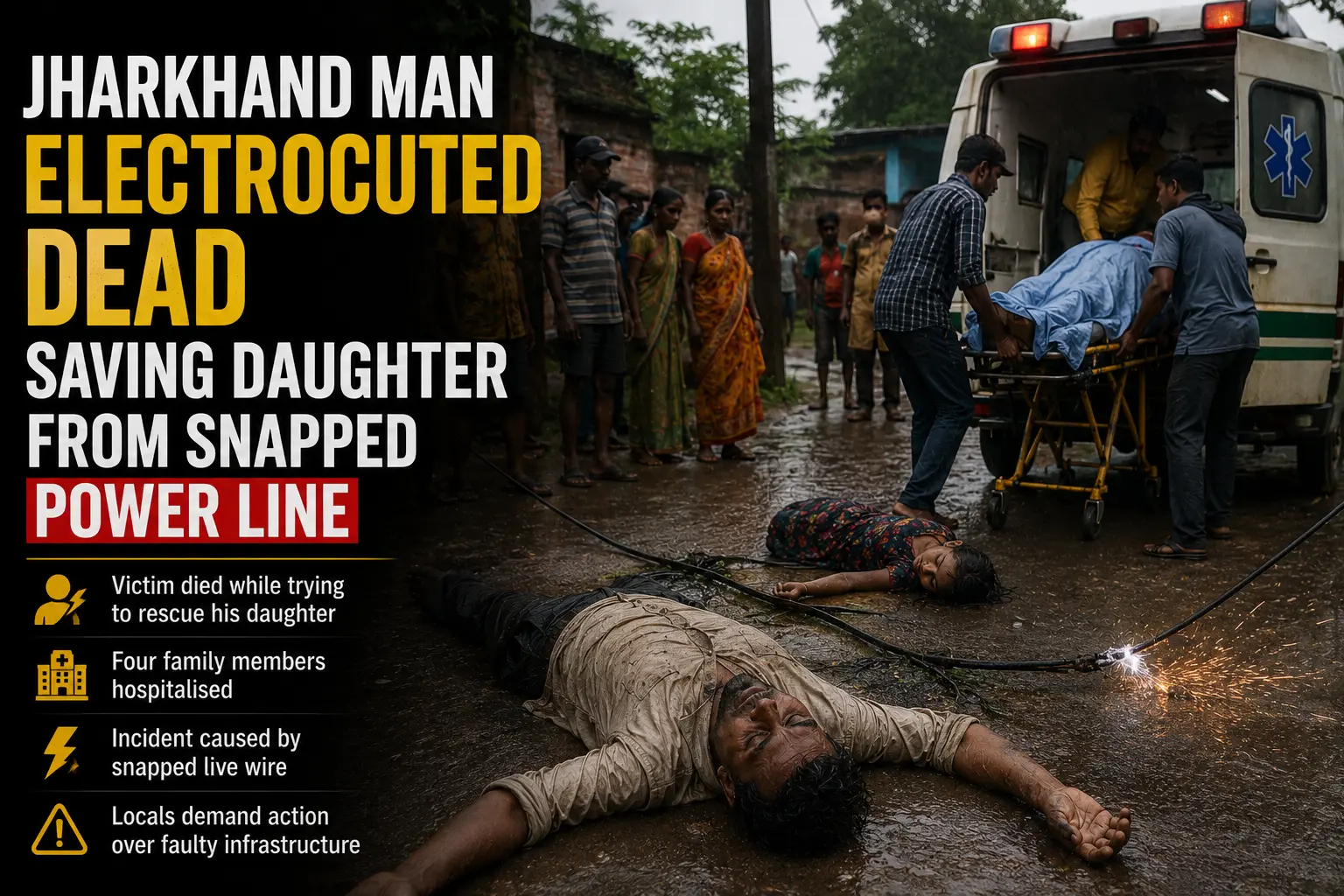
He ran toward his daughter. That was all he was trying to do. A live wire had snapped and fallen somewhere near her, and a father did what every father would — he moved fast, without thinking, without waiting. He never came back. A man in Jharkhand was killed on the spot after he came in contact with a downed power line while rushing to pull his daughter to safety, police said. Four other family members who followed him into that same desperate rescue attempt also suffered serious burn injuries and are now receiving treatment at a government hospital.
- A man in Jharkhand died after touching a live, snapped power line while trying to save his daughter from electrocution.
- The daughter had come in contact with the downed wire first — the father ran to rescue her and was fatally electrocuted on the spot.
- Four other family members who rushed to help also suffered burn injuries and are currently hospitalised.
- Police have confirmed the incident and said an investigation into the cause of the wire snapping is underway.
- Snapped power lines during rains and storms are responsible for dozens of civilian deaths across India every monsoon season.
- Electricity departments in Jharkhand and neighbouring states have faced repeated criticism for delayed maintenance of aging power infrastructure in rural areas.
The Story That Led to This Moment
Power lines snap. They do it every monsoon. And every year, people — most of them in villages and small towns, most of them with no warning — walk into them, or they fall near someone they love, and the instinct to help takes over before the brain can catch up.
Jharkhand has roughly 3.8 crore people. A large portion live in semi-rural and tribal areas where electricity infrastructure is old, maintenance is irregular, and the gap between a working power line and a dangerous one can be as small as one bad storm. The state's power distribution network has been flagged repeatedly by energy experts and civil society groups for its aging transmission towers and inadequately insulated low-hanging wires — particularly in districts away from Ranchi and Dhanbad.
This is the backdrop against which a family's ordinary evening turned fatal. And it raises a question that nobody in power seems to want to answer plainly: how many more people have to die reaching for someone they love before the lines get fixed?
What Actually Happened
According to police, a power line snapped — the exact cause is still under investigation — and fell in the vicinity of the family's home. The man's daughter came in contact with the live wire first. Her father, realising she was in danger, ran toward her immediately. He touched the wire, or came close enough to it, and the current killed him on the spot.
- Victim: The deceased man, whose name has not been officially released in initial police reports, was a resident of Jharkhand. Police have registered a case and informed the relevant electricity department.
- His daughter: She survived the initial contact but sustained injuries. Her current condition is being monitored at the hospital where the family has been taken for treatment.
- Four other family members: All four ran in after the father — a chain of rescue attempts that turned into a chain of casualties. All four are now hospitalised with burn injuries of varying severity, according to police.
- The wire: A snapped power line, live at the time of the incident. Whether it was a low-tension distribution line or a higher-voltage transmission cable has not been confirmed by the electricity department in initial statements.
- Time and location: The exact time and district within Jharkhand have not been specified in the initial police statement, and local administration has not issued a formal press release as of the time of this report.
- Police action: Officers reached the scene, recorded the details, and have informed the Jharkhand electricity authority. A formal inquiry is underway.
What is not under question is the sequence of events. The daughter went down first. The father went in after her. Then came the others — one after another, each one thinking they could help, each one not knowing the ground was still live. It's a pattern emergency responders call “secondary electrocution” — and it kills rescuers with alarming regularity across India.
The family did exactly what most people would do. That is precisely the problem. There is no public awareness campaign robust enough, no warning sign visible enough, no training accessible enough in most of rural India to override the human impulse to grab someone who is hurt.
Why This Is Bigger Than One Family's Tragedy
This is not an isolated incident. That is the hardest thing to write, and the most important.
Across India, snapped power lines kill and injure civilians every single monsoon season — and many times outside of it too. The pattern is always the same: a wire falls, someone touches it, someone else tries to help, and the current claims multiple victims before anyone can cut the supply. According to data compiled by the National Crime Records Bureau (NCRB) in its most recent accidental deaths report, electrocution accounts for thousands of accidental deaths in India annually — with a significant portion involving power line contact in rural and semi-urban areas.
In October 2024, three people — identified as Rashid, Saddu, and Arbaz — were killed in Assam after a tazia procession came in contact with an 11kV high-tension power line, according to reports from The Sentinel, Assam. In Hyderabad, during heavy rains, a father and his teenage daughter stepped out to move a car damaged by a fallen tree — and a snapped power line killed them both, as reported by The News Minute and Times of India. In Gorakhpur, Uttar Pradesh, a man, his daughter, and his niece were burnt to death after a high-tension cable fell directly on them, according to NDTV.
Each story sounds different. Every single one follows the same script.
The government's view, as expressed through various state electricity board communications over the years, is that infrastructure upgrades are ongoing and that citizens should report dangerous power line situations to the nearest electricity office. The opposition — in Jharkhand as in most states where these deaths occur — points to budget cuts, understaffed maintenance crews, and the political reality that rural electrification headlines get far more attention than rural electrification upkeep.
The ordinary citizen's view is simpler. “We call. Nobody comes. And then something like this happens,” is a sentence that local journalists across five states have heard in five different languages over the past three years.
Historically, India's per-capita electricity consumption has grown sharply over the past two decades — from about 566 units per person per year in 2001 to over 1,200 units per person per year by 2023, according to Ministry of Power data. But the distribution network — particularly the last-mile infrastructure in states like Jharkhand, Bihar, Odisha, and Uttar Pradesh — has not kept pace with demand. Old poles. Aging cables. Wires strung too low. Maintenance cycles stretched too thin.
The result is exactly what happened to this family.
How Ordinary Indians Will Feel This First
For a family living within 500 metres of a power distribution line — which describes hundreds of millions of households in rural and semi-urban India — this story is not distant. It is a geography lesson about their own front yard.
Think about it this way. Most rural homes in Jharkhand, Bihar, and Odisha are connected to power through overhead lines that run along roads, across fields, and sometimes directly over courtyards. During a storm, these lines can snap. When they do, they don't always go dead — they often stay live, sparking on the ground or hanging just above it, invisible in the dark, indistinguishable from a dead wire to someone who isn't trained to know the difference.
For a daily-wage worker whose child plays in the yard at dusk, this is not a hypothetical. For a woman cooking near an open window when the monsoon hits, this is not someone else's problem. The risk is structural, geographic, and entirely preventable — and that is what makes each death like this one so hard to absorb.
Here is what you should know and do right now. First — never touch a person who is in contact with a live wire. Not with your hand. Not with a wet cloth. Not with anything that conducts electricity, which includes most things you'd reach for in a panic. The only safe first move is to cut the power at the nearest switch or fuse box, or call your electricity department's emergency line immediately. Second — if you live in an area with overhead power lines and notice a line hanging low, fraying, or in poor condition, report it in writing to your state electricity distribution company (DISCOM). Keep a record of the report. Third — if you see a wire on the ground after a storm, treat it as live. Always. Even if it looks dead. Even if there's no sparking. Walk away and call for help.
These are not complicated steps. But in the absence of regular public awareness campaigns — the kind that run on Doordarshan during prime time, the kind that reach villages — most people don't know them. And so they run in. And so they die.
What Comes After This
The immediate next steps are procedural. Police in Jharkhand will complete their inquiry. The electricity department will likely send a team to assess the line and restore supply. A case may or may not be registered against the utility company for negligence — such cases are filed occasionally, pursued rarely, and concluded even more rarely in India's overburdened lower courts.
The family will receive — if past precedent holds — a condolence amount from the state government. In Jharkhand, compensation for accidental electrocution deaths caused by electricity department negligence has ranged from ₹2 lakh to ₹5 lakh in documented cases, though families often report having to follow up repeatedly to receive even that. Whether this family receives compensation, and how quickly, will depend on the administrative will of the local collector's office and the electricity board.
Three scenarios are possible from here. In the best case: the state electricity department conducts an audit of vulnerable power lines in the district, expedites repair, and the family receives full compensation within 60 days. In the most likely case: the line gets fixed within a week, the inquiry is filed away, the compensation takes months, and nothing structurally changes. In the worst case: the line gets fixed, the family's file gets lost in the bureaucracy, and six months from now a different wire falls in a different village — and the story runs again, with different names.
The Jharkhand state government, under Chief Minister Hemant Soren, has made rural electrification a visible priority — and the state's household electrification numbers have improved markedly under successive governments. But electrification and safe electrification are not the same thing. Getting power to a home and keeping the lines that carry it safe are two different administrative challenges. The second, quieter one is where families like this one fall through.
Watch for two things in the coming weeks. First, whether the Jharkhand Bijli Vitran Nigam Limited (JBVNL) — the state's power distribution company — issues any public statement on this incident or announces a line inspection drive in the affected area. Second, whether the family files a formal compensation claim and whether the district administration processes it within the statutory 30-day window.
Frequently Asked Questions About Power Line Deaths in India
What should you do if someone is electrocuted by a fallen power line?
Simply put, do not touch them. The single most dangerous thing bystanders do is grab the person — the current is still passing through the body and will pass into yours. Cut power at the nearest switchboard first. Then call emergency services and your electricity department's helpline. Only approach the person once power is confirmed off.
Who is responsible when a snapped power line kills someone in India?
Here's the thing: legal liability falls on the electricity distribution company (DISCOM) responsible for maintaining that line. Families can file a compensation claim with the state electricity board and also approach the State Consumer Disputes Redressal Commission. Courts have, in documented cases, awarded compensation ranging from ₹2 lakh to over ₹15 lakh depending on circumstances and negligence established.
How common are power line electrocution deaths in rural India?
More common than most city residents realise. According to NCRB accidental deaths data, electrocution is consistently among the top ten causes of accidental death in India. Rural and semi-urban areas bear a disproportionate share of these deaths due to aging infrastructure, low-hanging wires, and delayed maintenance in states like Jharkhand, UP, Bihar, and Odisha.
What compensation does a family get if their relative dies due to electricity department negligence in Jharkhand?
Good question — the answer depends on who you ask. JBVNL (Jharkhand Bijli Vitran Nigam Limited) has a published schedule of compensation for electrocution deaths linked to supply-side faults. State government ex-gratia amounts have ranged from ₹2 lakh to ₹5 lakh. Families can additionally sue the electricity board in civil court or approach the consumer forum for higher amounts.
What is the latest update on the Jharkhand power line death case?
The short answer: police have confirmed the man's death and the hospitalisation of four family members, and an investigation is underway. The Jharkhand electricity department has been informed. As of the time this report was published, no official compensation announcement or departmental statement had been issued. The inquiry is ongoing.