Every May 15th, India remembers why some of our animals are disappearing. National Endangered Species Day sounds like just another calendar event — but it is actually a hard look at whether our laws are working. Right now, tigers, elephants, and countless other creatures are vanishing faster than we can protect them. And honestly? Our wildlife laws look good on paper. In real life, they are struggling.
Here is the uncomfortable truth nobody talks about: India has one of the world's strictest wildlife protection laws — the Wildlife Protection Act of 1972 (WPA) — but animals are still dying at record rates. Tiger reserves exist. Elephant corridors are marked. But development projects, poaching, and habitat loss keep pushing past the legal safeguards meant to stop them. So on National Endangered Species Day, the real question is not whether we care about animals. The question is: can our laws actually save them?
- The Wildlife Protection Act (1972) is India's main law protecting endangered animals — but recent projects have bypassed its rules in favor of “Ease of Doing Business”
- India lost critical tiger habitat to development projects even in protected areas, showing legal gaps that need urgent fixing
- Over 100+ species in India are classified as critically endangered by IUCN standards
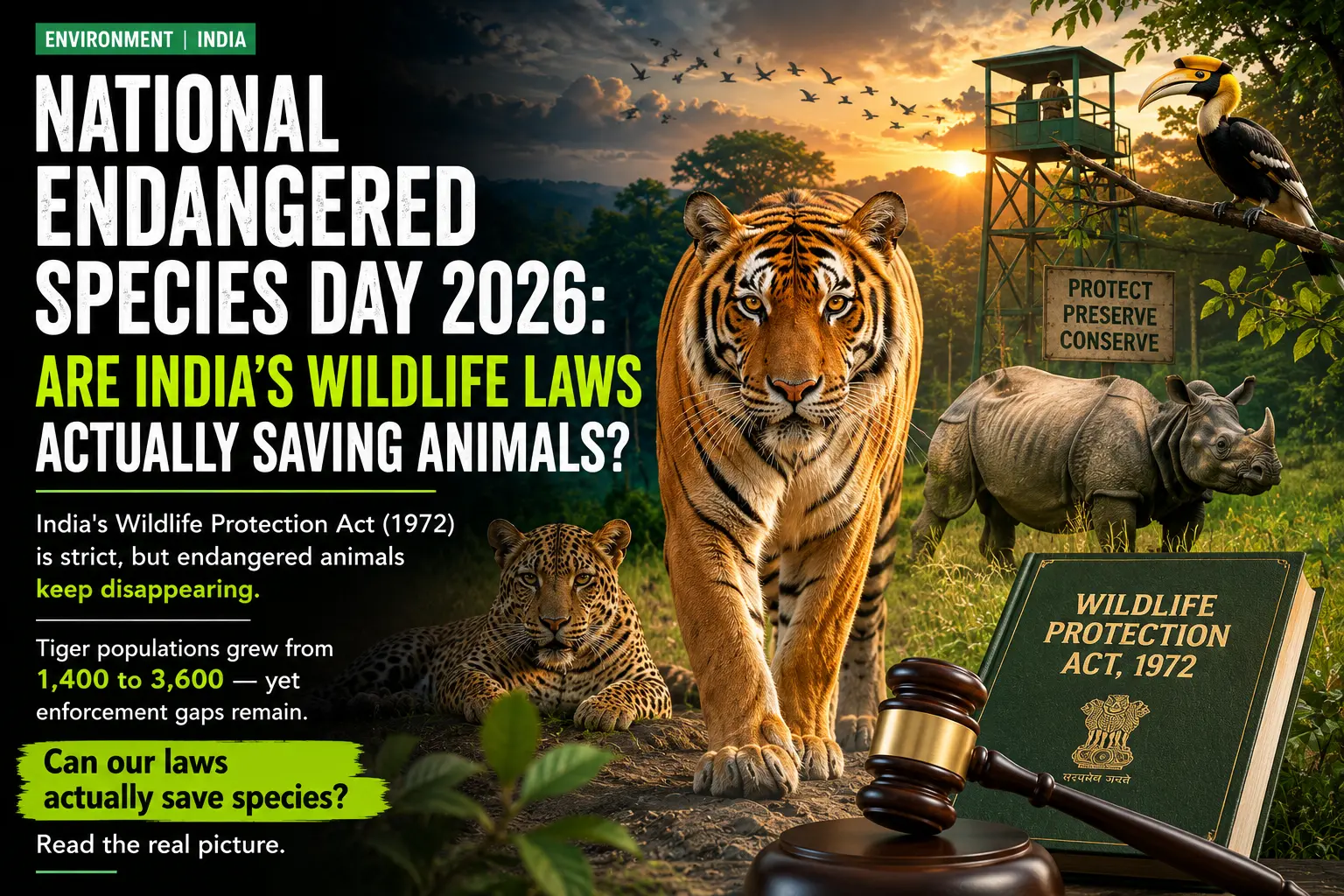
- Tiger populations grew from about 1,400 in 2006 to over 3,600 by 2023 — proof that strict protection CAN work when properly enforced
- Elephant-human conflicts are rising because habitat corridors are shrinking despite legal protection
- May 15th is National Endangered Species Day — a moment to ask hard questions about whether we are willing to enforce the laws we already made
Why India's Wildlife Laws Exist (And Why That Matters Right Now)
Let us start with some history — but the short version. India adopted the Wildlife Protection Act in 1972 because we were losing species fast. Tigers, rhinos, elephants — all heading toward extinction. The law was strict. It created tiger reserves. It banned hunting. It created protected forest areas where animals could actually live.
Here is what worked: between 2006 and 2023, India's tiger numbers more than doubled — from roughly 1,400 to over 3,600 tigers living in the wild. That is not luck. That is law enforcement working. So why are we still losing animals?
The answer is messier than a simple yes-or-no. India has strict wildlife laws, but something has started chipping away at them. Development projects — highways, dams, power plants, coal mining operations — increasingly get approval even in sensitive forest areas. The phrase “Ease of Doing Business” keeps showing up in government approvals, sometimes overriding the careful environmental checks that the Wildlife Protection Act demands.
For someone like you studying environmental science in school, this is the real lesson: laws are only as strong as the people enforcing them.
What Is Actually Happening to Endangered Animals in India Right Now?
India is home to roughly 15% of all species on Earth. That sounds amazing. But here is the problem: about 103 species are classified as critically endangered by the International Union for Conservation of Nature (IUCN). That means they could vanish within decades if nothing changes. Let me break down what is happening to some of them:
- Bengal Tigers: Once hunted to near-extinction, they now number around 1,200 across India. But habitat shrinkage means they are running out of space and eating livestock — which makes villagers kill them in retaliation.
- Asian Elephants: About 27,000 wild elephants roam Indian forests. But 400-500 elephants die every year — some from poaching, many more from being hit by trains or killed in human-animal conflicts because their forest corridors keep shrinking.
- One-horned Rhinos: Less than 3,600 exist globally, and most live in India (mainly Assam). They are protected by law, but poaching for their horns (which sell for more than gold) still happens.
- Gharials (Indian Crocodiles): These river reptiles nearly went extinct in the 1970s. Conservation breeding brought them back to maybe 2,000 in the wild, but river dams and pollution keep threatening them.
- Great Indian Bustards: Only about 250 pairs survive. They need open grasslands, which keep disappearing to solar farms and agriculture.
- Nilgiri Tahr (Mountain Goat): Found only in a small part of the Western Ghats, their numbers hover around 3,600. Climate change and habitat loss are their biggest threats.
So here is the pattern you will notice: even when a species is legally protected, it still dies if its home disappears or if enforcement becomes weak.
The Real Problem: Laws on Paper vs. Laws in Practice
India's Wildlife Protection Act sounds powerful. But there is a growing gap between what the law says and what actually happens on the ground. Here is where the friction is:
First: Development projects are increasingly getting fast-tracked. Highways cut through tiger reserves. Dams flood elephant habitats. Coal mining eats into protected forests. And sometimes — not always, but sometimes — environmental clearances happen on schedule, not because the science says it is safe, but because a company needs to start work on time.
Second: Enforcement is patchy. In well-funded reserves like Bandhavgarh (Madhya Pradesh) or Sundarbans (West Bengal), protection is serious. But in smaller protected areas with less budget and fewer forest guards, poaching and illegal logging happen regularly. A forest guard earns maybe ₹15,000-20,000 a month. A poacher selling tiger parts can make ₹5-10 lakh in one night. Do you see the math?
Third: Human-animal conflict is getting worse. When elephant corridors shrink or tigers lose hunting grounds, they raid villages looking for food. Farmers kill them. Then the forest department and villagers end up on opposite sides, and the animal loses.
Think about it this way: a law is just words until someone enforces it. Right now, enforcement is uneven across India.
What This Means for Indians Like You
You might be thinking: “Okay, but why should I care if some animal goes extinct? I live in a city.” Here is why this matters for you personally:
Forests are not just home to animals. They create the air we breathe, hold back floods, and store water. When endangered species disappear, the entire forest ecosystem starts to collapse. That affects rainfall patterns, which affects farming, which affects food prices in your city. When tiger reserves shrink, forest cover shrinks — and that means less water storage.
For someone living in a city like Delhi or Mumbai, weaker environmental enforcement means cheaper building materials and faster project timelines — but it also means more flooding, worse air quality down the line, and higher water costs. For a farmer in Maharashtra or Karnataka, shrinking wildlife corridors mean more conflict with animals raiding crops — which costs money and sometimes lives.
Here is the real bottom line: protecting endangered species is not about being nice to animals. It is about protecting the systems that keep us all alive.
What Is the Government Actually Doing About This?
Let us be fair. India has done serious work on species conservation. The tiger population growth is real. Rhino numbers in Assam have recovered. Breeding programs for species like gharials and bustards have worked. The Ministry of Environment, Forest and Climate Change runs these programs — and some of them are genuinely world-class.
But government experts are also pointing out that new development rules are making their job harder. The “Ease of Doing Business” push sometimes means environmental clearances move faster than scientific review recommends. Forest officers say they are getting pressure to approve projects on time rather than give projects the full environmental check they need.
This is not a conspiracy. It is just the tension between two legitimate goals: India wants economic growth AND wants to protect wildlife. The question is: can we do both without sacrificing one?
On National Endangered Species Day, the answer from conservation experts is pretty clear: we can, but only if we enforce the laws we already have. We do not need new laws. We need to actually use the ones from 1972.
What Can Actually Happen Next?
Here is what wildlife groups are pushing for in 2026:
- Stronger enforcement in tiger reserves: More forest guards, better surveillance technology, and real punishment for poaching — not just fines that people ignore.
- Actual protection for forest corridors: Elephant and tiger corridors need to stay forest, not turn into roads or industrial areas. The law says this already. It just needs to be enforced.
- Compensation programs for villages: When animals raid crops or kill livestock, farmers should get real money from the government — not empty promises. This makes people less likely to kill endangered animals.
- Habitat restoration: It is not enough to have protected areas. The land needs to be actively restored — remove invasive plants, rebuild water sources, create proper corridors between reserves.
- Technology and monitoring: GPS collars on endangered animals, camera traps in forests, and real-time data sharing between reserve staff and central authorities.
The best part? Most of this does not need new laws. It needs budget, trained staff, and actually following the laws we made 50 years ago.
The Hard Truth About Conservation
Here is something honest that conservation experts will tell you if you ask them directly: protecting endangered species costs money, requires patience, and sometimes means saying no to economic projects that could be profitable.
India is not unique in struggling with this balance. But India IS unique in having both incredible biodiversity to protect AND rapid economic growth that puts pressure on that biodiversity. The Wildlife Protection Act of 1972 was the country's answer to that tension.
Fifty years later, that law is still the best tool we have. The question on National Endangered Species Day is not whether India cares about endangered animals. We do — the tiger recovery proves it. The question is: are we willing to actually enforce the protections we promised?
Frequently Asked Questions About Endangered Species in India
What exactly is an endangered species?
Simply put, an endangered species is an animal (or plant) that is at serious risk of vanishing forever. The IUCN rates species in categories: Vulnerable (at risk), Endangered (very high risk), and Critically Endangered (about to die out). India has over 100 critically endangered species. Being endangered does not mean the species is already gone — it means we still have time to save it if we act now.
How does India's Wildlife Protection Act actually protect animals?
Here is the thing: the 1972 WPA makes hunting endangered animals illegal, creates protected forest reserves where animals can live safely, and sets up penalties for poaching. But enforcement varies wildly. Well-funded tiger reserves protect animals strictly. Smaller reserves sometimes struggle. The law works when properly funded and staffed — but that is not always the case across all of India.
Why do animals keep disappearing even though they are legally protected?
In plain words: laws alone do not save species. Habitat loss (forests turning into roads, farms, or industrial areas) is the biggest threat. Poaching still happens because criminals find it profitable. And human-animal conflict kills many protected animals. Legal protection is necessary — but it is not enough without enforcing it and protecting actual forest habitat.
What should I do if I care about endangered species?
Good question — here is what actually works: support local conservation groups, avoid buying products made from endangered animals (like ivory, skins, or traditional medicines from threatened species), and vote for leaders who take environmental enforcement seriously. Small things like these add up. Sharing facts about endangered species with friends also spreads awareness, which builds pressure for real protection.
When will we know if India's wildlife laws are actually working?
The short answer: tiger and rhino numbers tell us the laws CAN work when enforced. But rising human-animal conflicts and ongoing habitat loss show we still have a long way to go. Watch for these dates: India's next wildlife survey happens in 2024-2025 (results will show if protection is improving). Major court rulings on development projects in protected areas will show whether laws are being respected in practice.
The Bottom Line
National Endangered Species Day is not just a calendar reminder. It is a reality check. India made serious laws to protect wildlife. Those laws have actually worked — tiger populations prove it. But new pressures are testing whether we will keep enforcing them, or whether economic growth will win out.
The real question is not whether we can save endangered species. We can. We proved it with tigers. The question is: will we?