COVID Death Toll Actually 3 Times Higher Than Official Numbers — WHO Report Reveals 2.2 Crore Excess Deaths
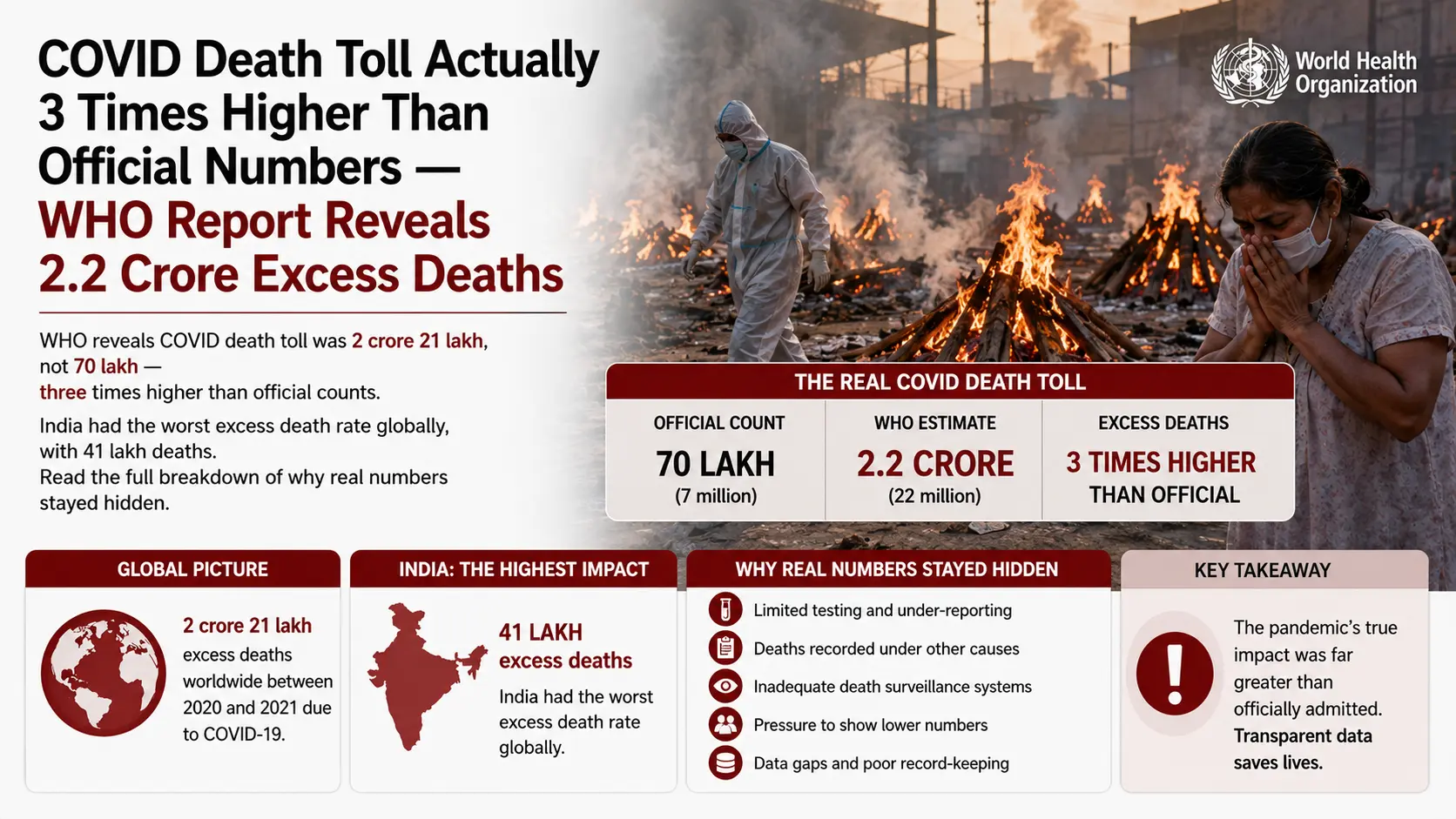
The World Health Organization just dropped a bombshell that nobody—and I mean nobody—saw coming, revealing the real death toll from COVID-19 isn't 70 lakh like governments claimed. Wow. It's actually closer to 2 crore 21 lakh, which is more than three times higher. Not small. And here's what makes it worse: most countries, including India, haven't been telling the world the real story.
Wow.
Between 2020 and 2023, the world lost a shocking number of people that nobody admitted to—a figure far beyond the official narrative. Huge. The WHO studied excess deaths, which is the number of people who died above what's normal in any given year, and the number is staggering. And more. Not everyone who died from COVID got tested, and not everyone got counted. Governments had their reasons, sure, but the bodies tell the real story.
So for ordinary Indians, this matters a ton because it means the pandemic was far deadlier in your own neighbourhood than anyone ever told you. That stings. If you lost a family member during those years, you weren't alone—but you were probably told you were a rare case. Let that sit. You weren't.
- 2 crore 21 lakh excess deaths — this is the real global COVID death toll from 2020-2023, per the WHO.
- Official count was only 70 lakh deaths — a number that's more than 3x lower than what actually happened.
- 41 lakh excess deaths in India alone — and that put India at the top of the list for the highest death toll of any nation.
- Men died at nearly twice the rate of women — we're talking a 50% higher mortality rate for males across the globe.
- Poor countries hit hardest — it's no surprise that low-income nations saw way more excess deaths than the wealthy ones.
- Governments undercounted deliberately and by accident — a mix of no testing, lost rural data, and political pressure created the gap.
And here's why that matters.
Why Nobody Knew the Real Number Until Now
Think about what happened during the pandemic — a relative dies, the hospital is overflowing, and there's no test available or the family can't afford one. Right? Is it COVID? Maybe. Nobody writes it down as COVID. That's the truth. And that person just becomes a statistic nobody counts.
Or this: a lockdown happens in a small village where there aren't any hospitals nearby, and someone gets sick, can't reach a doctor, and dies at home. Think about it. Their death never reaches the government's official COVID counter. Big deal. Across India, with its villages spread across 28 states and 8 union territories, how many deaths like this actually happened? Nobody was keeping track.
So the WHO spent years collecting data from 183 countries and comparing death rates to previous years—a massive undertaking. True. When they saw how many more people died in 2020, 2021, 2022, and early 2023 compared to 2015-2019, the gap was just enormous. And that's big. This gap, known as excess mortality, is the real picture.
And here's the thing: governments didn't want big numbers. A high death toll looks like a complete policy failure. Yep. It looks like a healthcare system that failed and a sign of total mismanagement. And now? So officially reported numbers stayed suspiciously low. But the WHO's math doesn't care about politics. Excess deaths don't lie.
India's Death Toll Was Actually Among the World's Worst
India officially reported about 5 lakh COVID deaths. The WHO data, however, suggests it was actually closer to 41 lakh. That's eight times higher than the official count. Period.
Period.
Think about what that means. In 2021 alone, researchers found a staggering 41 lakh excess COVID deaths in India by December 31st. Unreal. And India topped the list—it had more excess COVID deaths than any other country on Earth. That's real. Seven countries together accounted for more than half of all excess deaths worldwide, and India was number one. Is this really a surprise?
Why? Several reasons hit India harder than wealthier nations:
- Testing was scarce — especially in rural areas and poor neighbourhoods, people just never got tested. No test means no official COVID death. Simple as that.
- Rural deaths went uncounted — we're talking villages in Bihar, Uttar Pradesh, and Madhya Pradesh losing people with absolutely zero documentation.
- Healthcare was miles away — if a farmer in a small town got sick, the nearest hospital could be 50 kilometres away. A lot of people didn't make it.
- Government hospitals were packed — and during the peak waves, private hospitals were just rejecting poor patients. Public hospitals had nothing: no beds, no oxygen, no medicine.
- Economic pressure forced people out — some workers actually left hospitals early just to save money. They went home, got sicker, and died there.
- Home deaths weren't recorded as COVID — when someone died at home without a test, doctors just wrote it off as “pneumonia” or something similar, not COVID.
The kind of thing most people miss.
Look, for someone living in a small town or village during 2020-2021, the pandemic was almost certainly worse than the official numbers suggested. Wild. Your city likely lost way more people than the government ever counted. Facts.
What the Numbers Actually Tell Us
So the WHO data breaks down in ways that reveal a hard truth: poorer countries paid a much, much steeper price. Big shift.
Big shift.
When you look globally, deaths didn't spread equally at all—not even close. Rich countries with good healthcare and massive testing capacity had lower excess death rates. And? Countries like Australia, South Korea, and parts of Europe tested more people and caught more COVID cases early. The result? Poorer countries, including India, Brazil, and Mexico, had fewer tests, fewer hospitals, and fewer doctors per person, so more people died without ever getting counted as a COVID death.
And gender matters, too. Men died at nearly twice the rate of women. And why does this matter right now? Key point. Men tend to seek medical help later than women, plus they smoke and drink more—both huge risk factors. Not anymore. Men have more heart disease and diabetes, both of which make COVID deadlier. This wasn't an accident. It's biology meeting poverty and healthcare access.
Age also tells a very clear story. Of course, older people died more often. But deaths also hit working-age adults hard in poor countries—people aged 25-45 who really should have survived. Why? Because they were malnourished, because they had untreated diseases, and because they reached hospitals way too late.
What This Actually Means for You and Your Family
But not for the reasons you'd expect.
So if you're a parent in Mumbai or a farmer in Maharashtra, here's what the WHO report means in practical terms: the pandemic was deadlier in your area than you were told. Worth it. That makes you think differently about future pandemics. No joke. It makes you ask: what would I do differently next time?
For government workers and healthcare staff—doctors, nurses, administrators—this report says your job is so much harder than anyone acknowledged. You fought to save people during the deadliest public health crisis in a century. And? The official death counts made it sound like you succeeded, but the real numbers show you were fighting an impossible battle with not enough weapons.
For students and young people planning their careers, this data matters because it shows gaps in India's healthcare system that still exist today. Let that sit. If 41 lakh excess deaths happened partly because poor areas had no hospitals, that problem hasn't just magically fixed itself. That's the truth. It's still there, and that's where India needs more doctors, more clinics, more investment.
And for elderly people and people with chronic diseases, the numbers mean this: you have to protect yourself more carefully. Your risk was real. And more. The pandemic was far more deadly for you than the official numbers suggested. Read that again. When the next health crisis comes—and it will—don't wait for the government to tell you it's serious. Watch your own health signals first.
Why Governments Undercounted (And Why It Still Matters)
Look, this wasn't always about intentional lying. Three things happened:
First—and this is a big one—tests just weren't available. In 2020 and early 2021, there just weren't enough COVID tests to go around. Big. Even if someone clearly died of COVID, you couldn't prove it without a test. And? No test meant no official COVID death. This was especially true in villages and small towns.
Think.
Second, the paperwork failed completely. When someone died at home, especially in a rural area, nobody filed the official COVID death certificate. True. The death happened, the person was buried or cremated, but the paper trail never, ever reached the government's counter. And now?
Third, political pressure was real. Let's be honest. A government that reports thousands of daily deaths looks like it failed completely. Right? A government that reports hundreds looks like it's handling things. This created a massive incentive to keep official numbers low. And it wasn't always deliberate, but the incentive was there, and behavior changed because of it.
But the WHO's excess death calculation doesn't have these problems. They didn't need individual tests or individual death certificates. They just looked at overall death rates—how many people died in 2020-2023 compared to the years before COVID. The difference is the excess. You just can't hide from mathematics.
What Comes Next — And What You Should Know
Nobody is talking about this enough.
This WHO report completely changes how we prepare for future pandemics. If the next major disease spreads, governments and hospitals should assume the real death toll will be higher than official numbers. And? They should plan everything—healthcare, oxygen, vaccines, hospital beds—based on the worst-case scenario, not the officially reported one. Period.
India's government has started fixing some things, like adding more hospitals in rural areas and building better disease tracking systems. Big shift. But the gaps the WHO exposed are still partly there. Worth it. More work needs to happen.
So what does this actually mean for you personally? When the next health crisis comes, don't wait for official numbers to decide if it's serious. Watch hospital occupancy in your city. Talk to doctors directly. Notice if people around you are getting sick or dying more than normal. Trust those signals faster than you trust government announcements. That's the real lesson from these 2 crore 21 lakh deaths.
Frequently Asked Questions About COVID Excess Deaths
What exactly is “excess mortality” and how is it different from COVID deaths?
Honestly—excess mortality is the total number of people who died above the normal rate for a given year. Some died from COVID, others from things like heart attacks because hospitals were full. That's the difference.
How did the WHO calculate 2 crore 21 lakh excess deaths when governments only counted 70 lakh?
Here's the short version: The WHO compared death rates in 2020-2023 to the pre-COVID average from 2015-2019. If more people died than the historical trend predicted, that gap is 'excess mortality.' They studied 183 countries using advanced statistical models and whatever death records they could get. This is key: it doesn't require a single COVID test or official certificate—just the raw number of bodies, which is a lot harder to fudge.
Why did India's death count become eight times higher when the WHO recalculated?
Look—India's official count of 5 lakh missed millions because testing was so scarce, especially in rural areas. Many deaths at home or in villages were never recorded as COVID. The system simply couldn't see them, and that's the truth.
What should Indian families do with this information right now?
Good question. First, these numbers validate your grief; you weren't alone. The pandemic was worse than we were told. Second, think about home healthcare—maybe an oxygen concentrator if you have elderly family, and basic first-aid supplies. Third, use this data to push local politicians. The WHO proved our rural areas need more doctors and hospitals. Your voice can actually help make that happen.
Will this WHO report change how governments report pandemics in the future?
In plain words, yes, but it'll be slow. The WHO is pushing countries to track excess mortality now, not just confirmed cases. But change takes years. The real takeaway is for you: next time, trust local hospital data and doctor reports over official announcements.
Watch for these updates: The WHO is going to release more detailed state-by-state death data for India sometime in 2026. And India's government is upgrading its Civil Registration System to catch more deaths in real time. Your own state health department may release its own excess death analysis, so read it when it comes out. These numbers aren't just numbers; they shape how your government prepares for the next pandemic.