CNG Price Hike in Delhi: Second Rise in Just Two Days
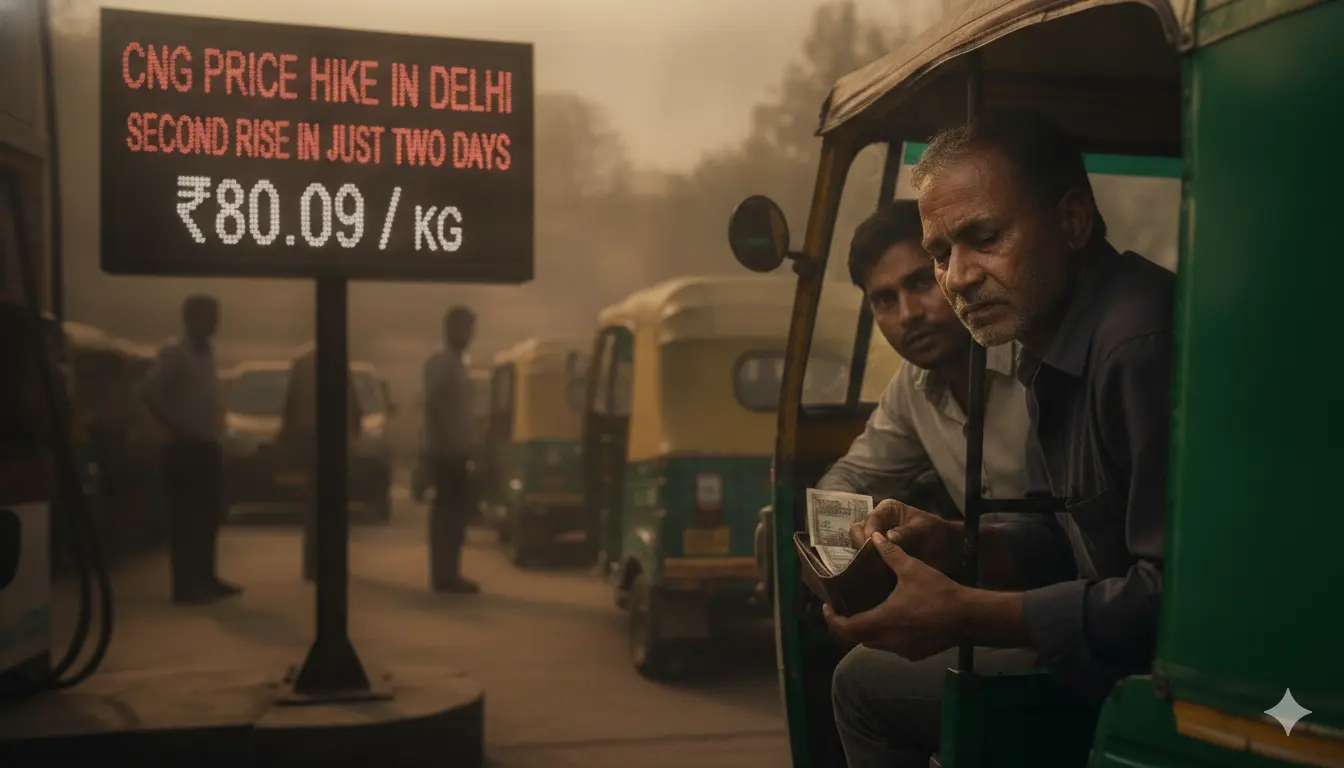
Two days, two price hikes—and your CNG bill just got heavier, again. Big deal. Delhi woke up to a second straight increase in compressed natural gas prices, a move pushing the rate to ₹80.09 per kg from ₹79.09 per kg. That stings. That might sound like just one rupee, but if you drive an auto-rickshaw or a CNG cab for a living, that one rupee per kg adds up to hundreds of rupees every single month. And this is the second time in 48 hours that the price has gone up. The first hike—from ₹77.09 to ₹79.09 per kg—came just a day before. So in two days flat, Delhi CNG has jumped by ₹3 per kg. If you're wondering why this is happening, who decides these prices, and what it means for your daily commute or business—keep reading. So what does this actually mean?
- Delhi's CNG price is now officially ₹80.09 per kg, thanks to two hikes in just two days.
- The most recent increase was Re 1 per kg, coming less than 48 hours after the previous one.
- And in Noida and Ghaziabad, you'll pay even more—CNG there now costs ₹88.70 per kg.
- The first price jump took the rate from ₹77.09 to ₹79.09 per kg just one day before this second increase.
- Look, Indraprastha Gas Limited (IGL), the main CNG supplier in Delhi-NCR, is the one that announced both price changes.
- This really hurts auto drivers, cabbies, and anyone who relies on a CNG vehicle for their daily commute.
Not something you see every day.
Why CNG Prices Even Change — Most People Don't Know This
Look, most people assume petrol and diesel prices are the ones that keep changing—that CNG was supposed to be the cheaper, stable option. Think about it. And that's exactly what made so many people switch to CNG vehicles in the first place. Facts. Delhi alone has lakhs of autos, taxis, and private cars running on CNG.
But here's something many people don't know: CNG prices aren't fixed by the government directly. Key point. They're decided by gas distribution companies—and in Delhi's case, that's Indraprastha Gas Limited (IGL). And now? IGL buys natural gas, compresses it, and then sells it to you through its filling stations. When their input cost goes up—meaning the price they pay to buy gas—they pass that on to you.
And right now, the cost of sourcing natural gas has been going up. That's real. It's tied to global gas prices, domestic allocation policies, and how much the government decides to subsidise or not. No joke. Look, the petrol and diesel prices were also revised recently—and CNG has followed quickly. So this isn't random. There's a chain reaction happening.
But the real question is—how much has this actually changed in your pocket, and is there any end in sight?
And here's why that matters.
What Actually Happened: Two Hikes, 48 Hours, No Warning
Let's lay it out clearly. Here's the full timeline of what happened in Delhi's CNG market over these two days.
- First Hike — Day 1: IGL raised CNG prices in Delhi from ₹77.09 per kg to ₹79.09 per kg. That was a jump of ₹2 per kg in one shot. This came right after petrol and diesel prices were also revised across India.
- Second Hike — Day 2: Just 24 hours later, IGL raised prices again — this time by Re 1 per kg, taking the Delhi CNG rate to ₹80.09 per kg.
- Total increase in two days: ₹3 per kg. From ₹77.09 to ₹80.09 per kg.
- Noida and Ghaziabad rate: CNG in these two cities now costs ₹88.70 per kg — almost ₹9 more than Delhi's rate for the same fuel.
- Who announced it: Indraprastha Gas Limited (IGL), the authorised gas distribution company for Delhi and parts of NCR.
- No prior announcement: And get this—both hikes came without advance notice to the public. Drivers found out at filling stations or through news alerts.
Now, IGL is a listed company on Indian stock exchanges. And more. It distributes CNG and PNG (piped natural gas for homes) across Delhi, Noida, Ghaziabad, Rewari, Gurugram, and several other areas. Wild. When IGL revises prices, it affects millions of people—not just car owners, but also households using PNG for cooking.
And this decision came right after a broader fuel price revision in India. Big shift. Mahanagar Gas Limited (MGL), which supplies CNG in Mumbai, had also raised prices around the same time—showing this isn't just a Delhi problem but a countrywide pattern. Read that again.
Wow.
But for most auto drivers and cab drivers in Delhi, this wasn't just bad news; it was double bad news. Unreal. No warning. No time to plan. Let that sit. Just a higher number on the pump meter.
The Real Picture Behind the Numbers
One rupee doesn't sound like much. Think. But think about it this way: an auto-rickshaw in Delhi runs about 150 to 200 km a day, and at around 25 km per kg of CNG, that means a driver uses roughly 6 to 8 kg of CNG daily. That's the truth. At ₹3 extra per kg—from the first hike to today—that driver's now paying ₹18 to ₹24 more every single day. Over a full month, that's ₹540 to ₹720 extra just on fuel. For someone earning ₹600 to ₹800 a day after expenses, that is a serious cut.
So cab drivers on platforms like Ola and Uber are in an even tighter spot. And? Their fares are decided by the app, not by them. Right? When fuel costs go up, they can't just charge passengers more. They absorb the loss—unless the platform revises its per-km rate, which rarely happens quickly.
From the government's side, there's no official statement yet saying relief is coming. Not anymore. The fuel price revisions—including petrol, diesel, and CNG—are being justified as a correction after a long period of stable rates. And that's big. The argument is that prices were artificially held low for too long, and companies like IGL need to recover their costs.
But from the public's side—especially daily wage earners, small transport operators, and middle-class families—this feels like a squeeze from all sides. True. Grocery prices are up. Transport costs are up. Yep. And now even the CNG vehicle that was supposed to save money is costing more.
Opposition parties have already started reacting. No joke. Several Congress leaders and AAP representatives in Delhi have called the hike anti-people and demanded a rollback. And now? They've pointed out that Delhi residents were already dealing with high costs of living, and back-to-back fuel hikes only make things worse. Whether this pressure leads to any policy change—that's still unclear.
But not for the reasons you'd expect.
How Ordinary Indians Will Feel This First
Let's be very specific about who this hits hardest. Is this really a surprise?
For Ramesh, a CNG auto driver in Delhi who ferries school kids and office workers every morning—this means cutting one meal short, or skipping a family outing this weekend. That stings. His monthly fuel bill just went up by over ₹600 without any increase in what he earns per trip. Worth it.
For a middle-class family in Noida that owns a CNG car and fills up twice a week—at ₹88.70 per kg and about 4 to 5 kg per fill—each visit now costs roughly ₹18 to ₹22 more than a week ago. Not small. That's small per visit, but over a year, it adds up to over ₹1,800 to ₹2,200 extra in fuel costs alone. Think about it.
For delivery boys using CNG two-wheelers or three-wheelers for e-commerce companies, margins were already thin. Facts. This hike shaves off more from what little they earn per delivery. Big.
And it doesn't stop at vehicles. Nobody talks about this. If you cook on a gas stove using PNG (piped natural gas from IGL), watch out. PNG prices often move along with CNG. IGL hasn't announced a PNG hike yet—but given the back-to-back CNG increases, it would be smart to keep an eye on your gas bill in the coming weeks. Period.
So what should you do right now? Read that again. If you own a CNG vehicle, track your fuel consumption for the next 30 days and calculate the actual extra cost hitting your budget. Key point. If you run a small transport business, this is the time to review your pricing—don't wait for another hike to force your hand. And if you rely on public CNG transport like autos or shared cabs, expect fares to quietly inch upwards in the coming weeks, even if not officially revised.
Think.
What to Watch For Next
The bigger question is—are more hikes coming? The honest answer? Possibly yes. Let that sit. India imports a large chunk of its gas needs, and global prices directly affect what companies like IGL pay for supply—a detail many people miss. Huge. If those prices don't come down, there's a real chance of another revision in the next 30 to 60 days.
So here are three scenarios playing out right now. The result? Best case: global gas prices cool down, IGL's input costs stabilise, and there are no more hikes for a few months. Unreal. Most likely: one more small hike of Re 1 to ₹2 per kg comes before the end of the quarter, and prices stay above ₹80 per kg in Delhi. Worst case: if global energy prices spike again—the way they did after the Russia-Ukraine conflict—CNG in Delhi could cross ₹85 or even ₹90 per kg within three to four months.
Watch for IGL's next official communication. Big deal. You should also keep an eye on the government's decision on domestic gas allocation—if the government decides to give more subsidised gas to city distribution companies, prices could soften. And that's big. That decision, when it comes, will be the real signal.
One very specific thing to track: MGL's Mumbai rates. Yep. Mumbai and Delhi tend to move together. That's the truth. If Mumbai sees another hike, Delhi almost certainly follows within days.
The kind of thing most people miss.
Frequently Asked Questions About CNG Price Hike in Delhi
What is the current CNG price in Delhi after the latest hike?
Here's the short version: The current CNG price in Delhi is ₹80.09 per kg. This is after two back-to-back hikes pushed the price from ₹77.09 to ₹80.09. Noida and Ghaziabad's rate is even higher, at ₹88.70 per kg.
Why did CNG prices go up twice in two days in Delhi?
The thing is, CNG prices aren't directly set by the government. They're controlled by Indraprastha Gas Limited (IGL). IGL's costs for buying natural gas have gone up, influenced by global markets and supply policies. So, they pass that increased cost to consumers. These two hikes happened right after a national revision of petrol and diesel prices, suggesting it's part of a broader industry adjustment.
How does the CNG price hike affect auto and cab drivers in Delhi?
Look — the impact is huge. A typical auto driver using 6-8 kg of CNG daily now spends ₹18 to ₹24 more every single day. That's an extra ₹540 to ₹720 per month, a significant hit to their income.
Will CNG prices go up again in Delhi soon?
Good question. While nobody can be certain, it's definitely possible more hikes are coming. Global natural gas prices remain volatile, and since India is a major importer, those costs affect us directly. If IGL's supply costs don't stabilize, we could see another small increase in the next 30 to 60 days. Keep an eye on prices in Mumbai; they're often a leading indicator.
What is Indraprastha Gas Limited and who controls CNG prices in Delhi?
Honestly — Indraprastha Gas Limited, or IGL, is the public-listed company that supplies and sells natural gas in the Delhi-NCR region. It's not a government body. IGL controls the retail price for both CNG (for vehicles) and PNG (for homes), basing its decisions on its own operational and sourcing costs.