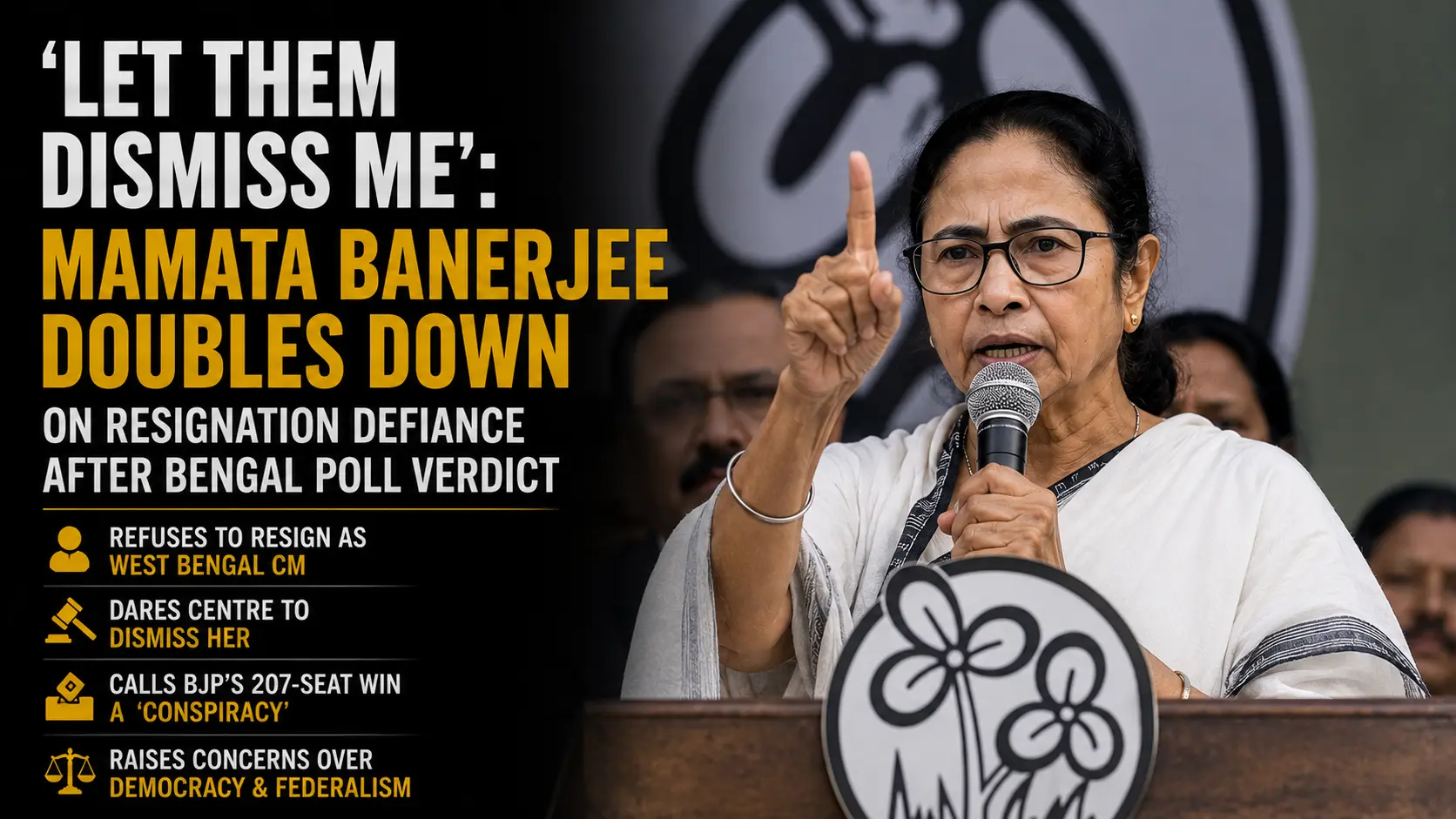
Mamata Banerjee's refusal to resign as West Bengal Chief Minister has turned into one of the most dramatic political standoffs in recent Indian state politics. Despite the BJP winning a landslide 207 seats in the West Bengal assembly elections — a result that would ordinarily compel any incumbent leader to step aside — Mamata has not only held her ground but actively dared the Centre to remove her. "Let them dismiss me. I want this to be a black day," she said, in words that now echo across the country's political corridors. This is not political theatre. This is a calculated, high-stakes gamble.
Why Mamata Banerjee's Resignation Defiance Is a Turning Point in Bengal Politics
To understand why this moment carries such enormous weight, you have to go back to how West Bengal's political identity has been shaped over decades. The state has historically been governed by powerful, ideologically rooted parties — first the Congress, then the Left Front for over three decades, and then the Trinamool Congress under Mamata herself since 2011. Her rise was not accidental. It was a hard-fought street-level battle against an entrenched left machinery. She built the TMC brand around her personal image of fearlessness, grassroots connect, and regional pride. For her to resign now, in her own reading, would be to betray that entire narrative.
The stakes here extend far beyond West Bengal's state assembly. A Chief Minister refusing to resign despite a clear electoral mandate against her party sets a constitutional and political precedent that is difficult to ignore. The BJP's 207-seat win essentially means they hold the legislative majority needed to form a government. Yet Mamata remains in office, questioning the legitimacy of the result and alleging manipulation by the Election Commission. This standoff raises uncomfortable questions about the relationship between electoral outcomes, constitutional propriety, and raw political will.
What Happened: The Key Developments in Mamata's 'Won't Resign' Standoff
The sequence of events unfolded fast. After the election results came in showing the BJP's decisive victory, political analysts and opposition leaders expected a conventional response — a graceful or even grudging concession and resignation. Instead, Mamata convened a meeting with TMC's newly elected MLAs and came out swinging. Her message was unambiguous: she would not be stepping down, not voluntarily, and not under pressure.
At the core of her argument is the claim that the result was engineered — a combination of what she describes as Election Commission bias and a BJP-driven conspiracy to systematically exclude TMC voters and intimidate polling booth workers in specific constituencies. She also pointed to what she called a "moral victory," arguing that the raw vote share tells a different story than the seat count alone. Whether or not you accept her narrative, the political impact of her stance is undeniable. It has immediately galvanised the INDIA bloc at the national level, with Bengal's TMC and allied parties closing ranks around her defiance.
- BJP wins 207 seats in West Bengal assembly elections, a result widely described as a landslide mandate for the party.
- Mamata refuses to resign as Chief Minister, calling a meeting of TMC MLAs to signal party unity and her intent to stay on.
- "Let them dismiss me" — Mamata publicly dares the Centre to invoke constitutional provisions to remove her from office.
- Allegations of electoral manipulation — She accuses the Election Commission and BJP of conspiring to manipulate the vote in key constituencies.
- INDIA bloc rallies behind her — Opposition parties at the national level have expressed solidarity with Mamata's defiance, framing it as resistance to central overreach.
- "Moral victory" claim — TMC argues that the vote share gap between BJP and TMC does not justify the massive seat differential, hinting at systemic distortion.
This is not the first time Mamata has used defiant, theatrical political language to hold the news cycle. But there is something different about this moment. The scale of the BJP's win makes her position constitutionally precarious. Ordinarily, a Chief Minister who loses majority support in the assembly is expected to resign or face a floor test. Mamata's decision to force a dismissal rather than go quietly is a strategic choice — she wants to be seen as a martyr, not a loser.
Impact and Analysis: What Mamata's Defiance Means for Indian Democracy and Opposition Politics
Let's be honest about what Mamata is doing here, and why it is politically shrewd even if constitutionally questionable. By daring the Centre to dismiss her, she transforms her exit — if it comes — from a defeat into a persecution narrative. Article 356 of the Indian Constitution, which allows the President to impose Central rule in a state, has a deeply controversial history in India. Its misuse by successive governments to topple inconvenient state governments is well-documented. Mamata knows that invoking it against her would generate national outrage, rally the opposition, and potentially boost her image as the face of federalism under attack. She is, in effect, inviting the BJP to hand her a political weapon.
At the same time, her refusal raises legitimate concerns about the health of India's democratic institutions. Elections are the foundational mechanism through which citizens express their will. When a sitting Chief Minister refuses to honour a decisive electoral verdict — regardless of the reasons offered — it risks normalising a dangerous precedent. Constitutional experts have pointed out that while there is no explicit legal timeframe within which a defeated Chief Minister must resign, the spirit of parliamentary democracy expects compliance with electoral outcomes. Mamata's move, however tactically brilliant, tests that spirit in ways that could have long-term consequences for state-level governance standards across India.
What's Next: The Constitutional Clock, BJP's Options, and Bengal's Uncertain Future
The next few days will be decisive. The BJP, holding 207 seats, has an overwhelming majority and the constitutional right to form the government in West Bengal. The Governor of West Bengal will play a pivotal role — he is constitutionally obligated to invite the party with a legislative majority to prove its numbers and form a government. If Mamata refuses to vacate the Chief Minister's office, the Governor can withdraw the invitation extended to her and formally invite the BJP's legislature party leader instead. This is the conventional constitutional route, and it does not require Presidential Rule at all. It is likely the path the Centre will pursue first, precisely to avoid handing Mamata the martyrdom narrative she is seeking.
For ordinary West Bengalis, the immediate concern is governance. A prolonged standoff at the top creates administrative uncertainty — from pending welfare scheme disbursals to law and order coordination. The state bureaucracy, already under the microscope after the election, will be watching closely for clarity on who holds authority. The coming weeks will test not just Mamata's resolve, but India's constitutional mechanisms and the BJP's appetite for a prolonged political war on the eastern front. Watch this space. Bengal has never been predictable, and it is not about to start now.
Frequently Asked Questions
Why is Mamata Banerjee refusing to resign as West Bengal Chief Minister despite BJP's election win?
Mamata Banerjee is refusing to resign because she alleges electoral manipulation by the Election Commission and BJP. She claims a "moral victory" based on vote share and has dared the Centre to dismiss her, framing her defiance as resistance to what she calls a politically engineered result against the TMC.
Can the Centre dismiss a state Chief Minister who refuses to resign after losing an election?
Yes. If the incumbent Chief Minister has lost the legislative majority, the Governor can withdraw confidence and invite the majority party to form the government. If the CM refuses to vacate office, the President can impose Central Rule under Article 356, though this route is politically sensitive and legally scrutinised.
What does Mamata Banerjee mean by saying she wants this to be a "black day"?
By invoking a "black day," Mamata Banerjee is signalling that if the Centre forcibly dismisses her, she wants it recorded as an assault on federalism and democratic norms. It is a political framing strategy designed to cast any central intervention as authoritarian overreach, building a sympathy narrative ahead of future elections.