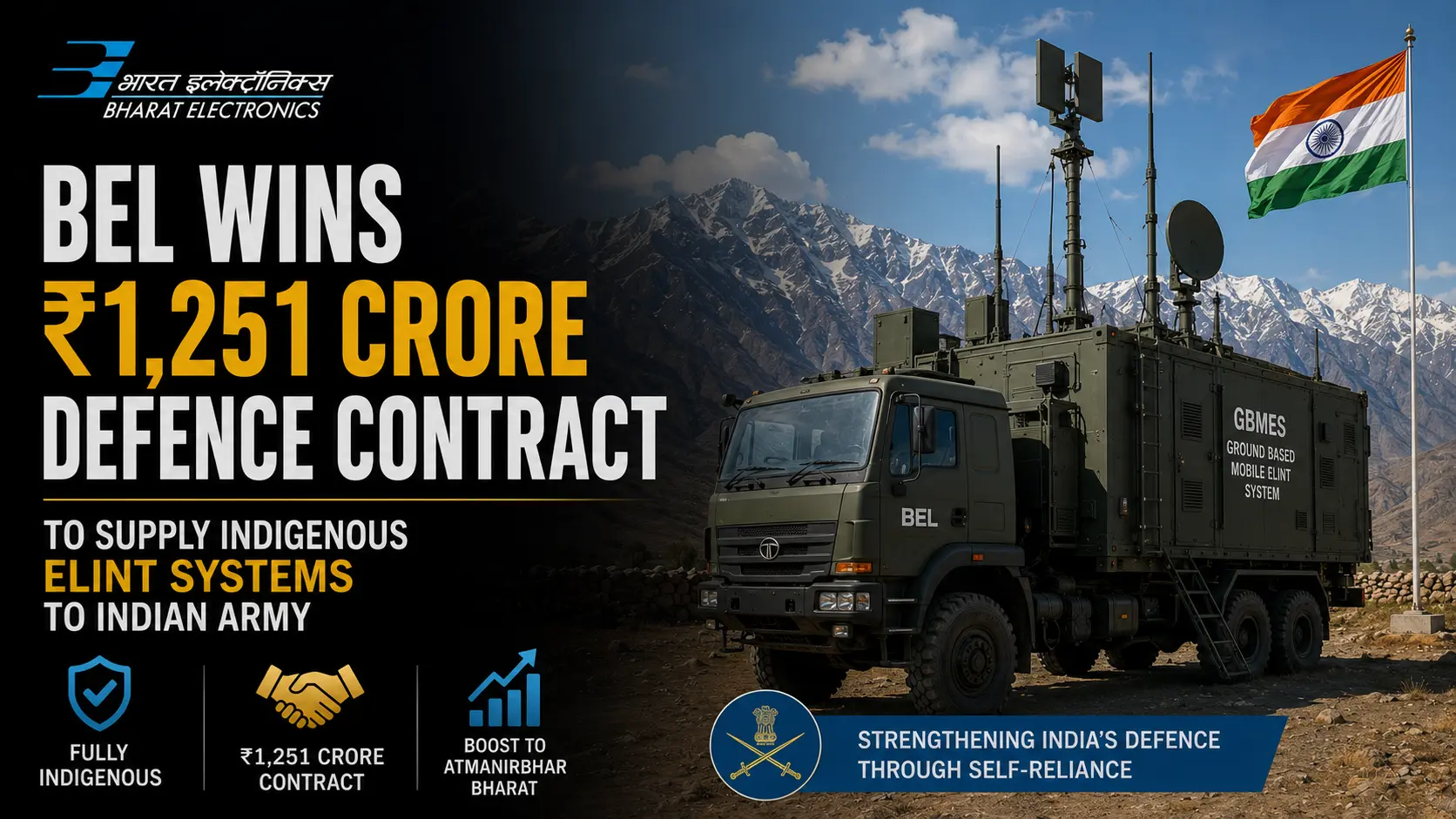
Bharat Electronics Limited's ₹1,251 crore ELINT system contract with the Ministry of Defence marks one of the most significant indigenous defence electronics orders signed in recent memory. The Navratna PSU, widely regarded as the backbone of India's defence electronics ecosystem, has secured a deal to supply its Ground Based Mobile Electronic Intelligence System — better known as GBMES — to the Indian Army. This is not just a procurement story. It is a statement about where India's military modernisation is headed, and how homegrown technology is finally stepping up to replace costly foreign imports.
Why BEL's GBMES Contract Is a Major Milestone for India's Indigenous Defence Electronics Push
For decades, India's military has relied on imported electronic warfare and intelligence-gathering systems, often at steep costs and with limited technology transfer. That dependency has slowly, sometimes frustratingly, been unwound through the government's Atmanirbhar Bharat initiative and the Ministry of Defence's push to place orders exclusively with domestic manufacturers for a growing list of platforms. BEL's latest win is a direct product of that policy shift — and it couldn't come at a more strategically relevant time, given the heightened tensions along India's northern and western borders.
ELINT, or Electronic Intelligence, is the kind of capability that doesn't make headlines but quietly defines the outcome of modern conflicts. These systems intercept, analyse, and catalogue enemy radar emissions, communication signatures, and electronic activity — building a picture of adversary capabilities before a single shot is fired. Equipping the Indian Army with a fully indigenous, mobile ELINT platform means frontline commanders will have access to real-time electronic battlefield awareness without depending on foreign vendors or facing supply chain vulnerabilities. That, in strategic terms, is a game-changer.
What the BEL GBMES Contract Covers: Key Facts and Timeline
BEL formally announced the contract through a regulatory filing on a Tuesday, confirming that the agreement had been signed with the Ministry of Defence, Government of India. The deal is valued at ₹1,251 crore excluding taxes — a substantial single-order addition to BEL's already healthy order book. The system to be supplied, the Ground Based Mobile ELINT System (GBMES), is described by BEL as a state-of-the-art, fully indigenous platform designed specifically to meet the operational requirements of the Indian Army in diverse and challenging terrain conditions.
What makes this contract particularly noteworthy is the word "totally indigenous." This isn't a system assembled from imported subsystems with a local label slapped on. The GBMES has been developed using domestic technology, which means the intellectual property stays in India, future upgrades can be managed locally, and the Army won't be held hostage to a foreign OEM's maintenance schedule or geopolitical considerations. BEL's role here isn't just as a manufacturer — it's as a technology developer and strategic partner to the Indian armed forces.
- Contract Value: ₹1,251 crore (excluding applicable taxes), signed with the Ministry of Defence, Government of India
- System Supplied: Ground Based Mobile Electronic Intelligence System (GBMES), a fully indigenous ELINT platform
- Customer: Indian Army — for deployment in field operations across varied terrain
- BEL's Status: Navratna Central Public Sector Enterprise under the Department of Defence Production
- Technology Origin: Fully indigenous development — no foreign components or licensed foreign technology
- Strategic Context: Part of India's broader Atmanirbhar Bharat push to reduce import dependency in defence electronics
This contract significantly bolsters BEL's order book, which has been on an upward trajectory over the past two years as the Ministry of Defence accelerates procurement from Indian vendors. Analysts tracking the defence PSU space have consistently flagged BEL as one of the primary beneficiaries of India's defence indigenisation drive, and orders of this scale validate that assessment decisively.
Impact and Strategic Analysis: What This ELINT Deal Means for India's Military Edge
The timing of this contract deserves careful attention. India's security environment has grown considerably more complex — the standoff in Eastern Ladakh, continued Pakistani adventurism along the Line of Control, and the broader Indo-Pacific competition all demand that the Indian Army maintain superior situational awareness. ELINT systems are central to that awareness. A mobile, ground-based system that can be rapidly deployed to forward areas gives field commanders the ability to detect, identify, and track enemy electronic emissions in near-real time — intelligence that shapes everything from artillery targeting to anti-drone operations. The fact that this system is indigenous means it can also be integrated more seamlessly with other Indian platforms, from the Akash missile system to indigenous radars currently in service.
From an economic and industrial standpoint, a ₹1,251 crore order of this nature creates substantial downstream benefits. BEL doesn't operate in isolation — it anchors a supply chain of hundreds of micro, small, and medium enterprises across India that supply components, assemblies, and sub-systems. Defence orders of this scale typically translate into sustained manufacturing activity over several years, skilled job creation, and incremental technology capability building across the ecosystem. For India's ambition to become a top-five global defence exporter by 2029, domestic orders like this one are the foundation — you can't export credibly what you haven't mastered domestically first.
What's Next: BEL's Growing Order Pipeline and the Army's Modernisation Roadmap
BEL is currently riding a strong wave of domestic defence orders, and the GBMES contract is unlikely to be the last large-ticket win this financial year. The Ministry of Defence has an extensive modernisation agenda for the Indian Army, covering everything from electronic warfare suites and communication networks to surveillance systems and counter-drone technologies. BEL, with its decades of defence electronics expertise and its expanding R&D infrastructure, is well-positioned to capture a significant share of these upcoming tenders. Investors and defence watchers should watch closely for further announcements around AESA radar systems, battlefield management systems, and communication platforms — all areas where BEL has been actively developing indigenous solutions.
For ordinary citizens and defence enthusiasts, the broader takeaway is that India's military is getting smarter and more self-reliant simultaneously. The GBMES isn't just a procurement win — it's proof that Indian engineers can design, develop, and deliver cutting-edge electronic intelligence systems that meet the exacting standards of the Indian Army. Every such contract won domestically is a contract that doesn't go to a foreign vendor, a technology that doesn't stay locked behind an export control regime, and a capability that India owns outright. That's the real value of Atmanirbhar Bharat when it actually works.
Frequently Asked Questions
What is the BEL GBMES contract and what does it involve?
BEL has secured a ₹1,251 crore contract from India's Ministry of Defence to supply the Ground Based Mobile Electronic Intelligence System (GBMES) to the Indian Army. The GBMES is a fully indigenous, state-of-the-art ELINT platform designed to intercept and analyse enemy electronic emissions on the battlefield.
What is an ELINT system and why does the Indian Army need it?
ELINT stands for Electronic Intelligence — it refers to intelligence gathered by intercepting and analysing electromagnetic signals like radar emissions and electronic activity. The Indian Army needs ELINT systems to monitor adversary capabilities, detect threats early, and support electronic warfare operations, especially along sensitive borders with China and Pakistan.
Is the BEL GBMES system truly made in India, or does it use imported components?
According to BEL's official regulatory filing, the GBMES is described as a "totally indigenous" system. This means the core technology, development, and manufacturing are entirely domestic — a significant distinction that ensures India retains full control over the platform's intellectual property, upgrades, and maintenance without dependency on foreign suppliers.