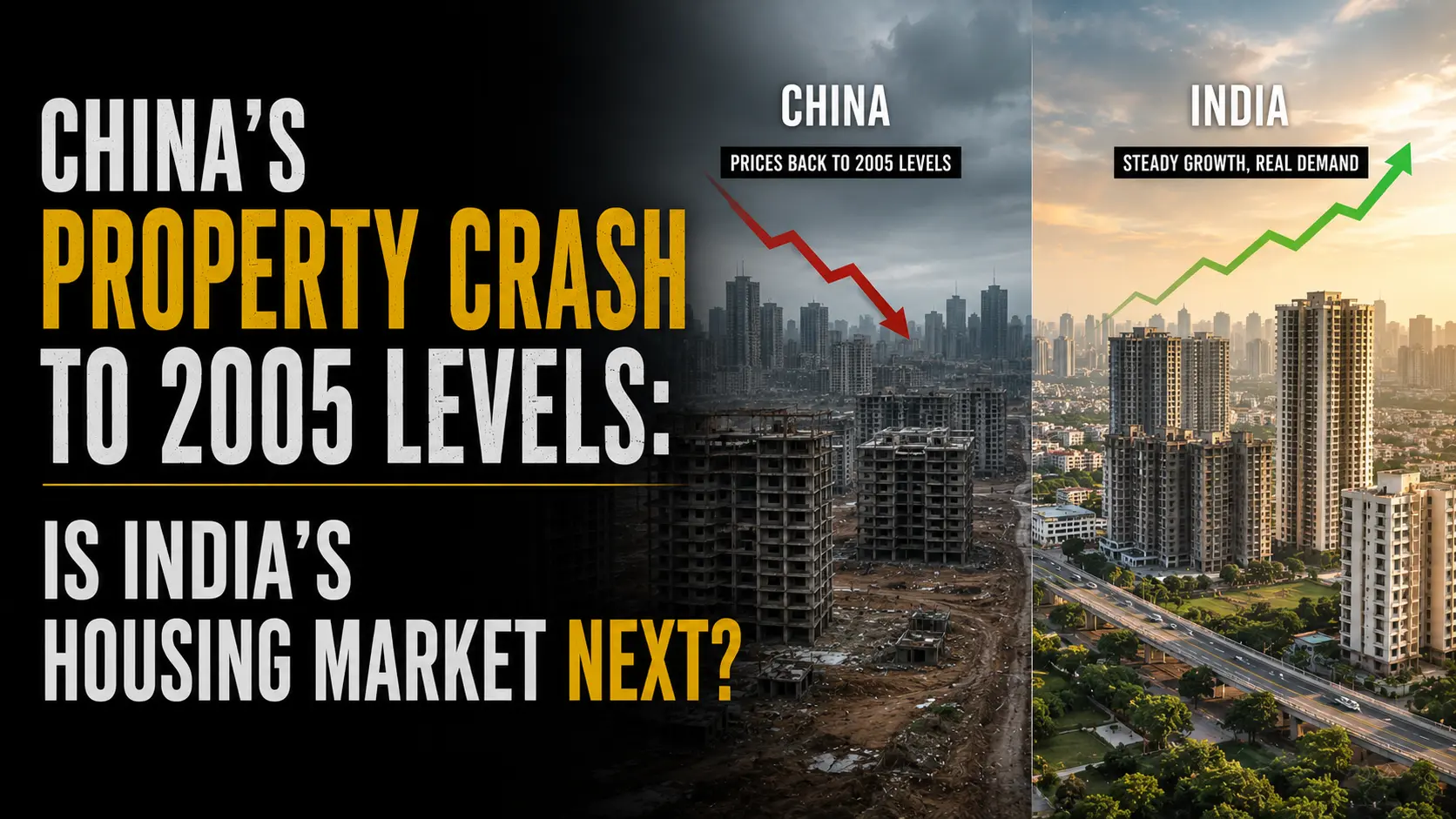
Something unexpected just happened in India's real estate market. Housing sales fell 7 percent in the first three months of 2026. Not a massive crash — but a real dip. And here is what is surprising: the reason is not what you would normally expect. It is not that Indians stopped buying homes. It is that rich Indians living abroad — NRIs — hit the pause button on their investments back home because of the war in West Asia.
For anyone thinking about buying property this year, this matters. It signals something bigger. When overseas Indians step back, it tells you the market has lost a little confidence. Not panic. Just caution. And caution in real estate spreads fast.
- Housing sales fell 7% quarter-on-quarter in Q1 2026 — dropping from 1,08,970 units worth ₹1.60 lakh crore in Q4 2025 to 1,01,675 units worth ₹1.51 lakh crore in the January-March quarter
- NRI buyers from West Asia pulled back investments — geopolitical tensions and rising oil prices made overseas Indians cautious about pumping money into Indian real estate
- Mumbai and Bengaluru still lead — these two cities together accounted for nearly half of all housing sales during the quarter
- Luxury homes actually grew despite the slowdown — showing that wealthy buyers within India kept purchasing high-end properties even as overall market cooled
- New project launches stayed steady — developers launched 1,26,265 new residential units in Q1 2026, up 26% year-on-year, suggesting confidence in future demand
- Rising construction costs added pressure — oil price spikes in March especially made construction more expensive, further dampening buyer enthusiasm
The Numbers Tell a Story Nobody Expected
Let us walk through what actually happened in the first quarter of this year. Across India's top seven cities — Delhi, Mumbai, Bengaluru, Hyderabad, Chennai, Pune, and Kolkata — property sales slowed down. 101,675 housing units were sold worth ₹1.51 lakh crore. Compare that to the quarter before (October-December 2025), when 108,970 units worth ₹1.60 lakh crore moved. That 7 percent dip might sound small. But in rupees, it is a loss of ₹9,000 crore in transaction value. That is enough to build 15 state-of-the-art hospitals.
Here is the key insight nobody is talking about loudly enough: this slowdown is not spread evenly. Some cities held up better than others. Mumbai and Bengaluru — India's money centres — still grabbed 48 percent of all housing sales in the quarter. That is nearly half the entire market. But even these strong cities felt the chill. It rippled through the whole system.
Who Actually Stopped Buying and Why
The real story sits with one specific group: NRI buyers. These are Indians settled in Gulf countries like UAE, Saudi Arabia, Kuwait, and Oman. They have money. They want to invest it back home. And they have been a huge part of India's real estate boom for the last ten years.
But something shifted in January 2026. The conflict in West Asia created uncertainty. Oil prices jumped. When oil prices climb, construction costs follow automatically — cement gets expensive, steel gets expensive, labour costs rise. And when your home becomes more expensive to build, buyers think twice.
Plus there is the psychological factor. An NRI sitting in Dubai hears about tensions. They ask themselves: Should I be investing my money abroad right now? Or should I hold back and wait? Most chose to wait. This hesitation from overseas investors directly triggered the 7 percent drop. Because NRIs typically buy in the luxury and high-end affordable segments — the segments that drive valuations higher.
The Luxury Market Tells a Different Story
Now here is where it gets interesting. While overall sales fell, something odd happened at the top of the market. Luxury homes — properties priced above ₹2 crore typically — actually sold well. In fact, they boomed.
Why? Because wealthy people inside India kept buying. They were not spooked by the West Asia situation. For them, real estate remains a solid investment. They see property as long-term security. And they have the money to not care about short-term market jitters. So while NRIs paused, domestic ultra-high-net-worth individuals accelerated. The market simply shifted. Not shrunk.
But this creates an imbalance. When only the luxury segment grows and the middle-income segment slows, the market becomes lopsided. Not healthy. Most Indians buy homes in the ₹50 lakh to ₹1.5 crore range. That is where the real market lives. And that is where the slowdown hit hardest.
What This Means for You If You Are Thinking About Buying
So you are a 35-year-old software engineer in Bangalore. You have saved for a down payment. You have been watching property prices. Now the market is softening a bit. What does this actually mean for you?
First — prices might hold steady or even come down slightly in the next quarter or two. Sellers facing lower demand sometimes become more flexible on price. Not a crash. Just slightly better negotiating position for buyers. If you have been on the fence about pulling the trigger, this might be the quarter to seriously start looking.
Second — banks are careful. When the market shows weakness, lenders become stricter about loan approvals. Make sure your credit score is clean. Make sure your income documents are solid. Because getting a home loan approval in a cooling market takes longer than in a hot market.
Third — construction costs are actually lower right now than they were in December 2025. If you are buying under-construction property or planning to build, this is the time to negotiate with developers. They are feeling the pressure too and are more willing to discount.
But here is the caution: do not expect prices to drop 20-30 percent. That is not happening. This is a slowdown, not a crash. Expect 5-8 percent negotiation room. Not more. And if you are buying for the long term (more than seven years), market timing matters less anyway. Buy for the location and the property, not for the quarterly numbers.
What Developers Are Actually Doing Right Now
Developer activity tells you a lot. In Q1 2026, new project launches grew 2 percent quarter-on-quarter and 26 percent year-on-year. That is significant. Developers launched 1,26,265 new residential units across the top seven cities.
This is an interesting signal. Developers are not panicking. They are not freezing new projects. In fact, they are launching more than they did a year ago. Why? Because they are betting that this slowdown is temporary. They are betting that the West Asia situation will cool down. They are betting that NRI confidence will return.
That is actually good news for you as a buyer. It means choice will stay high. Too many projects chasing buyers keeps prices honest. When supply gets tight, prices jump. Right now, supply is healthy.
The Real Question: Is This the Bottom or Just the Beginning?
Markets are psychological. Numbers matter, but sentiment matters more. Right now, sentiment is cautious. Not negative. Cautious. And there is a difference.
Real estate experts are watching three things closely. First — how long does the West Asia tension last? If it cools by Q3 2026, NRI confidence returns quickly and the market rebounds. Second — what happens to oil prices? Every $10 drop in crude makes construction cheaper and faster. Third — what does the Reserve Bank of India do with interest rates? If RBI cuts rates, loan EMIs fall and buying becomes easier.
Most experts believe this slowdown is a blip, not a trend. The property market is fundamentally sound. India is still urbanising. Young people still need homes. Companies are still expanding offices. All the long-term drivers are intact. This West Asia situation is real, but it is not permanent.
Frequently Asked Questions About Housing Sales and NRI Investment
What exactly is driving the slowdown in housing sales right now?
Simply put, NRI buyers from Gulf countries have paused their investments into Indian real estate because of geopolitical tensions in West Asia. Rising oil prices are also making construction more expensive, which makes property pricier and less attractive. It is not a permanent shift — just caution from overseas investors mixed with higher building costs.
Which cities are getting hit the hardest by this slowdown?
No single city is getting hammered. The slowdown is spread across India's top seven metros. Delhi, Mumbai, Bengaluru, Hyderabad, Chennai, Pune, and Kolkata all experienced lower sales. Mumbai and Bengaluru held up better because they have strong domestic (non-NRI) buyers. Mid-tier cities actually performed relatively better than expected.
Should I wait to buy a home or buy now given this market situation?
If you are buying to live in the home for more than five years, buy now. Market slowdowns actually give better negotiating power. Developers and sellers are more flexible. If you are speculating for quick profits, wait. But genuine homebuyers should treat this market as a chance, not a warning sign.
Is the luxury real estate market also affected by this slowdown?
No — luxury homes actually grew during this period. Ultra-wealthy Indians kept buying high-end properties. Only the middle-income segment (₹50 lakh to ₹1.5 crore range) felt the slowdown most. This shows that domestic wealth still drives the top end of the market.
When will NRI buyers likely return to the Indian market?
Experts expect NRI confidence to recover once West Asia tensions ease and oil prices stabilise. This could happen in Q2 or Q3 2026. Until then, expect the market to move on domestic buyers alone. Developers are not panicking because they are betting on recovery within 4-6 months.
What to Watch For in the Coming Months
Three dates matter. First — watch the news from West Asia. Any ceasefire announcement or escalation will immediately affect market sentiment. Second — watch crude oil prices. Every drop below $70 per barrel makes construction cheaper. Third — watch the Reserve Bank’s interest rate decisions in April, June, and August 2026. A rate cut changes everything for borrowers.
One more thing: don’t get fooled by hype. Some agents and builders will use this slowdown to create false urgency — “Prices are falling, buy now!” That is marketing talk. Prices are actually stable. What is happening is a pause in momentum. A pause creates opportunity, not crisis.
If you are seriously considering a home purchase, get your finances ready this quarter. Get loan approval in principle. Get your documents ready. Because when NRI confidence returns and the market speeds up again, you want to be ready to move fast. That is when good properties get taken off the market quickly.