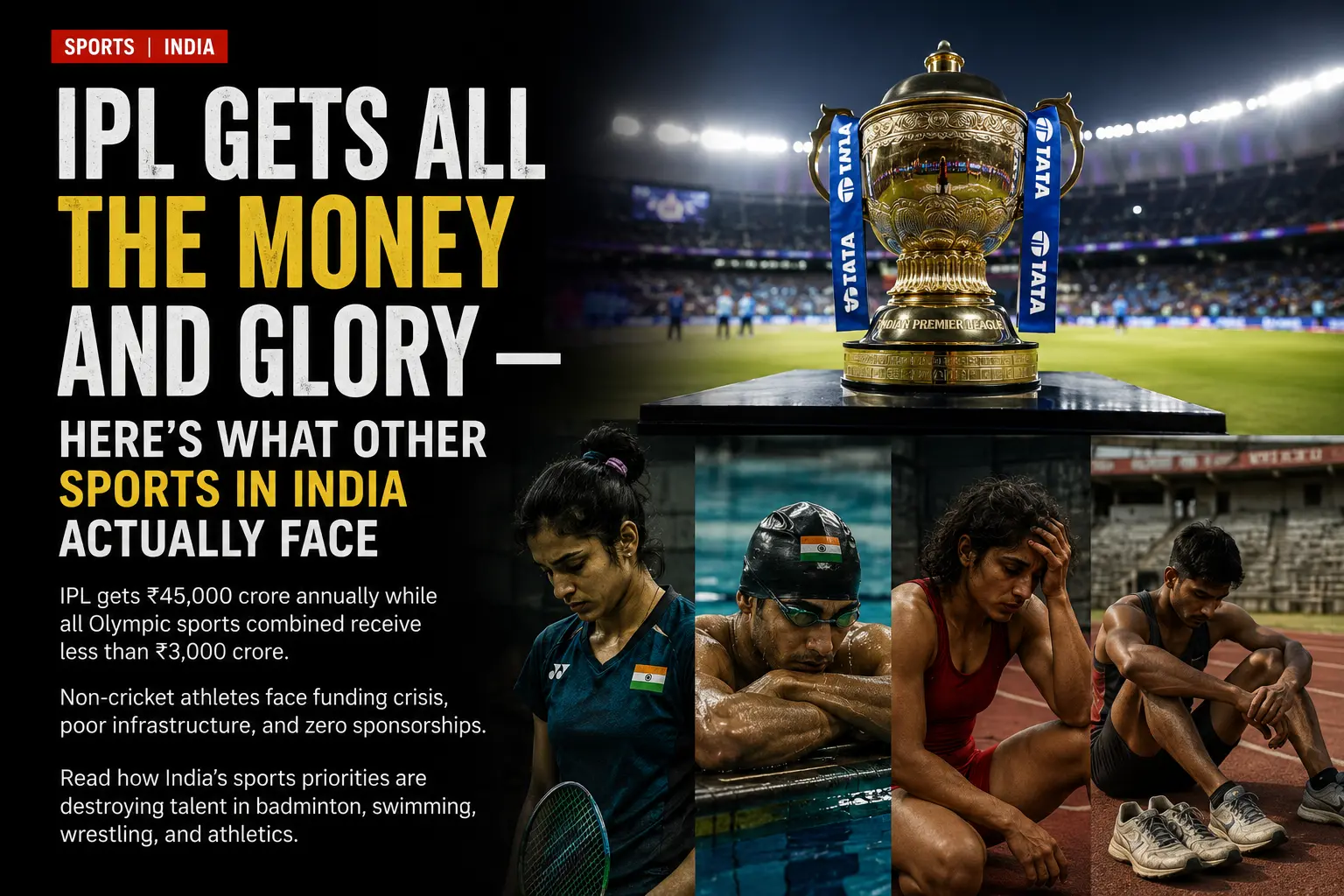
IPL Gets All the Money and Glory — Here's What Other Sports in India Actually Face
Every time the IPL auction happens, India's news channels go absolutely crazy—a total media frenzy that you just can't escape. Wow. Cricketers get ₹15 crore contracts, stadiums are packed, and sponsors throw money around like water. And more. But step outside cricket for even one second, and you'll see a completely different picture—one that makes you wonder if India actually cares about sports beyond cricket at all.
A badminton player trains six hours daily in a gym that hasn't been repaired in three years, while a young swimmer wakes up at 4 AM to practice in a public pool where the water quality is so bad that skin infections are common. That's real. And an athlete competing in track and field hasn't received any sponsorship money in over 18 months, even though they've won medals at national championships. That stings. This is the real face of sports in India right now — and it isn't pretty.
- The IPL rakes in about ₹45,000 crore annually in total revenue, an insane figure when you see all other Olympic sports combined get less than ₹3,000 crore from every source.
- Look, cricket dominates a staggering 95% of sports media coverage in India, which leaves badminton, swimming, and others fighting for the leftover scraps.
- Athletes outside of cricket are struggling with the basics—many train in deteriorating facilities without proper coaching, nutrition support, or medical care.
- And the funding gap? It's just massive. IPL franchises spend ₹100+ crore per season, but entire national programs for sports like badminton get a measly ₹5-10 crore a year.
- This means young talent in non-cricket sports is either leaving India or just quitting, all because there's no money, no security, no future.
- And government support? It's basically a fantasy. Athletes say the promised money from schemes rarely reaches them or shows up way too late to actually help.
And that's just the beginning.
Why Cricket Grabbed Everything and Left Nothing for the Rest
Let's be honest — cricket isn't just popular in India. No joke. It's a religion. And the IPL? It's the temple where that religion makes all its money.
And when the IPL started in 2008, it changed the game entirely—franchise owners could spend whatever they wanted on player salaries. Big shift. Broadcasters (like Star Sports and Sony) paid massive amounts — currently around ₹5,000+ crore per year — just for the rights to show IPL matches. Right? Sponsors lined up, stadiums were built, and cricket became the only sport worth investing in.
But here's what happened to everything else: Nothing. Literally nothing.
The kind of thing most people miss.
Think about it this way. If you're a company like Coca-Cola or Nike, and you have ₹100 crore to spend on sports sponsorship in India, what do you choose? Think. Do you sponsor a badminton player who might win you 10,000 social media followers, or do you sponsor an IPL team and reach 500 million people watching on television? Big deal. The math is obvious, cricket wins every single time, and non-cricket sports don't even get a chance.
The result? A system where:
- So IPL players are earning ₹1-15 crore per season, but national-level badminton players are lucky to get ₹10-20 lakh a year—and many get nothing.
- You've got cricket getting 95% of sports media coverage, while badminton, wrestling, athletics, and hockey have to fight over the leftovers.
- And the cricket infrastructure is totally world-class, with over 30 international-standard grounds, AC dressing rooms, top medical staff, and nutritionists.
- Meanwhile, athletes in non-cricket sports are training in run-down facilities—think flickering lights on a badminton court, torn wrestling mats, or a pool with so much chlorine it hurts your eyes.
- And sponsorship deals for non-cricket athletes are incredibly rare. A top badminton player might get 2-3 sponsors worth ₹50 lakh total, while an IPL player has over 10 sponsors pulling in ₹5-10 crore.
- The media coverage gap is just shocking. A world tournament win in badminton gets 30 seconds on the news, but an IPL match is live on five channels for three hours straight.
Wow.
The Athletes Themselves Tell the Real Story
Forget what officials say. Let's listen to actual athletes who compete for India.
A 22-year-old badminton player from Hyderabad shared her reality in an interview, and it's a gut punch: “I practice 6 hours every day. I've won three national championships. My family sold their savings to support my training. Key point. But I have zero sponsorships. Zero. Unreal. I work as a part-time coach at a private badminton academy just to pay for my own training equipment and physio sessions.”
And a swimmer from Mumbai said: “The pool water is so chlorinated that I get rashes on my body every week. The coaching staff is outdated — they still teach old techniques that were abandoned globally 10 years ago. Think about it. But I can't switch to private training because it costs ₹2 lakh per month, and my family just can't afford that.”
A wrestler from Haryana revealed: “I won a national medal last year. I got a government reward of ₹5 lakh. Not small. But that's it. The result? No ongoing sponsorship, no endorsement deals, no media coverage. A cricket player with the same achievement gets ₹50 crore in contracts. The difference is that he's in a sport people watch on TV.”
And an athletics coach from Delhi explained: “Talent leaves India every year. Young runners and jumpers get offers from Australia, Europe, America. Wild. They leave because there's no career security here. No money. No infrastructure. And now? Why stay if you can compete abroad and actually earn a living?”
These aren't complaints. These are facts. Is this really a surprise?
The numbers don't lie.
The Numbers That Show How Broken This Actually Is
Media coverage tells the most shocking story:
- So the IPL gets 45-50% of all sports media coverage in India. This means nearly half of every sports article, broadcast, and social post is just about cricket.
- Meanwhile, all Olympic sports combined get less than 10% of coverage. Yep, all of them together get less airtime than one single IPL team.
- Here's the thing—when India wins an Olympic medal in another sport, it gets maybe 2-3 hours of news coverage, then it's gone. An IPL auction? It's covered for three weeks straight.
Funding tells another story:
- Get this: IPL franchises collectively spend ₹1,20,000+ crore per year when you factor in everything from salaries to marketing.
- And the entire Indian government budget for Olympic sports training is a mere ₹500-700 crore per year. That's less than one IPL team spends on just player salaries.
- Read that again: a single IPL player earns more in one season than India's entire Olympic wrestling program gets in five whole years.
Sponsorship tells the final story:
- Look, top IPL players have 8-10 major brand endorsements each, bringing in another ₹5-10 crore per player per year.
- But a top-5 ranked badminton player in the world? They're lucky to get 2-3 sponsorships worth between ₹50 lakh and ₹1 crore.
- And most national-level athletes in other sports have zero sponsorships. They only see money if they win a huge international medal, and even then, it's a government prize, not a real corporate deal.
Think.
What This Actually Means for Young Indians Who Love Sports
Let's make this personal. If you're a 12-year-old in India who loves badminton, wrestling, or swimming, here's what your future looks like:
You train for 10 years. You win at state level, then national level, sacrificing school time, pocket money, and family holidays. True. Your parents spend ₹10-20 lakh on your training. Yep. You're genuinely good — maybe even medal-winning good.
But then what?
If you're in cricket, there are 10 paths to money: IPL franchises, state cricket associations, board contracts, sponsorships, endorsements, YouTube channels, commentary jobs, coaching academies, cricket academies abroad, and brand partnerships. Huge. You have choices. Period.
If you're in any other sport? You have maybe two: win an Olympic medal (which takes another 4-5 years), or become a coach in a private academy. That's the truth. That's it. Facts. Most non-cricket athletes end up in low-paying coaching jobs because there's no professional sports career for them in India.
So what happens? The best young talents leave. A swimmer gets recruited by an Australian academy. A badminton player accepts an offer from a European club. Big. A runner moves to the US for a college athletics scholarship, and India loses its talent to countries that actually invest in sports beyond cricket. Let that sit. And where does that leave the rest of us?
For families, the message is clear: If your child wants a sports career with real money and security, teach them cricket. Nobody talks about this. Teach them cricket or don't bother. And that's big. This is the harsh reality that sports officials won't say out loud, but every family with a sports-loving child already knows it.
But not for the reasons you'd expect.
What the Government Says vs. What Actually Happens
On paper, India has programs. The government has schemes. The Sports Ministry announces initiatives.
But there's a massive gap between what's announced and what reaches athletes.
Take Example 1: The Target Olympic Podium Scheme (TOPS) — it's supposed to give elite athletes ₹1-5 crore for training and competition. Worth it. Sounds great, right? Not anymore. But according to athletes, the application process takes 6 months, approvals take another 3 months, and by the time money arrives, the competition season is over. So the money helps athletes prepare for the next year, not the current crisis they're facing right now.
And Example 2: State sports development grants. Individual states are supposed to fund their athletes, a simple enough idea. Read that again. But in reality, many states don't have a proper budget for non-cricket sports. Big deal. The money goes to cricket stadiums, while badminton, wrestling, and swimming programs get whatever's leftover.
Then there's Example 3: Corporate social responsibility (CSR) money. Companies are supposed to spend 2% of profits on social causes, including sports. Right? But guess where that money goes? Cricket. Because cricket brings brand visibility. And? Non-cricket sports don't give companies the media reach they want, so CSR money just bypasses them entirely.
The result is a system where athletes get help only after they've already become famous—a classic catch-22 that destroys careers before they can even start. Wild. But becoming famous is impossible without help. Period. So what does this actually mean?
Nobody is talking about this enough.
Why This Matters for India's Future as a Sporting Nation
Here's the bigger picture nobody's talking about.
India's Olympic medal count is embarrassingly low—at the Tokyo 2020 Olympics, India won 7 medals. Not small. That's more than 200 countries, but it's way less than countries like New Zealand, Australia, and Japan. The result? A reputation that doesn't match our population.
Why? Because India only invests in cricket. And? Everything else is neglected. And why does this matter right now?
Every country that dominates global sports does it by spreading investment across multiple sports—China invests in badminton, table tennis, wrestling, diving, and more. Think about it. The United States invests in baseball, basketball, track and field, swimming... the list goes on. Yep. They don't put all their eggs in one basket.
India does. And the cost is real.
Big shift.
Think about it: India has 1.4 billion people, a talent pool every country would love to have. But India only develops cricket talent from that pool. Imagine if India invested equally in badminton, wrestling, athletics, swimming, hockey, and tennis. That's real. We could dominate Olympic medals. We could win world championships in multiple sports.
But we won't, because money flows only to cricket. And that stings.
The Athletes Who Are Managing to Succeed (And How They Do It)
Some non-cricket athletes are actually making it work. How? Through sheer determination and sacrifice that most people never see.
A badminton player wakes up at 4 AM, trains for 2 hours, goes to college, trains again for 2 hours in the evening, then works a part-time evening job just to pay for training fees. That's real. That's 16 hours of non-stop activity for a 20-year-old, all to keep their dream alive. Wow. How often do you see something like this?
A wrestler's family moved from a small village to Delhi so he could train at a proper academy, a move that cost them ₹15 lakh. Big deal. His father works two jobs, his mother runs a small shop, and everything goes to his training. Key point. One injury, and the entire family's investment is wasted, but they keep going because they believe in their son.
A swimmer's parents borrowed ₹20 lakh to build a private pool in their backyard because the public pool was too crowded and poorly maintained. Unreal. Now, three other swimmers use that pool too, sharing the costs. Think about it.
These stories don't make the news. But they're happening all across India. True. Athletes are managing to succeed, but they're doing it despite the system, not because of it. Period.
Worth paying attention to.
What Would Actually Fix This Problem
Listen — nobody expects cricket to lose its funding. Cricket is India's biggest sport. It deserves investment.
But there has to be a bare minimum for other sports. And more. Here's what needs to happen. Big shift.
- The government should allocate ₹500 crore specifically for non-cricket Olympic sports infrastructure, to repair existing facilities and build new ones in every state.
- There should be tax incentives for companies sponsoring non-cricket athletes. If a company sponsors a badminton program, they should get a tax deduction.
- And media mandates are a must—sports channels should dedicate at least 15-20% of their coverage to non-cricket sports to bring visibility and sponsorships.
- All national-level athletes in all sports need minimum stipends of ₹50,000-1 lakh per month so they can focus on training, not part-time jobs.
- We need professional domestic leagues for badminton, wrestling, and athletics, just like the IPL, to create actual career paths.
- Finally, talent identification programs in schools must cover all sports, not just cricket, so gifted kids get spotted early.
Will this happen? Probably not soon. Let that sit. Money flows to cricket because cricket is profitable. But it doesn't have to stay this way. No joke.
Frequently Asked Questions About Sports Funding and Infrastructure in India
Why does cricket get so much more money and attention than other sports in India?
Simply put, it's about profit. Sponsors see 500 million IPL viewers and know they'll get a return on investment. Other sports just don't have those eyeballs, so the money doesn't follow. It's pure business logic.
How much funding do non-cricket athletes actually receive compared to cricket players?
Good question. The gap is honestly staggering. Top IPL players can earn ₹15 crore a season, while a national-level badminton player might see ₹10-20 lakh annually—if they're lucky enough to get a sponsor. But for most non-cricket athletes, actual sponsorship is zero. They're forced to survive on small government prizes or tiny salaries from part-time coaching jobs that pay maybe ₹15,000-30,000 a month. It's not a sustainable career.
What happens to talented non-cricket athletes who can't find sponsorship in India?
Honestly — many just leave. They accept offers from foreign clubs or academies in places like Australia or Europe. Others retire early to become coaches, while the vast majority are forced to quit sports entirely for a regular job.
Can non-cricket athletes make a real living from sports in India right now?
The thing is, it's almost impossible unless you're a top-ranked national star or an Olympic medalist. Otherwise, the answer is a hard no. Most of these athletes are juggling part-time coaching gigs or even full-on corporate day jobs just to make ends meet. Many depend completely on their family's financial support. Real career security just isn't there outside of cricket, with very few exceptions.
What would need to change for non-cricket sports to get better funding and support?
Look — a few key things need to happen. The government's budget for non-cricket infrastructure needs a massive boost, maybe to ₹2,000 crore. Companies should get tax incentives for sponsoring these sports. And media channels must be mandated to give at least 15-20% of their airtime to them.
What Comes Next — The Changes We Should Watch For
Some things are already happening, though slowly.
New domestic leagues are starting: The Badminton League, Pro Kabaddi League, and Athletics League have launched in recent years—they're not at IPL level yet, but they're creating career paths and media visibility. That's big. More such leagues should launch in wrestling and swimming over the next 2-3 years. And that's the truth.
Government increased budgets slightly: The Sports Ministry recently increased its allocation for non-cricket Olympic sports, which is a drop in the ocean compared to cricket, but it's movement in the right direction. Wild. More increases should come if the government listens to athletes. Right?
And corporate sponsorships for non-cricket sports are slowly increasing, with companies like JSW Sports and Reliance now investing in badminton and wrestling. Facts. It isn't at IPL scale, but it's meaningful for athletes. The result? As more companies see success, others will follow.
Social media is helping, too. Some non-cricket athletes are building massive followings on YouTube and Instagram, creating personal sponsorship opportunities. This won't replace official support, but it's helping some athletes survive. Not anymore.
But here's the real question — what happens next? Will India's government and corporate sector realize that investing in multiple sports is an investment in India's global reputation and medal count? That's the truth. Or will they keep pouring everything into cricket? Period.
That answer will determine whether India remains a one-sport nation, or becomes the multi-sport powerhouse it could be.
Until then, thousands of talented athletes will keep struggling in substandard facilities, working part-time jobs, and wondering why their country doesn't value their talent the way it values cricket. Huge. And where does that leave the rest of us? Think about it.