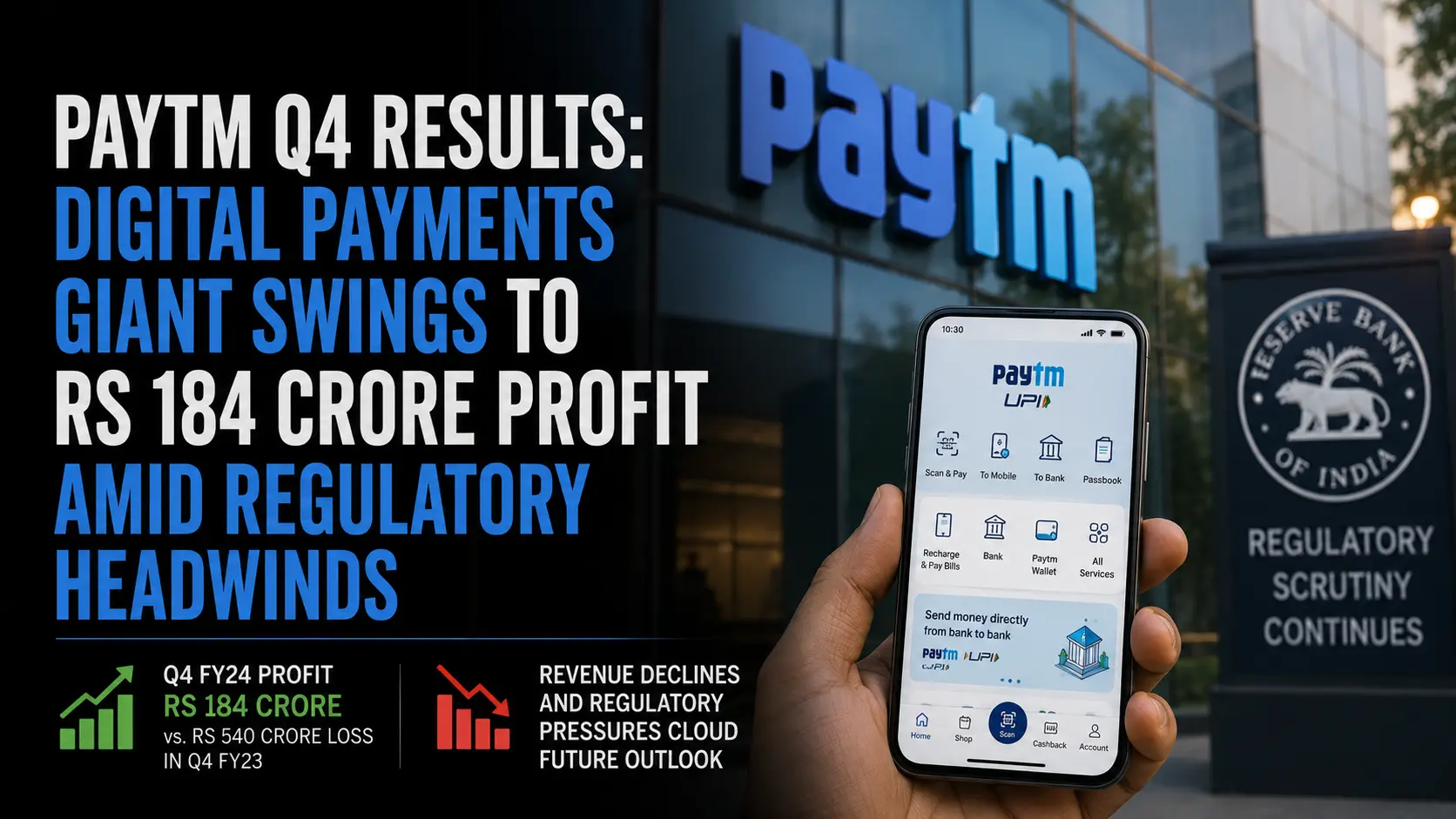
Paytm's turnaround story just got a significant plot twist. One 97 Communications, the company operating India's largest digital payments platform, reported a consolidated net profit of Rs 184 crore in the fourth quarter of FY24, reversing a staggering loss of Rs 540 crore in the same quarter the previous year. This dramatic swing marks a watershed moment for a fintech firm that has battled regulatory scrutiny, banking license restrictions, and shifting market dynamics since its catastrophic IPO debut in November 2021. For millions of Indian users dependent on Paytm's wallet, payment gateway, and merchant services, this recovery signals that the company may finally be stabilizing after years of turbulence.
Why Paytm's Profitability Shift Matters for India's Fintech Ecosystem
The broader context here reveals tensions simmering beneath India's digital payments revolution. When the Reserve Bank of India issued a show-cause notice to Paytm Payments Bank in 2023, citing regulatory breaches, it sent shockwaves through the startup world. The RBI's action wasn't just about compliance failures; it symbolized deepening regulatory skepticism toward fintech companies operating in the gray zones between payments, lending, and financial services. For Indian consumers and merchants who had grown comfortable with Paytm's convenience, this regulatory blow felt like betrayal. Yet it also forced the company to fundamentally rethink its business model and operational discipline.
Understanding Paytm's recovery requires zooming out to see how India's fintech sector is maturing. Unlike the early days when growth-at-all-costs was the mantra, regulators and investors now demand sustainable, compliant business models. Paytm's journey from loss-making darling to struggling giant to potentially profitable operator reflects this industry-wide evolution. For Indian households and small businesses reliant on digital payments, this stability matters tremendously—it means the payment rails they depend on are likely to remain operational and secure.
What Changed: Key Developments in Paytm's Q4 Performance
The financial turnaround didn't happen overnight. Several critical developments converged to push Paytm toward profitability. First, the company transitioned its payments business away from the RBI-restricted Paytm Payments Bank to alternative channels, including partnerships with other banks and NPCI's UPI infrastructure. This pivot, though forced, actually reduced certain compliance burdens. Second, Paytm aggressively cut costs across marketing, employee headcount, and unprofitable verticals—a painful but necessary restructuring. The company exited lending and insurance distribution in certain regions to focus on core competencies.
However, the path to profitability came with trade-offs. Operating revenues in Q4 fell 16 percent year-on-year to Rs 1,912 crore, signaling that growth didn't drive this profit swing—efficiency and cost discipline did. Transaction volumes remained strong across UPI and merchant services, but average revenue per user stagnated. The company's total operating loss of Rs 549.60 crore in one reporting period versus the Rs 184 crore profit in another reflects different accounting methodologies and one-time adjustments rather than consistent operational improvement, a critical distinction investors must grasp.
- Net Profit Achievement: Consolidated net profit of Rs 184 crore in Q4 FY24, compared to a loss of Rs 540 crore in Q4 FY23—a remarkable 724 crore rupee swing
- Revenue Contraction: Operating revenues declined 16 percent year-on-year to Rs 1,912 crore as the company prioritized profitability over top-line growth
- Business Transition: Payment services shifted away from the restricted Paytm Payments Bank to partner banks and UPI, reducing regulatory friction
- Cost Restructuring: Significant reductions in marketing spend, workforce optimization, and exit from unprofitable verticals like lending
- Valuation Reality Check: At 8.5x FY23 revenue multiple, Paytm requires Rs 139,000 crore in earnings capacity—a sobering metric showing the company still faces a long runway to justify its IPO valuation
- Market Sentiment: Stock price dipped 6 percent on the announcement despite profit numbers, indicating investor skepticism about sustainability
What's striking here is the gap between headline profitability and operational reality. The Rs 184 crore profit likely includes favorable adjustments and reduced loss-making from exited businesses rather than genuine, recurring operating profits from core services. For retail investors who bought Paytm shares at Rs 2,150 during the IPO and watched them crash to around Rs 500 levels, this quarter offers hope but not redemption.
Impact on Indian Digital Payments Users and Merchants
For India's 500+ million digital payment users, Paytm's stabilization means continued access to one of the country's most ubiquitous payment platforms. Millions of kirana stores, auto-rickshaw drivers, and neighborhood shops depend on Paytm's QR codes and merchant services for daily transactions. If Paytm had collapsed or been forced to shut operations by regulators, the disruption to India's digital payments infrastructure would have been severe. While competitors like PhonePe and Google Pay have grown stronger, Paytm's survival keeps competition healthy and prevents monopolistic concentration in UPI-based payments.
The regulatory lessons embedded in Paytm's story carry implications beyond the company itself. India's fintech ecosystem has learned that growth without compliance governance invites intervention. For small business owners and gig workers relying on payment platforms, Paytm's brush with the RBI and subsequent restructuring signals that platforms must operate transparently, maintain proper segregation of customer funds, and avoid regulatory arbitrage. The Rs 139,000 crore earnings capacity needed to justify the company's current valuation remains a daunting target, but at minimum, Paytm has proven it won't disappear overnight. That stability, though modest, matters to merchants and users who need reliable infrastructure.
What Lies Ahead: Paytm's Path to Sustainable Profitability
The burning question now is whether Paytm can sustain and grow these profits without returning to unprofitable growth experiments. The company has three critical priorities. First, it must stabilize merchant acquisition and retention on UPI despite operating through partner banks rather than its own payments bank. This removes direct customer relationships and creates friction. Second, diversification into credit and lending—which drove growth before the RBI crackdown—must happen carefully within regulatory bounds. Fintech startups globally have learned that payments alone don't generate venture-scale returns; financial services expansion is necessary but risky. Third, Paytm must prove that its cost structure is sustainable, not artificially engineered for one quarter.
Looking at the competitive landscape, Paytm faces entrenched rivals. PhonePe's UPI market share has grown to rival Paytm's, while Google Pay and WhatsApp Pay continue expanding. Unlike Paytm, these competitors aren't burdened by equity investors demanding IPO-scale returns. For Indian users, this competition is healthy—it drives innovation and keeps fees low. But for Paytm shareholders who invested betting on monopoly-like dominance, the reality is tougher. The Rs 8.5x revenue multiple shows the market pricing in significant execution risk. Recovery will require not just quarterly profits but sustained growth, margin expansion, and proof that India's digital payments market can support Paytm's ambitions without regulatory conflict.
Frequently Asked Questions
Did Paytm really make a profit in Q4, or is this accounting manipulation?
Paytm reported a consolidated net profit of Rs 184 crore in Q4 FY24, but investors should note this swung from losses due to cost-cutting and exiting unprofitable businesses rather than revenue growth. Operating margins improved through discipline, not through increased customer spending, making the profit partially structural rather than operationally sustainable without future cost reductions.
Why did Paytm's stock price drop if the company is profitable?
The 6 percent stock decline reflects investor skepticism about whether profitability is durable. With revenues falling 16 percent and the company needing Rs 139,000 crore in earning capacity to justify its valuation, markets see profitability as a one-time adjustment rather than evidence of a thriving business model. The profit came from efficiency, not growth—a red flag for equity holders.
What does Paytm's recovery mean for digital payments competition in India?
Paytm's stabilization means it won't exit the market, preserving competition against PhonePe, Google Pay, and WhatsApp Pay. However, the regulatory restrictions on its payments bank ensure it operates differently than competitors, making it harder to offer proprietary financial services. For users, this means continued choice but potentially fewer integrated services from a single Paytm app than originally promised.
Can Paytm return to growth without violating RBI regulations?
Paytm can grow payments volumes through partner banks and UPI, and can expand carefully into regulated lending, insurance, and wealth management. However, growth will be constrained compared to the pre-RBI action period when the company operated with more regulatory flexibility. Sustainable growth requires balancing ambition with compliance—something Paytm is learning the hard way.
Is it safe to use Paytm for payments and savings after the RBI controversy?
Yes. The RBI's action was about governance and compliance, not customer fund safety. Paytm's payment and wallet services remain operational and secure. However, customers should avoid keeping large balances in the Paytm wallet and instead use it for transactional purposes. For savings and lending products, compare Paytm's offerings against traditional banks and other fintech platforms before committing significant capital.