Title: TCS Q1 FY27 Results Lift IT Stocks: Why Analysts Are Bullish Despite AI Fears
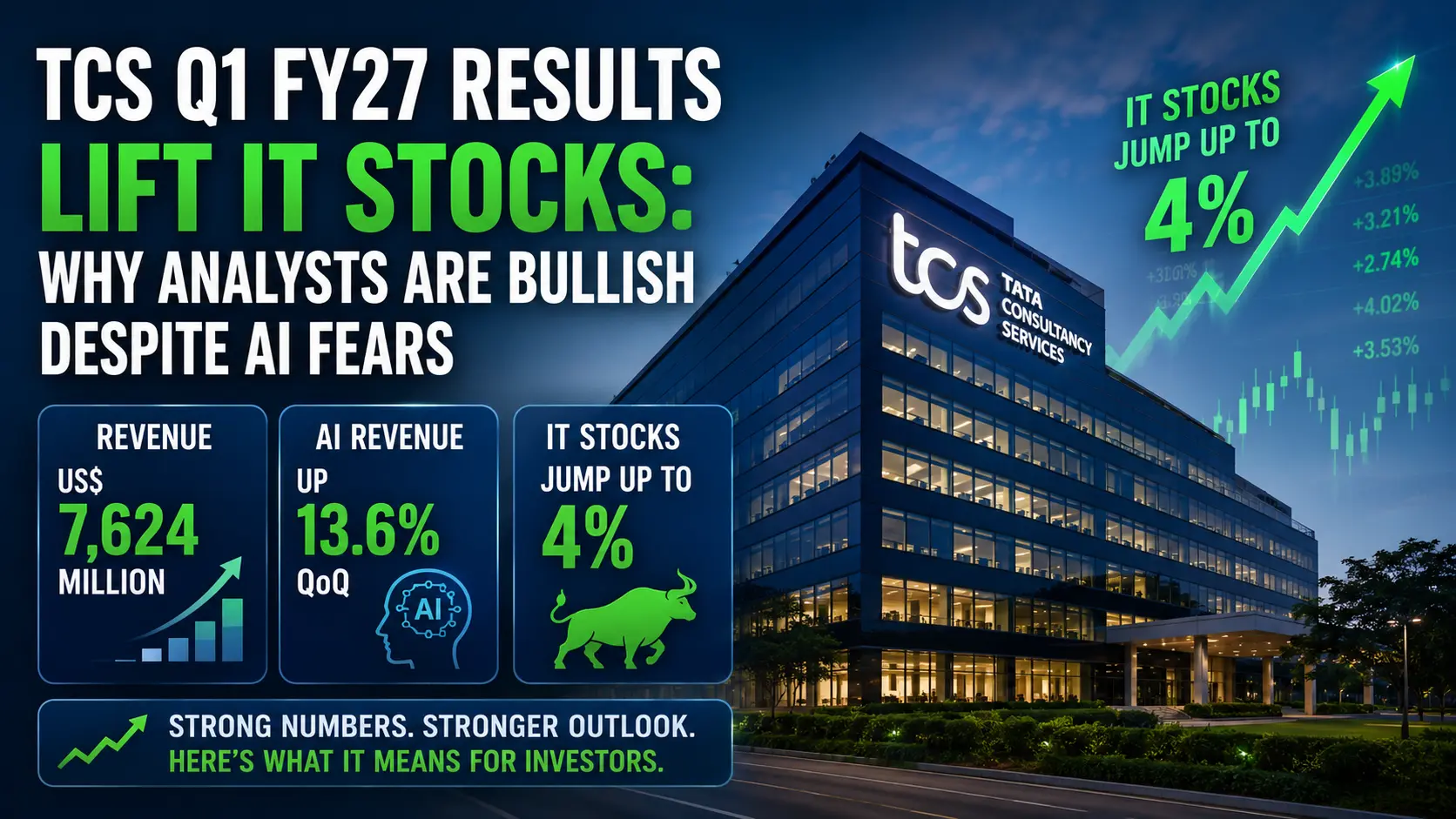
Nobody really expected TCS to start FY27 this quietly — and then surprise everyone anyway. Unreal. On July 9, 2026, India's largest IT company reported quarterly revenue of US$ 7,624 million for Q1 FY27, a growth of 2.7% year-on-year in dollar terms. The headline number looked modest. Not small. But buried inside — annualised AI revenue hitting US$ 2.6 billion, up 13.6% quarter-on-quarter — and the market woke up fast. Within hours, shares of Infosys, Wipro, HCL Technologies, and Tech Mahindra all climbed, with some jumping as much as 4%. So why is the Street suddenly feeling better about Indian IT — even while AI disruption anxiety hasn't gone anywhere?
- TCS reported Q1 FY27 revenue of US$ 7,624 million — up 2.7% year-on-year in dollar terms, flat quarter-on-quarter.
- Annualised AI revenue at TCS reached US$ 2.6 billion in Q1 FY27, a jump of 13.6% over the previous quarter.
- TCS declared an interim dividend of ₹12 per share for Q1 FY27.
- Operating margin came in at 24.0% and net margin at 19.2% for the quarter, according to TCS's official IFRS results.
- IT stocks including Infosys (NSE: INFY), Wipro (NSE: WIPRO), HCL Technologies (NSE: HCLTECH), and Tech Mahindra (NSE: TECHM) rose up to 4% after TCS results.
- Brokerages turned more optimistic, pointing to resilient margins, improving deal pipelines, and AI-led transformation as key reasons to stay invested.
Why the Indian IT Sector Was Already Walking a Tightrope
The past several quarters haven't been comfortable for Indian IT. Discretionary tech spending — the kind where a global bank or retailer says “let's modernise our entire data stack” — dried up as interest rates stayed high in the US and Europe. Companies paused big transformation projects. Not anymore. And then came the louder worry: if AI can write code, manage workflows, and automate testing, what exactly is the Indian IT industry selling anymore?
That fear isn't imaginary. It's real and it's been sitting on every earnings call for the last six quarters. No joke. The sector — which employs over 50 lakh people directly across India, with massive campuses in Bengaluru, Hyderabad, Pune, and Chennai — was waiting for a quarter that could tell a cleaner story. TCS's Q1 FY27 results, at least partially, gave the sector that story.
So the question every retail investor, mutual fund manager, and IT professional in India is now asking: is this a real turning point, or just a brief exhale before the next round of anxiety? And now? The answer, as it almost always is in markets, is complicated. But let's break it down properly.
Nobody is talking about this enough.
What TCS Actually Reported — The Numbers That Moved Markets
Here's what we know: TCS's official press release dated July 9, 2026, showed the company's consolidated financial results for the quarter ending June 30, 2026 as follows:
- Revenue: US$ 7,624 million — flat quarter-on-quarter, up 2.7% year-on-year in US dollar terms. In constant currency terms, sequential growth came in at 0.4%.
- Annualised AI Revenue: US$ 2.6 billion — this is the number that turned heads. Huge. A 13.6% jump over the previous quarter signals that TCS isn't just talking about AI; it's billing for it at scale.
- Operating Margin: 24.0% — healthy, and in line with what analysts had pencilled in. Margins are the one thing the Street watches most carefully in IT, because they signal whether the company's managing costs while growing.
- Net Margin: 19.2% — solid, and a mark of operational discipline even in a muted revenue environment.
- Interim Dividend: ₹12 per share — declared for Q1 FY27. For a retail investor holding TCS shares, that's real cash arriving in their account.
- Multiple AI transformation deals won — TCS's press release specifically highlighted continued momentum in AI-led transformation projects, including a deal to modernise Enento Group's IT infrastructure and digital workplace.
TCS's management has positioned this quarter as the beginning of a broader AI-led growth cycle. Think about it. The deal wins — while specific financial values weren't all disclosed — signal that global enterprises are now spending again, just differently. They want AI built into their systems, not bolted on. And that's where India's IT majors see their next decade of business.
Immediately after the results, the broader Indian IT index responded. Infosys, Wipro, HCL Tech, and Tech Mahindra all saw their share prices move higher — some by as much as 4%, according to market reports. The sentiment shift was fast and visible. Big shift.
Worth paying attention to.
What Analysts Are Actually Saying — and What They're Not
Brokerages turned optimistic after TCS's Q1 print. The bull case rests on four pillars, and it's worth understanding each one clearly — because not all of them are equally strong. Right?
First, margins held. A 24% operating margin in a quarter where revenue growth was modest tells you that TCS managed its workforce costs tightly. That's good news for the sector overall, because it means the profitability model isn't broken — even if topline growth is slow. And that's big.
Second, AI revenue is real and growing fast. US$ 2.6 billion annualised isn't a rounding error. It's a number that proves large enterprises are now writing actual cheques for AI-led work — not just running pilots. The 13.6% quarter-on-quarter jump is steep. If that trajectory holds even half as strongly over the next few quarters, the AI fear narrative starts to look like an opportunity narrative instead. Wild.
Third, valuations look more attractive than they did a year ago. IT stocks had a rough ride through FY26 as the sector re-rated downward. That means investors buying today are getting in at lower prices relative to earnings than those who bought in the bull run of FY22-23. Worth it.
Fourth, deal pipelines are improving. Healthy deal wins — even in a quarter with flat sequential revenue — suggest that future quarters have bookings to convert into revenue. In IT, today's deal win is next year's revenue. Key point.
But here's what the more cautious voices are saying, and they deserve equal time. Discretionary spending hasn't fully recovered. Companies in the US and Europe are still selective about which big transformation projects they greenlight. And the AI displacement concern — that AI tools will shrink the headcount needed to deliver the same output — hasn't been resolved, it's just been temporarily outweighed by optimism about AI-led new deals. And?
Year-on-year, TCS's dollar revenue grew 2.7%. That's real growth, but it's not the 8-12% clip the sector was used to in its high-growth years. The honest analyst view is: things are getting better, but the sector isn't back to where it was. This is recovery, not revival. At least not yet. Period.
The kind of thing most people miss.
What This Means for You — the Investor, the IT Professional, the Curious Reader
If you hold IT stocks — directly or through mutual funds — this quarter is good news, but it doesn't mean you should rush in or rush out. Here's the real picture for different kinds of people. True.
For a retail investor in Ahmedabad or Nagpur who has IT stocks as part of a long-term SIP portfolio: the ₹12 dividend from TCS is actual income. The margin stability suggests the underlying business is healthy. The AI revenue growth is a genuine tailwind. But don't read the 4% single-day jump in Infosys or Wipro as a signal to double your position — one good quarter doesn't erase the structural uncertainties still swirling around the sector. That's real.
For an IT professional at a mid-level company in Hyderabad or Pune: the improving deal pipeline at TCS is a leading indicator for the broader sector. When TCS wins large AI transformation contracts, smaller IT vendors and service providers often get subcontracts or see their own pipelines improve. That said, if your company is in a practice area that AI is actively replacing — basic testing, routine code reviews, templated analytics — the pressure on headcount and roles isn't going away. That stings.
For a first-time investor trying to make sense of all this: think of it this way. TCS is like the temperature gauge for India's IT sector. When TCS runs a good quarter, it usually means the air is clearing for the rest — Infosys (NSE: INFY), Wipro (NSE: WIPRO), HCL Tech (NSE: HCLTECH), Tech Mahindra (NSE: TECHM). This quarter, the gauge moved in the right direction. Not dramatically, but clearly. Yep.
The ₹12 per share dividend also matters more than it sounds. TCS has a massive shareholder base — including millions of retail investors through mutual funds. That cash payout is a signal of confidence from management. Companies that are worried about their own future don't hand out dividends this consistently. Big deal.
And here's why that matters.
What to Watch For Next — The Real Signals That Matter
The IT sector's next few months will be shaped by a handful of things worth tracking closely. And more.
First, Infosys's own quarterly results — expected shortly after TCS — will tell us whether the optimism is sector-wide or specific to TCS's deal mix. Infosys has historically been a more aggressive growth forecaster; what it says about FY27 guidance will carry real weight. The result?
Second, the pace of AI deal conversions. TCS reporting US$ 2.6 billion in annualised AI revenue is one thing. Seeing that number grow to US$ 3 billion or beyond in Q2 FY27 would confirm that AI is genuinely a new revenue engine, not just a relabelling of existing work. That's the truth.
Third, the macroeconomic backdrop in the US and Europe. Indian IT is a services export industry. Most of its revenue comes from large enterprises in America and Western Europe. If those economies slow down again, discretionary spending freezes first — and IT budgets get cut before anything else. Let that sit.
Three scenarios are worth keeping in mind. Best case: AI deals accelerate, discretionary spending recovers in the second half of the calendar year, and IT companies exit FY27 with 6-8% dollar revenue growth. Most likely: AI revenue grows steadily, overall growth stays in the 3-5% range, and the sector grinds higher slowly. Worst case: macro headwinds return, deal closures slow down, and the modest revival of Q1 FY27 doesn't carry forward. Think.
Right now, the market's pricing the middle scenario — which is why IT stocks moved up but didn't explode. That's actually a sane reaction. Watch Infosys's numbers next. They'll tell you a lot about whether this quarter was a signal or just a blip. Big.
But not for the reasons you'd expect.
Frequently Asked Questions About TCS Q1 FY27 Results and IT Stocks
What did TCS report in Q1 FY27 and why did it matter?
Honestly — TCS reported quarterly revenue of US$ 7,624 million for Q1 FY27, with 2.7% year-on-year growth in dollar terms. What excited the market most was annualised AI revenue of US$ 2.6 billion — up 13.6% over the previous quarter. Combined with a healthy 24% operating margin and ₹12 dividend, these results beat cautious expectations.
Why did Infosys, Wipro, and other IT stocks rise after TCS results?
Here's the thing: TCS is seen as the bellwether of Indian IT, and its performance often sets the tone for the entire sector. When TCS delivers a better-than-expected quarter — especially on key metrics like margins, AI deal wins, and overall revenue stability — investors interpret this as a positive signal for the broader industry. Infosys, Wipro, HCL Tech, and Tech Mahindra all saw their share prices move up to 4% because the market took TCS's numbers as strong evidence that the worst of the IT slowdown might be behind us, indicating potential for wider sector recovery. This suggests that the market's confidence in the Indian IT landscape is improving, and other companies might soon follow TCS's lead.
Is AI helping or hurting Indian IT companies right now?
Good question. The honest answer is that AI is doing both. It's creating new, significant deal opportunities, as clearly seen in TCS's rapidly growing AI revenue segment. But it's also compressing the number of people needed for many routine IT tasks. Companies that can effectively sell AI-led transformation projects to global clients are winning new business and expanding their service offerings. Conversely, those firms or practice areas focused solely on lower-value, routine work are facing real pressure on headcount and roles. For now, the larger, more adaptable players seem to be navigating this dual impact better than smaller, less specialized firms.
Should retail investors buy Indian IT stocks after these results?
Look — don't make a decision based on one quarter's results alone. While the positive signals from TCS — including margin stability, strong AI revenue growth, and improving deal pipelines — are genuine and certainly encouraging for the sector, several critical factors remain. Discretionary spending hasn't fully recovered globally, and there are still significant macroeconomic risks in key markets. If you already hold IT stocks through SIPs or mutual funds, there's no immediate reason to panic or change your long-term strategy. However, if you're considering a fresh entry into the market, it's always advisable to speak to a SEBI-registered financial advisor first to align any investment with your personal financial goals and risk tolerance. Nobody talks about this enough.
What is the latest update on TCS's dividend and when will investors get it?
The thing is, TCS declared an interim dividend of ₹12 per share for Q1 FY27, as announced on July 9, 2026, alongside its quarterly results. The exact record date for eligibility was part of the official announcement by the company. Investors holding TCS shares (BSE: 532540, NSE: TCS) on that specified record date will receive this payout directly in their linked bank accounts through the standard dividend distribution process, typically within a few weeks of the announcement. This consistent dividend payout demonstrates management's confidence.
Investment Disclaimer: This article is for informational purposes only and doesn't constitute investment advice. Stock market investments are subject to market risks. Past performance isn't indicative of future results. Please consult a SEBI-registered financial advisor before making investment decisions.