Title: 7,948 Assam Schools Lack Enough Teachers — What the Numbers Hide
Nearly 8,000 schools across Assam are running without enough teachers. Not small. Not marginally short — structurally, critically short, in ways that the Right to Education Act explicitly prohibits. That's real. And buried inside that number is another one: 2,670 government primary schools in the state have just one teacher each. One person. For every subject, every class, every child who shows up hoping to learn something that day.
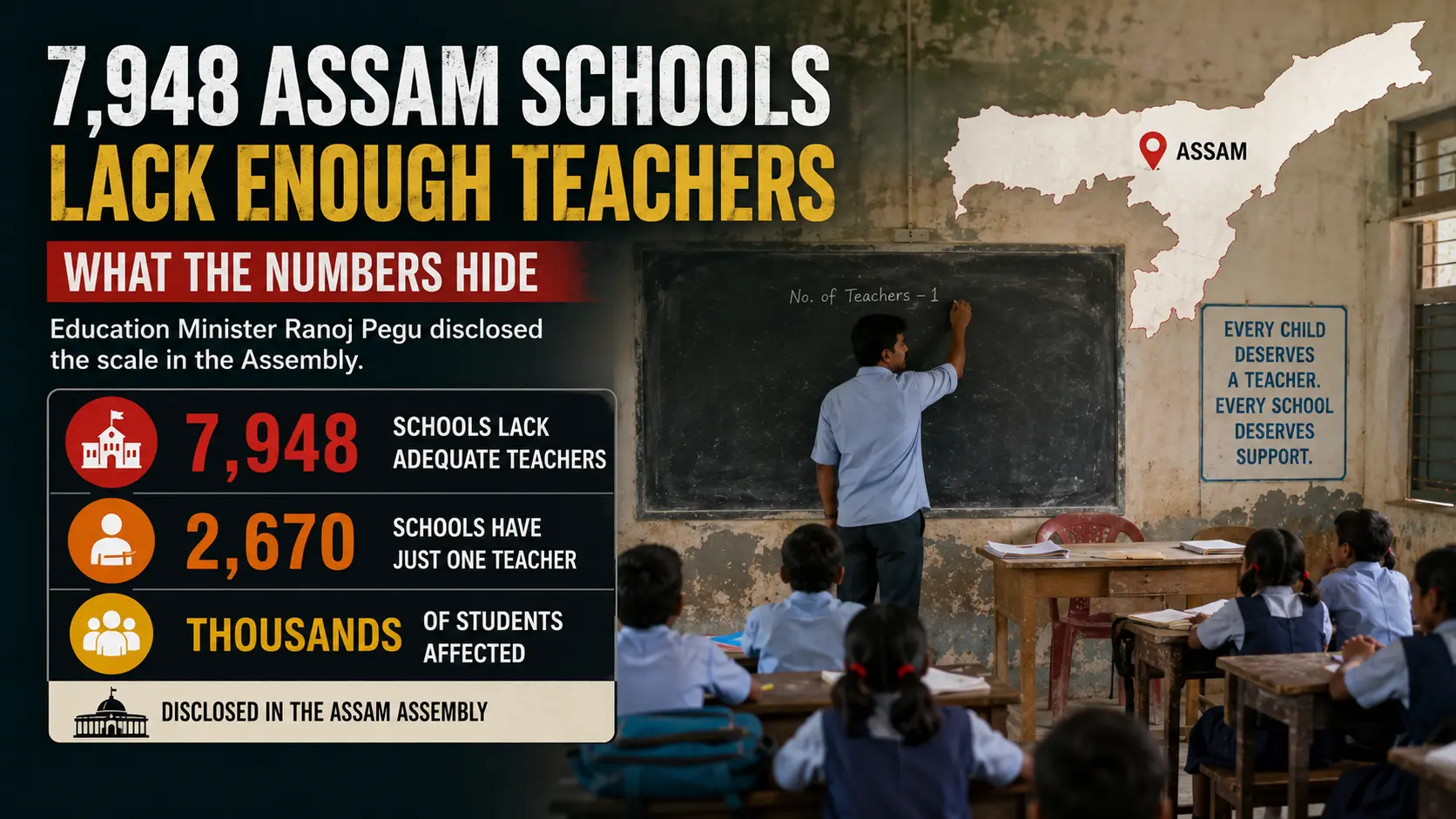
- 7,948 schools in Assam don't have an adequate number of teachers, according to Education Minister Ranoj Pegu's statement in the Assam Assembly.
- 2,670 government primary schools in the state operate with only a single teacher — one person managing an entire school.
- The number of schools falling short of the pupil-teacher ratio prescribed under the Right to Education (RTE) Act stands at 12,731, according to ministerial data shared in the Assembly.
- Children in affected schools — spread across rural and semi-urban Assam — face classrooms with no subject specialists, no backup when a teacher is absent, and no real path to learning at grade level.
- Assam has previously recorded that 70,000 children dropped out of school, a number officials have described as alarming even as the trend showed some decline.
- No official deadline or teacher recruitment timeline has been announced by the state government for resolving the shortage.
The Law Says One Thing. Assam's Schools Say Another.
The Right to Education Act — the law Parliament passed to guarantee free, compulsory schooling for every child between six and fourteen — lays down a clear pupil-teacher ratio. It isn't a suggestion. It is a legal standard. True. But across Assam, 12,731 schools aren't meeting it, according to figures Education Minister Ranoj Pegu shared with the Assam Assembly.
Think about it — what does that number mean in practice? A child sitting in one of these schools doesn't get a teacher for every subject. Doesn't get someone who can stay back and explain a concept. Doesn't get the basic guarantee the law promises. And in 2,670 of those schools, there's just one teacher — handling every class, every age group, every subject, every single day.
Here's the thing — this isn't a new problem. Nearly 70 per cent of schools in Assam had been found to lack a satisfactory pupil-teacher ratio as prescribed under the RTE Act, according to earlier data reported by the Times of India. The crisis has been documented. Big. Discussed. Debated in the Assembly more than once. And yet, 7,948 schools still don't have what the law says they must.
So here is the question worth sitting with: if the problem is this well-documented, why are the numbers still this large?
The numbers don't lie.
What the Assam Assembly Was Actually Told
Education Minister Ranoj Pegu didn't bury these figures. He stated them in the Assam Assembly — on the record, in response to questions about the state of government schools. What he said, stripped of any official language, is this: thousands of schools across Assam are operating in violation of central education law, and the scale of the problem is wider than most people realise. Unreal.
- 7,948 schools: the number Education Minister Ranoj Pegu told the Assam Assembly don't have an adequate number of teachers
- 2,670 schools: government primary schools with only a single teacher — a figure Pegu had shared previously, and which forms the sharpest edge of the larger crisis
- 12,731 schools: the number that fall short of the pupil-teacher ratio required under RTE norms, according to the minister's statement in the Assembly
- 70,000 children: the number recorded as school dropouts in Assam — a figure officials have described as alarming, even as the overall trend showed some decline
- The RTE Act: the central law that sets the legal minimum for teacher deployment in government schools — a standard thousands of Assam schools aren't meeting
- No recruitment deadline: the state government hasn't announced a specific timeline for filling teacher vacancies or resolving the shortage
What came immediately after these disclosures in the Assembly is what tends to happen with education data in India — acknowledgement without urgency. The numbers went into the record. They didn't go into a fixed plan with a fixed date. Period.
And here's why that matters.
One Teacher, Thirty Children, Zero Backup
Here's the thing — this is the part that deserves more attention than it gets. A single-teacher school isn't just understaffed. It is functionally broken as an educational institution. Wow. When that one teacher is sick — which happens — school stops. When that teacher has administrative work — which is constant in government schools — school stops. When that teacher has to conduct an exam for one class, every other class sits idle.
For a child in Class 3 in a single-teacher primary school somewhere in rural Assam, this is what school looks like. You show up. Sometimes your teacher is there. Sometimes they're not. When they are, they're managing four or five different classes in the same room, cycling between age groups, unable to give real time to any one of them. You don't get homework explained. You don't get a concept re-taught if you missed it. You fall behind. Eventually, for tens of thousands of children across Assam, you stop coming at all. That stings.
That isn't a policy failure in the abstract. That is a child's future narrowed before it had a chance to open. No joke.
The government's own data shows 70,000 children have dropped out of Assam's schools. The link between teacher shortages and dropout rates isn't a theory. It is a pattern — documented across states, confirmed by researchers, and visible in every district where classrooms run on skeleton staff. A child who can't follow a lesson because the teacher is managing three other classes at the same time isn't going to keep coming back. Wild.
Nobody is talking about this enough.
Who Actually Feels This — And How
For a parent in a village in Barpeta or Dhubri, the conversation about pupil-teacher ratios and RTE norms doesn't happen in those words. What they see is simpler and more devastating: their child comes home from school having learned nothing new that day. Again. And the next day. And the week after. And?
For the lone teacher running one of Assam's 2,670 single-teacher primary schools, the workload is something most people in cities can't picture. Teaching every subject to every class. Maintaining attendance records. Filling midday meal registers. Handling infrastructure complaints. Doing the administrative work that every government school generates. All of it. Alone. Every day. For whatever salary a primary school teacher in Assam earns — and it isn't a salary that attracts people to remote postings voluntarily. Key point.
The children who suffer most aren't in Guwahati. They're in the districts furthest from government attention — where schools are sometimes the only public institution in a village, and where a dysfunctional school leaves children with no alternative. Private schools cost money most of these families don't have. Home tutoring isn't an option. The government school, understaffed and under-resourced, is it. And right now, for 7,948 schools, even that option is falling short of what the law guarantees. That's big.
What should you do if your child is in one of these schools? First — know your rights. The Right to Education Act gives parents the legal standing to demand adequate teacher deployment. School management committees, which are mandatory under the RTE framework, can formally raise this with district education officers. It won't fix the problem overnight. But it creates a paper trail. And paper trails, in India's education bureaucracy, eventually produce action — when enough of them pile up. Yep.
Think.
What Comes After the Assembly Statement
The figures Pegu shared in the Assembly are now on record. That matters — but only if something follows. Assam isn't the first state to acknowledge a teacher shortage in the legislature and not the first to leave it unresolved for years afterward. The question now is whether this disclosure leads to a recruitment drive, a redeployment of teachers from overstaffed urban schools to understaffed rural ones, or simply another round of data collection before the next Assembly session. And now?
Three scenarios are realistic. Best case: the state announces a targeted teacher recruitment notification, prioritising the 2,670 single-teacher schools, and begins filling vacancies before the next academic year. Most likely: a committee is formed, district-level data is collected again, and the recruitment process moves through the state's standard slow cycle — taking months, possibly longer. Worst case: the numbers stay in the Assembly record, no timeline is set, and the same figures appear again in a future session as evidence that nothing changed. Big shift.
What to watch for: whether the Assam government issues a fresh teacher recruitment notification, whether single-teacher schools are given priority in any deployment plan, and whether the state moves to redeploy teachers from schools with surplus staff — a mechanism the RTE framework allows but states rarely use quickly. These are the specific signals that'll tell you if this Assembly disclosure becomes policy or just another statistic.
Nearly 8,000 schools. One law. And a generation of children who can't afford to wait for the answer. Big deal.
Worth paying attention to.
Frequently Asked Questions About Assam's Teacher Shortage
What is the pupil-teacher ratio required under the Right to Education Act?
Here's the short version: The RTE Act sets a legal minimum for how many teachers a school must have relative to its students. The exact ratio depends on the number of enrolled children. However, the law requires enough teachers so no single teacher is responsible for an unmanageable number of students across multiple classes, which is crucial for effective learning. In Assam, 12,731 schools aren't meeting this standard, according to the state education minister, impacting thousands of children daily.
How many single-teacher schools are there in Assam right now?
The thing is, Education Minister Ranoj Pegu has stated that there are 2,670 government primary schools in Assam with only one teacher each. That means one person is responsible for every class, every subject, and every administrative task in that school — with no backup if they're absent or occupied with other duties. This creates immense pressure and often disrupts consistent learning for students.
How does the teacher shortage affect children in Assam's schools?
Honestly — children in understaffed schools get less individual attention, miss out on subject-specific teaching, and often attend classes where the single teacher is splitting time across multiple age groups simultaneously. Assam has recorded 70,000 school dropouts — and researchers consistently link high dropout rates to poor classroom conditions, including teacher shortages in government schools. This directly impacts their foundational learning and future prospects.
What can parents do if their child's school doesn't have enough teachers?
Good question. Parents have more standing than they realise. The RTE Act makes School Management Committees mandatory in every government school. Parents can raise the teacher shortage formally through this committee, which can then escalate it to district education officers. Complaints documented through official channels tend to get faster responses than verbal ones. Start there, and keep a written record — it's powerful.
Has the Assam government announced any plan to fix the teacher shortage?
Look — the short answer: not yet, at least not with a specific deadline. Education Minister Ranoj Pegu disclosed the figures in the Assam Assembly, putting the scale of the problem on official record. But as of the information available, no specific recruitment timeline or redeployment plan with a fixed date has been publicly announced by the state government to address the shortage, leaving many questions unanswered for now.