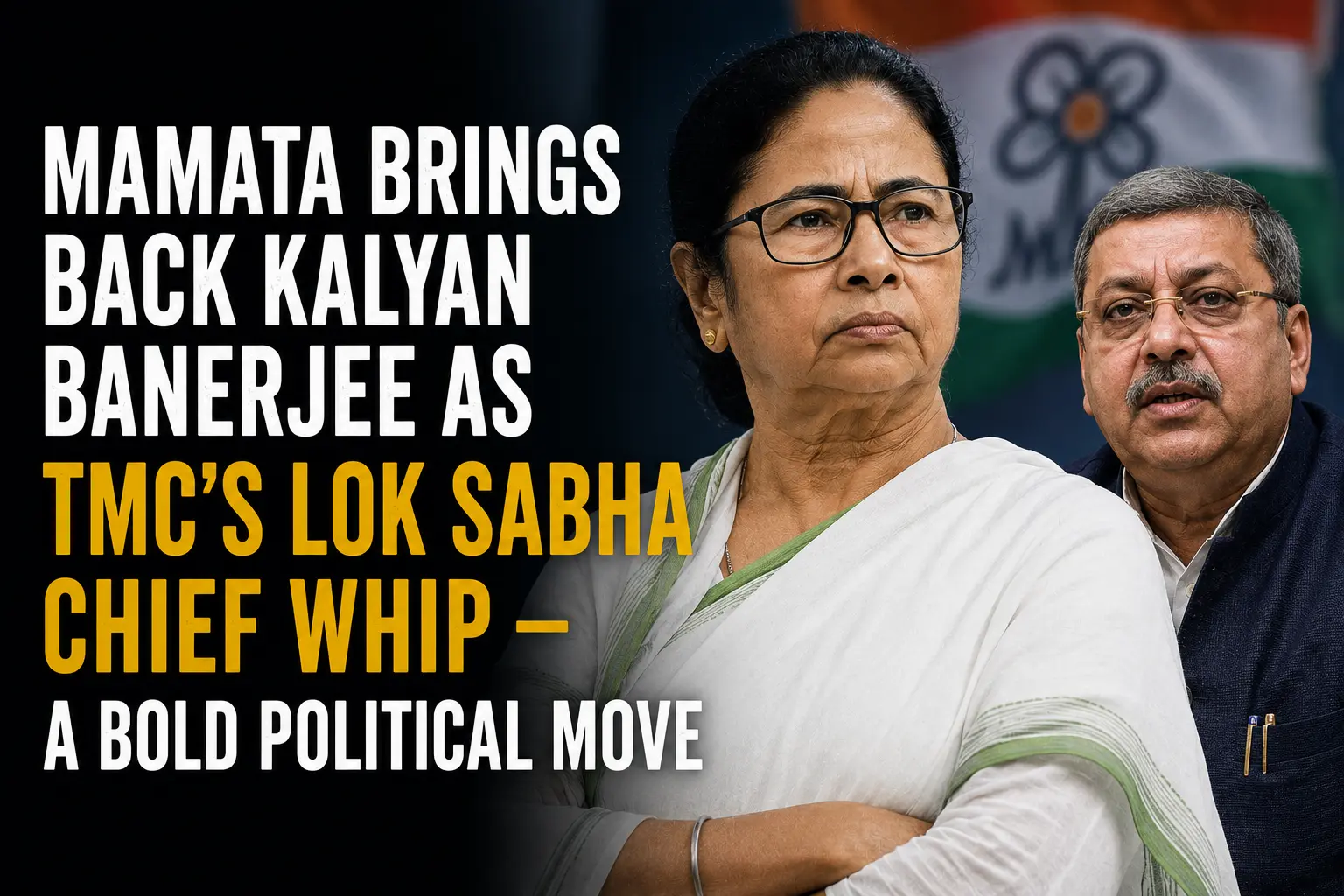
Mamata Banerjee just made a major move. She brought back Kalyan Banerjee as the Trinamool Congress's Chief Whip in the Lok Sabha. This happened after the party faced electoral losses, and it signals something important about where Mamata's party is heading right now.
Why does this matter to you? Because this shuffle shows how Indian political parties respond when things get tough. And it tells us something about loyalty, aggression, and who Mamata trusts in her inner circle when the pressure is on.
- Kalyan Banerjee returns as TMC's Chief Whip in Lok Sabha, replacing Kakoli Ghosh Dastidar
- The move comes after electoral setbacks that forced the party to reorganize its parliamentary strategy
- Kalyan's role includes legal and political defense of the party during challenging times
- Chief Whips control party discipline in parliament — they ensure MPs vote as the party wants
- This reshuffle signals Mamata's focus on aggression and loyalty within the party ranks
- TMC has 29 MPs in the current Lok Sabha — Kalyan must keep them all aligned on party positions
How We Got Here — The TMC's Recent Struggles
The Trinamool Congress isn't what it was a few years back. The party has faced real electoral pressure recently. When a political party loses elections or faces losses in votes, the leadership usually makes changes. That is exactly what happened here.
Kalyan Banerjee stepping down as Chief Whip earlier wasn't just a normal shuffle. It happened during a virtual meeting of TMC MPs that Mamata herself led. Then, after some time passed, Mamata brought him back. For ordinary TMC workers and supporters watching this, it felt like watching a chess match — someone was removed, then reinstated.
Think about what this means. If you are a TMC party worker in West Bengal, you are watching to see if your party is getting stronger or weaker. When senior leaders change positions this way, workers wonder: Is the party fixing its problems? Or are there internal fights we don't know about?
What Actually Happened and When
Let's break down the timeline and facts clearly:
- Kalyan Banerjee's earlier role: He served as Chief Whip before, which means he was responsible for keeping TMC MPs in line during parliamentary votes
- The reason he left: After electoral losses, party dynamics changed, and the leadership decided to make a shift in parliamentary positions
- Kakoli Ghosh Dastidar's temporary appointment: She took over the Chief Whip position after Kalyan stepped aside
- The recent reassignment: Mamata Banerjee, in a virtual meeting of TMC MPs, announced that Kalyan is back as Chief Whip
- What Kalyan is known for: He has defended the party both legally and politically — meaning he fights for the party in courts and in parliament
- The significance now: His return shows Mamata believes he is the right person to manage party discipline in the Lok Sabha right now
Here is what a Chief Whip actually does, by the way. A Chief Whip makes sure that every member of parliament from their party votes the way the party wants them to vote. If an MP wants to vote differently, the whip tries to convince them. It is a position of real power and real responsibility. You cannot do this job if party members don't respect you or trust you.
Why This Move Matters — What Experts Are Saying
This reshuffle shows something critical about how Mamata runs her party. She values loyalty. She values people who will fight for the party even when things get difficult. Kalyan fits that description.
Now here is where it gets interesting. The fact that Mamata brought Kalyan back — after he had left — suggests she sees him as essential right now. Why? Because the Trinamool Congress needs to be sharp and aggressive in parliament. With 29 TMC MPs in the Lok Sabha, they have enough strength to matter. But they need discipline. They need a strong Chief Whip to keep every single MP voting together on key issues.
Different people see this move differently. Some TMC supporters view it as smart — Mamata is putting her strongest players back in position. Others in the opposition might see it as a sign that TMC is struggling internally. And political analysts in Delhi are likely watching to see if this reorganization will actually make TMC stronger in parliament or if internal divisions are real.
But here is the plain truth. When a party reshuffles its top parliamentary leadership, it usually means one of two things. Either the party is tightening its grip — getting ready for a big parliamentary battle. Or the party is fixing real internal problems. Sometimes it is both.
What This Means for Ordinary Indians and TMC Supporters
If you live in West Bengal, or if you follow Indian politics closely, this matters more than it might seem at first.
For a TMC party worker in Kolkata, this reshuffle could mean: Your party is getting serious again. After losing some elections, the leadership is putting experienced hands back in charge. That might feel good — or it might worry you if you think Kalyan's return means the party is admitting it made mistakes by moving him away in the first place.
For ordinary voters who care about West Bengal politics, this reshuffle tells you something about Mamata Banerjee's leadership style. She makes bold moves. She removes people. She brings them back. She does not hesitate. Some Indians see this as strong leadership. Others see it as unpredictable.
Here is what changes practically. With Kalyan back as Chief Whip, TMC will likely be more aggressive and coordinated in parliament. You might see more TMC statements on key national issues. You might see TMC MPs speaking more forcefully against the BJP in parliament. A strong whip means a party speaks with one voice.
What to Watch For Next
Three things matter right now.
First, watch how TMC performs in the next parliamentary votes on major bills. If they stay completely united, Kalyan is doing his job. If there are any defections or contradictions, it shows the party still has internal issues.
Second, pay attention to whether Kalyan stays in this position or if there are more shuffles coming. Political appointments in India can change fast. If he is still Chief Whip six months from now, that signals stability. If he is moved again, it means real internal problems exist.
Third, keep an eye on TMC's approach to the next set of state elections. Will the party's parliamentary reshuffle translate into stronger performance in elections? That is the real test. For a political party, elections matter more than any internal reorganization.
Frequently Asked Questions About Mamata's TMC Reshuffle
What exactly does a Chief Whip do in parliament?
Simply put, a Chief Whip ensures that all MPs from their party vote the way the party leadership wants them to vote on important bills. They manage party discipline, convince members to follow the party line, and handle rebels. It is one of the most powerful positions in parliament after the party leader.
Why did Mamata bring Kalyan Banerjee back after he stepped down?
Here's the thing: After electoral losses, the party likely realized it needed someone strong in the Chief Whip position. Kalyan has experience and respect within the party. Bringing him back signals Mamata is serious about regaining ground and coordinating her parliamentary members tightly.
How many TMC MPs are there in the current Lok Sabha?
In plain words, the Trinamool Congress has 29 MPs in the current Lok Sabha. That is a significant number — enough to make a difference on key parliamentary votes. A strong Chief Whip like Kalyan keeps all 29 voting together when it matters most.
What does this reshuffle tell us about Mamata Banerjee's leadership?
Good question — it shows that Mamata values loyalty and experience. She removes people when she wants to make changes, but she also brings them back when she needs them. This suggests she makes decisions based on what she thinks the party needs at that moment, not based on holding grudges.
Will this change how TMC performs in the next elections?
The short answer: Not directly. A parliamentary reshuffle does not automatically improve election performance. But a stronger, more united TMC in parliament might boost the party's image and messaging. That could help in future elections — or it might not. Elections depend on many factors beyond internal reorganization.