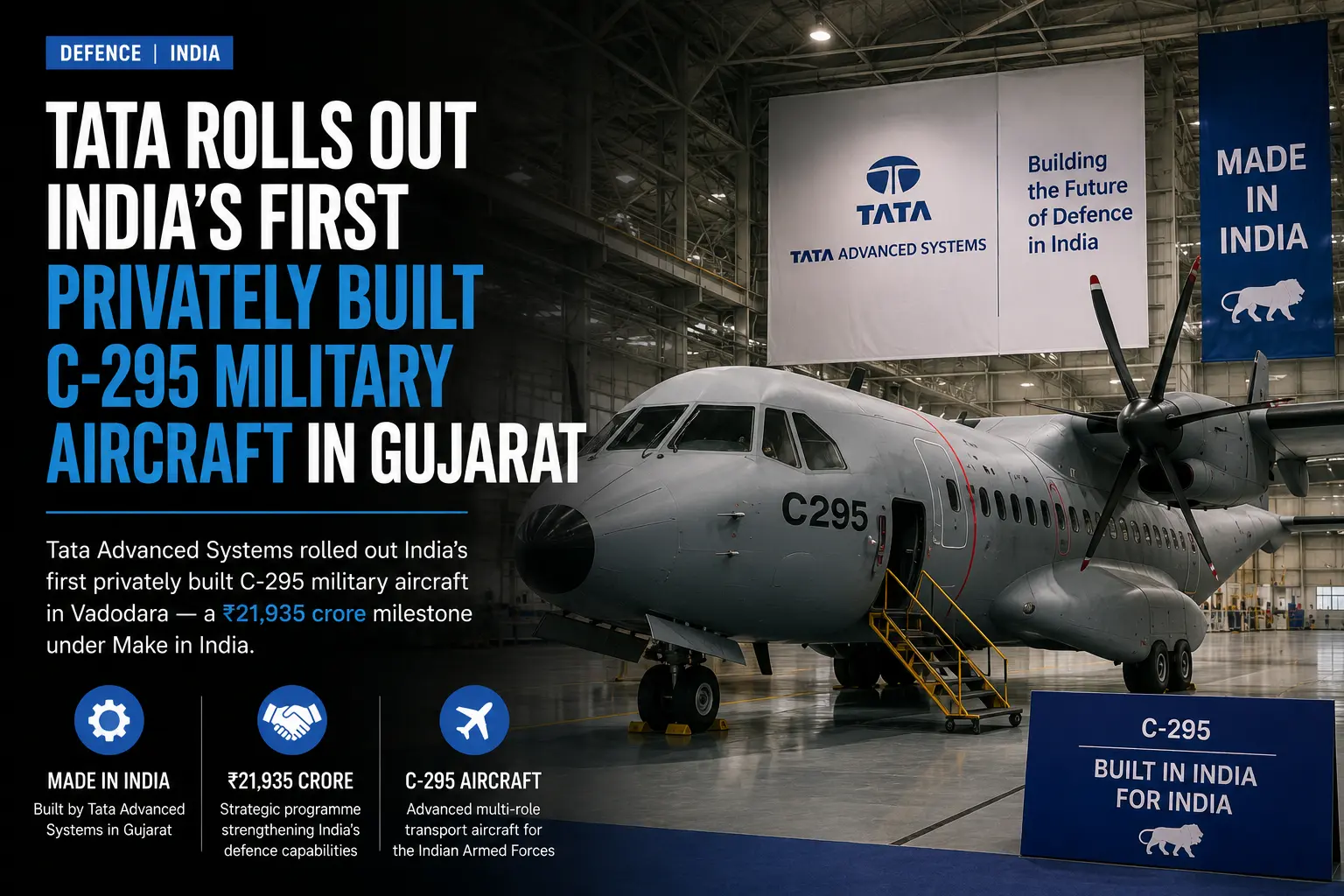
Tata Rolls Out India's First Privately Built C-295 Military Aircraft in Gujarat
Something happened in Vadodara, Gujarat that most Indians haven't fully heard about yet—and honestly, they should; Tata Advanced Systems, working with European aerospace giant Airbus, just rolled out the very first C-295 military transport aircraft built entirely on Indian soil. No joke. Not a government factory, not a public sector unit—a private Indian company made a military plane. Think about it. That is a first. The whole project is worth ₹21,935 crore, and it’s meant to replace the Indian Air Force's old, tired Avro aircraft that have been flying since before most of us were born. So why does this matter to you? Because this is the moment India stops buying military aircraft from abroad and starts making them at home. And what comes next could change how India defends itself for the next 50 years.
- In a rare move, Tata Advanced Systems rolled out the first Made-in-India C-295 aircraft ahead of schedule from its Vadodara facility.
- Valued at ₹21,935 crore, this landmark programme involves constructing 40 of the aircraft entirely on Indian soil.
- It's a historic first: a private Indian company is building a military aircraft on home soil, a massive win for the Make in India initiative.
- These new planes are set to replace the Indian Air Force's ancient Avro HS-748 fleet, which has been in service for a staggering 60+ years.
- Spain's Airbus Defence and Space is the key foreign partner, transferring technology to the Indian manufacturing lead, Tata Advanced Systems.
- The domestic supply chain is huge, with hundreds of Indian MSMEs involved, supporting thousands of local jobs across the country.
And here's why that matters.
Why the Indian Air Force Desperately Needed This
Look, the Indian Air Force has been flying the Avro HS-748—a British-made propeller aircraft—since the 1960s, a fact that's almost hard to believe. Let that sit. Some of these planes are older than your grandparents' retirement. Unreal. They carry troops, drop supplies, and do short-distance missions, but they're worn out, slow, and crazy expensive to maintain. Replacing them wasn't just overdue; it was two decades late.
Think.
So the Air Force needed something modern—something that could carry more soldiers, fly to remote areas like Ladakh or the Northeast, land on short runways, and survive tough weather. Big. The C-295 fits all of that. And more. It can carry up to 71 fully equipped soldiers or about 9 tonnes of cargo, and it can land on unpaved airstrips—the kind you find near the China or Pakistan border.
But here's the part that makes this deal different from everything India has done before: instead of just buying ready-made aircraft from Airbus, India said: make them here. Yep. In India. With Indian workers. Key point. And that single decision changed the entire shape of this programme. So how exactly did this deal come together?
The kind of thing most people miss.
What Actually Happened in Vadodara — The Full Story
And the rollout happened at the Tata Advanced Systems facility in Vadodara, and here's what we know: it came ahead of the original schedule—which, if you follow defense projects in India, you'll know is actually rare and worth celebrating. Wild. The plane physically rolled out of the factory. And that's big. That means the airframe is assembled, the structure is complete, and it's now moving toward flight testing and final delivery to the Indian Air Force. Is this really a surprise?
- The ₹21,935 crore deal: This was signed between the Indian government and Airbus Defence and Space of Spain back in September 2021. It covers 56 aircraft total—16 delivered directly from Spain in fly-away condition, and 40 to be built right here in India by Tata Advanced Systems.
- Tata Advanced Systems (TASL): And this is the defense and aerospace arm of the Tata Group. They've been quietly building components for Airbus and Boeing for years. Now they're putting a full plane together.
- The Vadodara plant: This isn't just any factory. It was built specifically for this project, making it India's first private-sector military aircraft manufacturing facility. That plant alone is a big deal.
- Airbus partnership: Airbus is transferring technology to India as part of this deal. That means Indian engineers are learning how to build modern military aircraft—knowledge that stays in India long after this contract ends.
- MSME involvement: More than 100 Indian small and medium businesses are supplying parts and components. From metal brackets to wiring harnesses—Indian companies are building pieces of this plane.
- Ahead of schedule: The rollout reportedly happening earlier than planned shows the Vadodara facility has hit its stride. This is the kind of news that builds confidence for future private defense contracts.
Wow.
Look—the government, through the Ministry of Defence, has been pushing this programme hard under the Make in India initiative. The result? Defence Minister Rajnath Singh has repeatedly pointed to this project as proof that private Indian companies can handle serious, complex defense manufacturing. Not anymore. It isn't just simple spare parts or uniforms; we're talking actual combat-capable aircraft. Period.
And the C-295 is built by Airbus Defence and Space and is currently used by the air forces of more than 35 countries. Facts. Spain, Portugal, Poland, Egypt, Saudi Arabia—they all fly it. True. India joining that list was expected. But India making it at home? That wasn't something most defense experts thought would happen this smoothly or this fast.
But not for the reasons you'd expect.
Why This Is Much Bigger Than One Aeroplane
Let's be honest—one aircraft rolling out of a factory isn't going to scare China or Pakistan. Big deal. But that's not really the point here. The point is what this factory and this project prove.
For decades, India has been one of the world's biggest importers of weapons and military equipment—a reality that has cost us hundreds of thousands of crores buying jets from Russia, helicopters from the US, and guns from Israel. Let that sink in. Every time India buys a weapon from abroad, money leaves the country, jobs go to foreign workers, and India stays dependent on other nations for its own safety. That stings. It's a real problem. A big one.
And this C-295 project is India saying: we're going to fix that. Slowly, one aircraft at a time. The government has set a target of reaching ₹1,75,000 crore worth of domestic defence production by 2025. That's real. The C-295 programme is a major piece of that plan. Right? When 40 planes are built in Vadodara instead of Spain, that's money staying in India, workers getting paid in India, and skills growing in India. And that's the truth.
Compare this to how things were done before. The Avro replacement was stuck in planning and bureaucracy for nearly 15 years before this deal was finally signed in 2021. Nobody talks about this. India had been talking about replacing those old planes since at least 2006. Read that again. Fifteen years of waiting. Now, just four years after signing the deal, the first plane is already rolling out. That pace—even if it's slower than ideal—is progress.
And here's the part that defense experts are genuinely excited about: technology transfer. Airbus is teaching Indian engineers how to build this aircraft. That knowledge doesn't just disappear when the contract is done. Not small. India can use it to build better planes, train more engineers, and eventually design its own aircraft. Huge. This is how aerospace industries are built—one project, one factory, one generation of engineers at a time.
And that's just the beginning.
Who Actually Feels This — And How
For an Indian Air Force pilot flying missions to Arunachal Pradesh or Ladakh, this means getting a modern, reliable aircraft instead of nursing a 60-year-old machine through mountain turbulence. Big shift. That's a direct quality-of-life—and safety—improvement. Worth it.
And for an engineer working at the Tata Advanced Systems plant in Vadodara, this is a career-defining job. Think about it. Building a military aircraft isn't something most aerospace engineers in India have ever had the chance to do. These are highly skilled, well-paying jobs that didn't exist in Gujarat's private sector five years ago. And now?
For a small business owner running a metal fabrication unit in Pune or a wiring company in Bengaluru, being part of the C-295 supply chain means stable orders and a chance to meet international aerospace quality standards. And? Once you're certified to supply parts for a military aircraft, doors open to other defense and commercial contracts around the world. But who really benefits here?
And for you—the ordinary Indian taxpayer—this means that the ₹21,935 crore being spent on this programme is at least partly staying inside India. That's the truth. A portion of that money flows back to Indian workers, Indian companies, and Indian tax revenues. And that's big. It's not a perfect equation, but it's far better than sending the entire amount to a factory in Seville, Spain.
Really.
Think of it this way: ₹21,935 crore is roughly enough to build about 4,000 government primary schools across India. When a big chunk of that money stays inside India through local manufacturing, it's not just about planes. It's about the economic activity that money creates right here at home. And where does that leave the rest of us?
Nobody is talking about this enough.
What to Watch for Next
The rollout is done. Period. But the journey from rollout to actual Indian Air Force service has several steps still left. Here's what comes next and what you should keep your eye on.
First, the aircraft will go through ground testing and then flight testing from the Vadodara facility—a process where Indian engineers and Airbus test pilots will check everything. That's real. This process takes months, not weeks. Second, after testing is cleared, the aircraft gets formally handed over to the Indian Air Force, which then runs its own acceptance trials. Key point. Third, the remaining 39 aircraft in the India-built batch will follow on a rolling production schedule from the Vadodara plant.
So what's the best-case scenario? Deliveries of India-made C-295s begin to the Air Force within the next 12-18 months, the production line hits its pace, and India starts exporting components or even fully assembled aircraft to other C-295 operators. But here's the real question—what happens next? Several countries that buy C-295s might be interested in Indian-made versions, especially given our cost advantages in manufacturing.
And the most likely scenario is this: there will be some delays—that's just the reality of complex aerospace projects. But the fact that the rollout happened ahead of schedule suggests the Vadodara team is serious. Expect the first India-built C-295 to formally enter IAF service sometime in 2026. Yep.
The one thing to watch closely: whether the Indian government now places additional orders for C-295 variants—including maritime patrol or surveillance versions—which would deepen the production line and make the Vadodara factory even more valuable. Defence Ministry officials have hinted at this possibility, but nothing is confirmed yet. And? That announcement, if it comes, would be the next big milestone for this programme. And that's big.
Frequently Asked Questions About India's C-295 Military Aircraft
What is the C-295 aircraft and why does India need it?
Simply put, the C-295 is a modern Airbus military transport plane. India desperately needs it to replace its ancient Avro HS-748 aircraft, which can't handle missions in tough border areas like Ladakh.
Who is building the C-295 in India and where?
The thing is, Tata Advanced Systems Limited (TASL), the Tata Group's defense arm, is building the aircraft in Vadodara, Gujarat. This isn't just any factory; it's India's first-ever private-sector facility built specifically for manufacturing military aircraft from the ground up. Airbus of Spain is the foreign partner providing the critical technology and support, making it a true 'Make in India' collaboration.
How does this C-295 project affect ordinary Indians?
Good question. It's bigger than you'd think. Over 100 Indian small businesses supply parts, creating thousands of skilled jobs. Plus, the ₹21,935 crore program ensures a huge chunk of our defense budget stays and circulates within India.
What is the total cost of the C-295 deal and who is paying for it?
Here's the short version: the entire deal is worth a massive ₹21,935 crore, funded by the Indian government via the Ministry of Defence. This contract, signed in September 2021, covers 56 total aircraft. The first 16 are being bought ready-made from Spain, but the real game-changer is the next 40, which will be built right here in India.
When will the Indian Air Force actually start using these India-made C-295 aircraft?
Honestly — the rollout just happened ahead of schedule, which is a fantastic sign. After extensive ground and flight testing, which takes months, the first India-built C-295 should be formally handed over. Most experts are pointing to sometime in 2026.