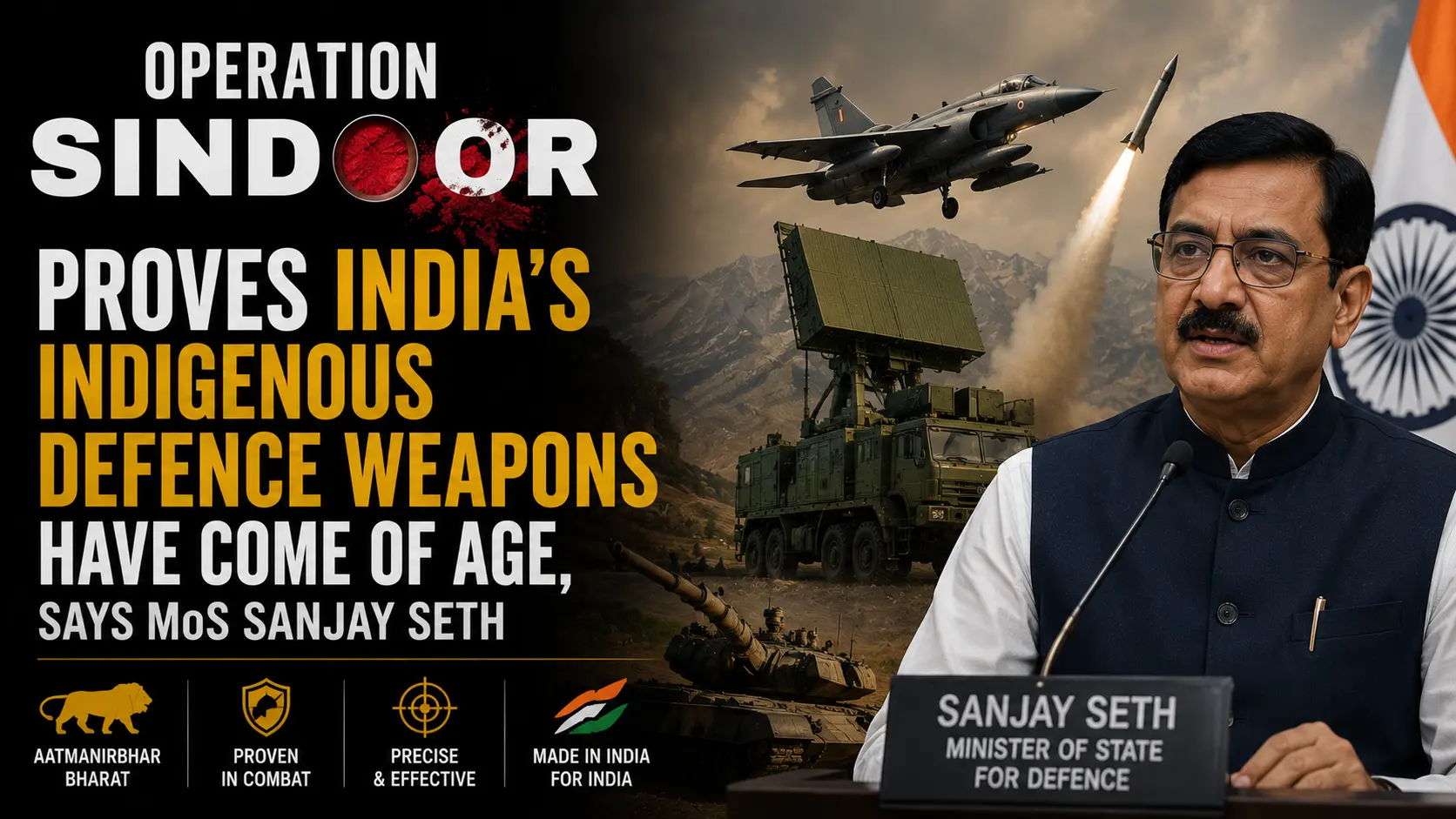
Operation Sindoor has done more than neutralise terror infrastructure across the border — it has sent an unmistakable signal about the combat-readiness of India's homegrown defence arsenal. Minister of State for Defence Sanjay Seth made this point emphatically at a public event in Prayagraj, stating that the operation stands as definitive proof that India's indigenous weapons systems are no longer aspirational projects but battle-tested realities. For a country that spent decades importing the bulk of its military hardware, that is a statement worth pausing over.
Why Operation Sindoor Marks a Turning Point for India's Indigenous Defence Ecosystem
For the better part of the last five decades, India ranked consistently among the world's top three arms importers. That dependency was never just a budget problem — it was a strategic vulnerability. Every foreign-sourced platform came with strings: technology denial, delivery delays, and the ever-present risk that spare parts could be withheld in a crisis. India's push toward self-reliance under the Aatmanirbhar Bharat framework was designed precisely to break that cycle, and Operation Sindoor appears to have provided the sharpest real-world validation of that shift.
The timing matters enormously. India's defence export targets have scaled from a mere ₹1,500 crore in 2016-17 to over ₹21,000 crore in recent years. Domestically developed platforms — spanning precision-guided munitions, loitering munitions, air defence systems, and electronic warfare suites — have progressively moved from test ranges to frontline deployment. Operation Sindoor, by all accounts, stress-tested many of these systems under live conditions and, crucially, they delivered. That operational credibility now gives Indian defence diplomacy a new kind of leverage.
What MoS Sanjay Seth Said and What Actually Happened During Operation Sindoor
Speaking at an event in Prayagraj, Minister of State for Defence Sanjay Seth offered one of the most direct official endorsements yet of the performance of Made-in-India weapons during the operation. He praised the armed forces for executing strikes with precision, dismantling terror hideouts without collateral escalation, and doing so largely on the strength of domestically developed systems. His remarks were not mere political rhetoric — they came embedded in specific references to the strategic effectiveness of the hardware deployed.
Operation Sindoor, for those still piecing together the full picture, was a focused counter-terror military operation that targeted infrastructure linked to terrorist groups operating from Pakistani soil. The Indian military executed the strikes with a degree of precision that drew international attention. Multiple platforms and weapons categories were involved, and the post-operation assessment pointed to a high success rate in hitting designated targets. The operation has since become a reference point in defence policy circles for what coordinated, technology-backed military action can achieve.
- Precision strike capability: Indigenous precision-guided munitions reportedly played a central role in the targeting of terror camps, minimising the risk of unintended escalation.
- Loitering munitions deployment: India's domestically developed loitering munitions — sometimes called kamikaze drones — were assessed to have been part of the operational toolkit, reflecting years of DRDO and private sector development work.
- Air defence integration: Coordinated air defence systems ensured Indian assets operated in a secured envelope throughout the operation's duration.
- Electronic warfare support: Indigenous EW platforms provided the signal intelligence and jamming cover essential for any modern strike operation.
- Multi-service coordination: The Army, Air Force, and Navy reportedly operated in a joint framework, with indigenous command-and-control infrastructure managing real-time coordination.
- Zero platform loss (reported): The operation was conducted without reported loss of Indian military platforms, a testament to both planning and the reliability of the systems used.
What makes Seth's statement particularly significant is the institutional weight behind it. As Minister of State for Defence, his public endorsement of indigenous systems carries policy implications — it signals that the government is not just satisfied with the outcome but intends to double down on the domestic defence production push that made this outcome possible.
Strategic and Geopolitical Impact: What This Means Beyond the Battlefield
The geopolitical ripple effects of Operation Sindoor extend well beyond the Line of Control. Countries that have been fence-sitting on Indian defence exports — watching closely to see whether Indian platforms can perform under real operational stress — now have a data point they could not have purchased through any trade fair or defence expo. The operation effectively served as the most credible product demonstration India's defence industry has ever had. Nations in Southeast Asia, the Middle East, and Africa that are currently in dialogue with India over systems like the BrahMos missile, Akash air defence, and various DRDO-developed platforms will factor this operational record into their procurement decisions.
Domestically, the implications are equally significant. The government's Defence Acquisition Procedure has long sought to privilege indigenous procurement, but bureaucratic inertia and risk-aversion within the armed forces sometimes slowed adoption of locally developed systems. A successful high-stakes operational deployment is precisely the kind of proof-of-concept that can shift institutional culture. If Operation Sindoor accelerates the Indian military's willingness to field more indigenous systems — and if it prompts faster clearance for domestic platforms stuck in procurement pipelines — the strategic payoff could compound over the next decade in ways that dwarf the immediate tactical outcome.
What Comes Next: Defence Policy, Export Ambitions, and the Road Ahead
The government's stated goal is to achieve ₹50,000 crore in defence exports by 2029. Before Operation Sindoor, that target was widely seen as ambitious — achievable perhaps, but requiring a sustained push against established competitors. Post-Sindoor, the narrative has shifted. India now has a operational combat record attached to some of its key export platforms, and that changes the sales conversation fundamentally. Expect Indian defence delegations to reference Sindoor explicitly in upcoming bilateral discussions with partner nations evaluating Indian hardware.
For Indian citizens, the broader takeaway is this: the investment in DRDO, in Defence Public Sector Undertakings, and in private sector defence startups under the iDEX initiative is beginning to pay dividends that show up not just in export order books but on actual battlefields. The work is far from complete — India still imports critical sub-systems, aero-engines, and high-end electronics — but the direction of travel is clear and, after Operation Sindoor, validated. The next phase will test whether the institutional momentum generated by this operational success can be sustained through smarter procurement, faster trial cycles, and deeper investment in indigenous R&D.
Frequently Asked Questions
What did MoS Sanjay Seth say about Operation Sindoor and indigenous defence weapons?
Minister of State for Defence Sanjay Seth stated that Operation Sindoor powerfully demonstrated the strategic capability and reliability of India's indigenously developed defence weapons. He commended the armed forces for neutralising terror infrastructure using homegrown systems, calling the operation a landmark validation of India's Aatmanirbhar Bharat defence push.
Which Indian indigenous weapons systems were used in Operation Sindoor?
While a full official inventory has not been publicly disclosed, reports indicate that Operation Sindoor involved indigenous precision-guided munitions, loitering munitions, electronic warfare platforms, and integrated air defence systems — all developed through DRDO, DPSUs, and private sector partners under India's defence self-reliance programme.
How does Operation Sindoor affect India's defence export ambitions?
Operation Sindoor significantly boosts India's defence export credibility. By demonstrating that Indian-made weapons perform effectively in live combat conditions, it gives potential buyers in Southeast Asia, the Middle East, and Africa a verified operational track record — a critical factor in international arms procurement decisions that no defence expo can replicate.