Title: India Tightens Drug Rules for High-Alcohol Formulations — What Changed
Walk into any pharmacy in India and you'll find cough syrups, tonics, and ayurvedic preparations sitting right next to antibiotics and blood pressure pills. Nobody thinks twice. But for years, some of those bottles — the ones with high alcohol content — have been quietly slipping out of medicine shelves and into a very different kind of demand. Big. On July 8, 2026, the Health Ministry shut that door. The Drugs (Tenth Amendment) Rules, 2026 brought all oral drug formulations containing more than 12 per cent alcohol under strict prescription control and mandatory licensing — and the implications go well beyond a pharmacy counter. That's real.
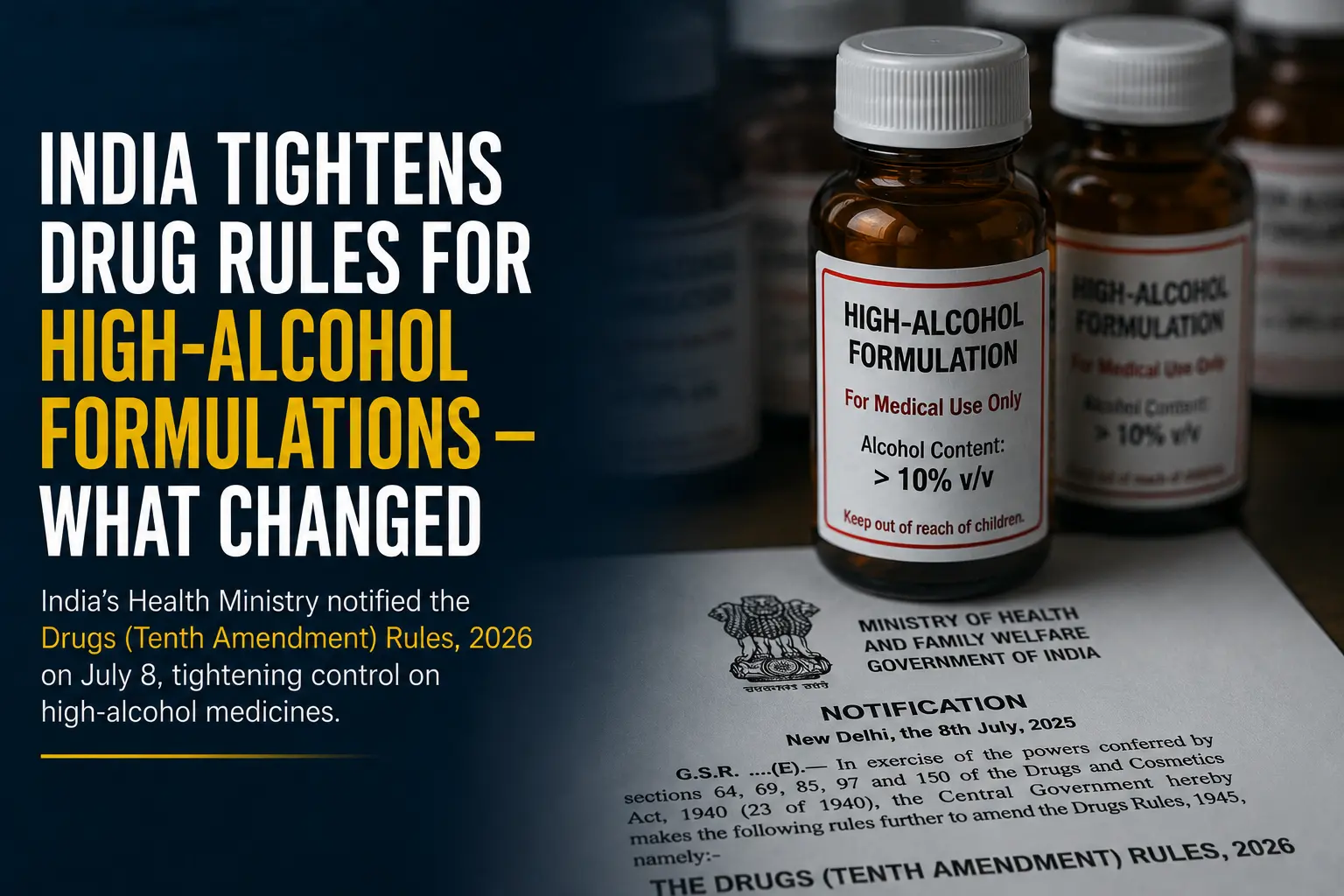
- The Health Ministry notified the Drugs (Tenth Amendment) Rules, 2026 on July 8, 2026, amending India's existing Drugs Rules, 1945.
- All oral drug formulations containing more than 12 per cent ethyl alcohol and sold in bottles now fall under tighter government control.
- These formulations have been placed under Schedule H1 of the Drugs Rules, 1945 — meaning they can only be dispensed with a valid prescription.
- Manufacturers and stockists will now need a specific licence to produce, stock, or sell these products — a requirement that previously didn't exist for many in this category.
- The amendment targets the risk of high-alcohol medicinal products being diverted for non-medical use, according to officials.
- If you want to buy cough syrup or any tonic with high alcohol content, you'll now need a doctor's prescription at the chemist's counter.
Period.
The Quiet Loophole That Let This Go On for Years
Look, India's drug regulation framework is old. The Drugs Rules, 1945 — the very foundation of how medicines are controlled in this country — were written when penicillin was still a medical miracle. Unreal. Over eight decades, hundreds of amendments have been layered on. But certain categories of products fell through the cracks, and high-alcohol oral formulations were among the most consequential of them. Wild.
And cough syrups, herbal tonics, and certain Ayurvedic preparations can legally contain significant percentages of alcohol — sometimes well above what you'd find in a glass of beer. For most patients, this is medically irrelevant. But for those looking for a cheap, accessible, and legally purchased source of alcohol — especially in dry states or areas with restricted liquor access — these bottles were exactly that. Big shift. The diversion problem has been on the Health Ministry's radar for years. This amendment is the government's answer to it. And more.
So what exactly changed on July 8, and how does it touch your life the next time you walk into a chemist? That's what the rest of this story unpacks. Think about it.
And here's why that matters.
What the Drugs (Tenth Amendment) Rules, 2026 Actually Say
The amendment is specific, and the specifics matter. Here's the full picture of what changed, based on the government notification:
- The 12 per cent threshold: Any oral formulation — meaning any medicine you swallow, including syrups and liquid tonics — containing more than 12 per cent ethyl alcohol is now in a controlled category. Below that, the old rules apply. Above it, the new ones kick in.
- Sold in bottles: The rule applies to products sold in bottle form, which covers the vast majority of liquid oral medicines in the Indian market.
- Schedule H1 placement: Schedule H1 of the Drugs Rules, 1945 is where India keeps its most tightly controlled non-narcotic medicines — drugs that can only be dispensed against a prescription from a registered medical practitioner. That's the category these formulations now sit in.
- Prescription mandatory: A chemist can't legally hand you one of these products over the counter without a valid doctor's prescription. Full stop. No exceptions.
- Licence requirement: Manufacturers, distributors, and retailers dealing in these formulations now need a specific licence to do so. This is the supply-side control — the demand-side control is the prescription requirement.
- Regulatory intent: According to officials, the amendment is designed to prevent products meant for medicinal use from being diverted to non-medical consumption — which is the formal language for what amounts to alcohol misuse through medicine packaging.
The amendment doesn't name specific brands or products. But if you've ever bought a cough syrup that left you feeling unexpectedly warm, or a “health tonic” that tasted more like a drink than a medicine — those are exactly the products now under the microscope. That stings.
Before July 8, many of these formulations existed in a grey zone. They were technically medicines, so they sat in pharmacies. But they weren't tightly controlled enough to require prescriptions in all cases, and licensing requirements were inconsistently applied. The amendment closes that grey zone — at least on paper. And that's big.
The kind of thing most people miss.
Why the Government Moved Now — and What It Signals
Timing matters in policy. This isn't the first time India has tightened drug rules, and it won't be the last. But the Drugs (Tenth Amendment) Rules, 2026 come at a moment when the Centre has been systematically plugging gaps in pharmaceutical regulation across multiple fronts — from cracking down on fixed-dose combinations that had no therapeutic rationale, to tightening oversight on online pharmacies. That's the truth.
The alcohol-in-medicines problem has a particular geography in India. States with prohibition — Bihar, Gujarat, parts of Manipur, Nagaland — have long struggled with the diversion of high-alcohol medicinal products. In dry areas, a bottle of cough syrup with 20 per cent alcohol content isn't just a medicine. It's a substitute. And because it was sold in a pharmacy, not a liquor shop, it sat outside the enforcement net of excise departments. The Health Ministry's move essentially creates a new enforcement layer — one that works through drug regulation, not liquor control. Big deal.
Think about what Schedule H1 actually means in practice. Medicines in this schedule — like certain antibiotics and sedatives — require a registered medical practitioner's signature before a chemist can dispense them. Not small. Pharmacies are supposed to keep records of Schedule H1 sales. That record-keeping is the trail that makes diversion harder. Not impossible. But harder. True.
And the licence requirement adds the second layer. A distributor or retailer who wants to stock these products now has to formally register for the right to do so. That creates accountability at the supply chain level — not just at the point of sale. Yep.
Not something you see every day.
How This Affects You — and Who Feels It First
For most people buying a standard prescribed cough syrup, the change is simple. Your doctor writes a prescription, you take it to the chemist, and nothing feels different except there's now a paper trail where there wasn't one before. Right?
But think about who this really touches first. For a person in a village in Bihar — where the nearest government liquor outlet may be 40 kilometres away, where prohibition is state law, and where a pharmacy is the only health-related shop in the local market — this amendment means the high-alcohol tonic that was previously handed over the counter now needs a doctor's chit. That's a friction that didn't exist before. Whether you see that as a necessary inconvenience or an overreach depends entirely on which side of the dispensing counter you stand on. And?
For chemists and pharmacists, the change is operational. Those who sell these products now need to verify prescriptions, maintain records, and ensure their licences are in order. Small pharmacies in semi-urban areas — the ones where the owner-pharmacist is the same person, and where record-keeping is informal — will feel the compliance burden most acutely. No joke.
For manufacturers of Ayurvedic and herbal preparations — a ₹50,000 crore-plus industry in India — the amendment raises a legitimate question about formulation review. If your product crosses the 12 per cent alcohol threshold and is sold in a bottle, you're now in a regulated category. Some manufacturers may choose to reformulate. Others will adapt to the new licensing framework. Either way, it's not business as usual. Facts.
And for patients with legitimate medical needs — someone managing a persistent cough, or an elderly person on a prescribed herbal tonic — the new requirement means one extra step at the doctor's clinic before the pharmacy. Inconvenient, yes. But not impossible. Worth it.
Worth paying attention to.
What Comes Next — and What to Watch
An amendment is only as strong as its enforcement. India has a long and complicated history of rules that look good on paper and dissolve at the district level. Wow. Schedule H1 already applies to several drug categories, and any honest pharmacist will tell you that compliance is uneven across the country. The question with this new addition isn't whether the rule is right — most health experts would agree it is — but whether chemists in small towns and rural areas will actually follow it, and whether drug inspectors will check. The result?
There are two things worth watching. First: how quickly state governments — which have primary enforcement responsibility for drug retail — move to issue guidance to pharmacies and begin compliance checks. Second: whether manufacturers of Ayurvedic and herbal products that cross the 12 per cent threshold apply for the required licences, or whether a quiet workaround emerges through reformulation or relabelling. And now?
The Centre has signalled intent. Turning that intent into practice is where the real work begins — and where most Indian regulatory stories either succeed quietly or fail loudly. Enforcement officers at state drug control departments now have a July 8, 2026 notification to point to. What they do with it is the next chapter of this story. Let that sit.
And that's just the beginning.
Frequently Asked Questions About the Drugs Tenth Amendment Rules 2026
What is the Drugs (Tenth Amendment) Rules, 2026 and what does it change?
Here's the short version: it's a July 8, 2026 government notification that amends India's Drugs Rules, 1945, placing all oral medicines — syrups, tonics, liquid formulations — containing more than 12 per cent ethyl alcohol under Schedule H1. This means they can only be sold with a valid doctor's prescription and require a specific licence to stock or sell. It's a big deal.
Which medicines are covered under the new 12 per cent alcohol rule?
The thing is, any oral formulation sold in a bottle and containing more than 12 per cent ethyl alcohol is covered. This includes certain cough syrups, herbal tonics, and Ayurvedic preparations in liquid form. Standard low-alcohol medicines remain unaffected. If you're unsure about a specific product, ask your pharmacist to confirm its alcohol content, but generally, anything with a kick is in. This isn't just about coughs anymore.
Why did the government bring in this rule — what problem does it solve?
In plain words, these high-alcohol products were being diverted for non-medical use. In states with alcohol prohibition, medicinal bottles with high alcohol content were sometimes bought and consumed like liquor. The new rule creates a prescription barrier and a licensing requirement to make that diversion harder — using the drug regulation system as an enforcement tool, and that's key.
What should you do the next time you want to buy a cough syrup or tonic?
Good question. Check with your doctor first. If the product you normally buy contains more than 12 per cent alcohol, you'll need a prescription from a registered medical practitioner before the pharmacist can legally sell it to you. It's one extra step, but it protects both you and the chemist from non-compliance issues under the new rules, and ensures proper medical usage. Nobody wants legal trouble for a cough.
When does the new drug rule come into effect and who enforces it?
Honestly — the Drugs (Tenth Amendment) Rules, 2026 were notified on July 8, 2026, making them effective from that date. Enforcement rests primarily with state drug control departments, which oversee pharmacy compliance across India. Manufacturers and retailers dealing in these formulations are expected to obtain the necessary licences and begin following prescription requirements without delay. It's happening now.