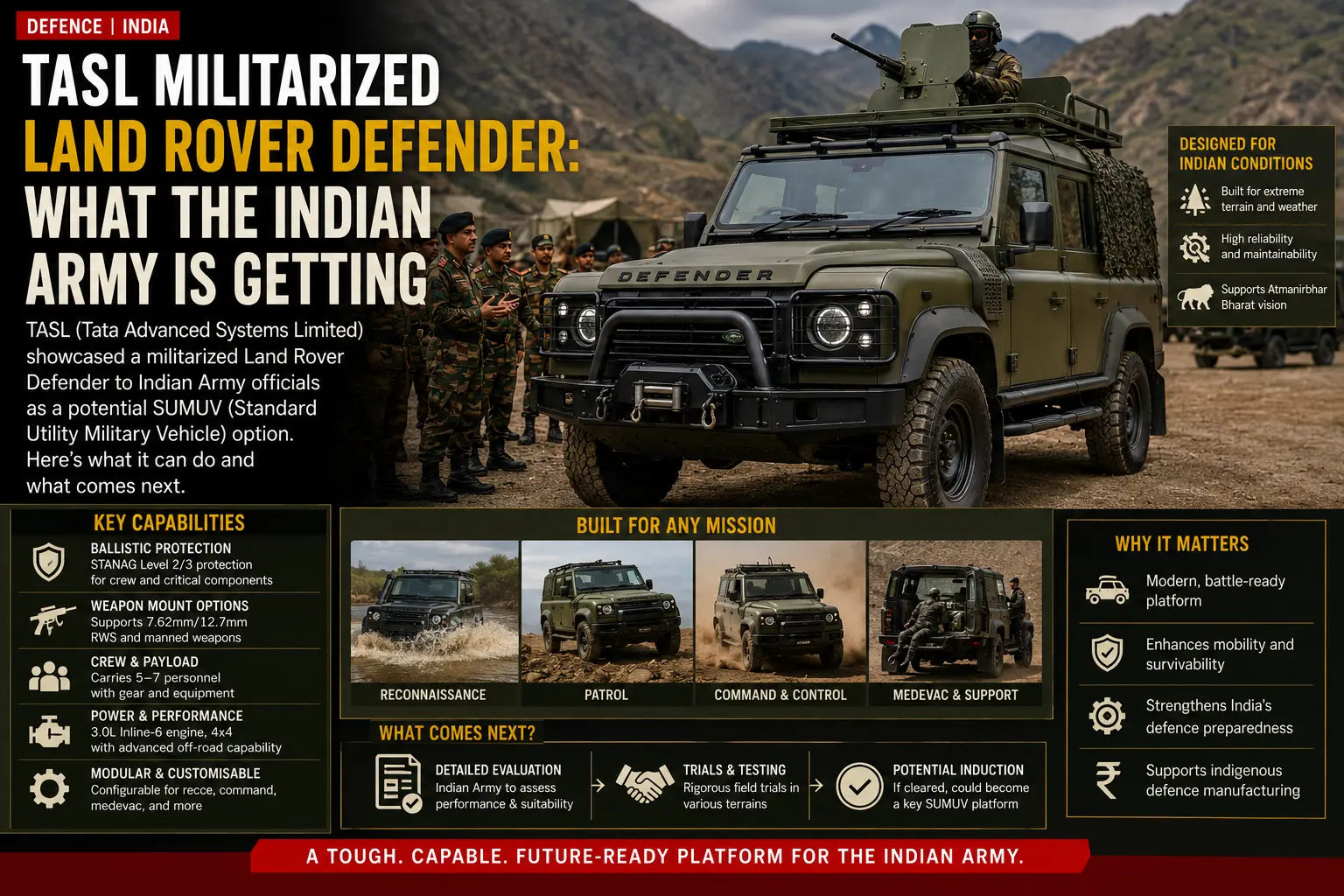
Picture a Land Rover Defender — the tough, boxy SUV you've probably seen in movies — but now imagine it painted army green, fitted with gun mounts, and driven by Indian soldiers through the mountains of Ladakh or the dense jungles of the Northeast. That's exactly what Tata Advanced Systems Limited, known as TASL, is pitching to the Indian Army right now. The company recently showed off a specially built military version of the iconic Defender at its own facility — and senior Indian Army officials were right there watching. So is this the Army's next big vehicle? Let's break it all down.
- TASL — the defence arm of the Tata Group — has built a military-spec Land Rover Defender and shown it to senior Indian Army officials.
- The vehicle is being pitched as a Special Utility Military UV, or SUMUV — a fast, tough, multi-role vehicle for troops on the ground.
- The Defender already serves military forces in several countries globally, which gives it a head start over newer, untested designs.
- TASL showed the vehicle at its Armoured and Combat Vehicle facility, where India's top brass got a close look at what it can do.
- No official order has been placed yet — but defence watchers say the timing and the audience suggest serious intent from both sides.
- This move fits right into India's push for ‘Make in India’ defence — Tata wants to build and supply this vehicle locally rather than import it.
The Story Behind This Unusual Military Vehicle
Land Rover Defenders aren't new. The original Defender — boxy, loud, built like a tank — was used by militaries around the world for decades. Britain's SAS used them. Armies across Africa and the Middle East swore by them. But the new-generation Defender, relaunched in 2020, is a completely different animal. It's modern, powerful, and far more capable than its old-school ancestor.
TASL spotted something others missed. Tata Motors already owns Jaguar Land Rover — yes, the British car company is actually Indian-owned now. That means Tata has direct access to the Defender platform. So the idea of taking that platform and building a military version of it for the Indian Army is not some wild dream. It's a very real business plan backed by real engineering muscle.
And the Indian Army has a real need here. Right now, the Army uses a mix of vehicles for different jobs — from the old Maruti Gypsy to imported SUVs to heavy armoured carriers. But there's a gap in the middle. A fast, versatile, light tactical vehicle that can carry soldiers and equipment into difficult terrain quickly. That's the gap TASL is trying to fill with this Defender.
So what exactly did TASL build — and what can it actually do?
Here Is the Full Story of What TASL Built and Showed
TASL didn't just slap some paint on a showroom Defender and call it military. The company built a proper militarized version — changed from the inside out — and showed it to Indian Army officials during a visit to TASL's Armoured and Combat Vehicle facility. This is the same place where TASL works on serious defence hardware, not just concept cars.
- The Platform — Land Rover Defender 110: The military version is based on the Defender 110, which is the longer, 5-door body style. It's bigger than the 90 (the shorter version), which means more space for soldiers, gear, and mission equipment.
- Engine Power: The Defender runs on a 3.0-litre six-cylinder diesel engine that produces about 249 horsepower. That's serious power — enough to pull heavy loads uphill while carrying a full squad of soldiers. For comparison, most civilian SUVs in India run engines half this size.
- Off-road Capability: The Defender comes with permanent four-wheel drive, adjustable air suspension, and terrain response systems. In simple words — it can go where most vehicles simply cannot. Mud, rocks, water crossings, steep hills — this vehicle is built for all of it.
- Weapons Mounting Points: The military version has been fitted with weapon mounts — places where soldiers can attach and operate machine guns or other weapons while the vehicle is moving. This turns it from a passenger carrier into a fighting vehicle.
- SUMUV Role: TASL is positioning this as a Special Utility Military UV, or SUMUV. Think of it as a Swiss Army knife on wheels — it can carry troops, serve as a command vehicle, do quick reconnaissance missions, or act as a weapons platform depending on what equipment is attached.
- Global Military Use: The Defender in various forms already serves military and special forces units in multiple countries. That real-world proven record is a big selling point — the Indian Army isn't being asked to trust an untested design.
The showcase happened at TASL's facility where Indian Army officials saw the vehicle up close. No test results have been made public — but the fact that TASL invited senior Army brass to see it rather than just sending a brochure tells you this isn't just a PR exercise.
TASL is the defence and aerospace arm of the Tata Group — one of India's oldest and most trusted industrial houses. The company already makes a wide range of defence equipment including aerospace parts and systems. Pitching a militarized Defender is a natural next step given that Tata Motors owns Jaguar Land Rover.
Why This Is Bigger Than Just One New Vehicle
Here's what most people reading about this will miss. This isn't really about the Defender. It's about India's entire approach to defence manufacturing changing in front of our eyes.
For years — decades, actually — India imported most of its military equipment. Guns, aircraft, ships, vehicles. We had the money, we had the need, but we didn't have the home-grown industry to build it ourselves. That started changing seriously around 2014 when the government pushed hard for 'Make in India' in defence. The idea was simple: if India needs it, India should build it.
TASL's Defender pitch fits that idea perfectly. Instead of the Indian Army importing foreign military vehicles at huge costs — often in foreign currency — TASL is saying: let us build it here, in India, with Indian workers, under Indian ownership. Tata already owns the technology through Jaguar Land Rover. The engineering know-how exists. The manufacturing facility exists. All that's needed is an Army order.
From the Army's point of view, there are at least three reasons this is attractive. First, local production means faster supply and easier spare parts — you're not waiting for a ship from Europe. Second, it can be customised for Indian conditions — Ladakh winters, Northeast monsoons, Rajasthan heat. Third, buying locally keeps the money inside India rather than flowing out to foreign companies.
Look at what other countries do. The US Army uses the JLTV (Joint Light Tactical Vehicle). The British Army uses — yes — Land Rover Defenders, though they're slowly replacing them. Special forces across the world love light, fast vehicles that can carry a team and a weapon. India's special forces, including the Para SF and the NSG, also need exactly this kind of vehicle for their operations. A locally built, locally supported SUMUV would be a big deal for them.
But there's a tough question worth asking. Is the Defender — a vehicle that also sells as a luxury SUV to Bollywood stars for over ₹1 crore — really the right base for a military vehicle? Won't it be expensive? That's a fair concern. TASL hasn't released pricing, and the Army will have strong views on cost. Military procurement in India is notoriously slow and complicated. An approval could take years.
Who This Really Affects — and What It Means on the Ground
For a young soldier posted in a forward area near the Line of Actual Control in Ladakh — where temperatures drop to minus 30 degrees and supply roads are often blocked by snow — the vehicle they move in is a matter of life and death. Not an exaggeration. A vehicle that breaks down, gets stuck, or can't handle the terrain in a hostile area is a danger to every person inside it.
Right now, many such soldiers move in older vehicles that are reliable but ageing. The Maruti Gypsy, for example, is old enough to have been used by their fathers' generation. Replacing that with something modern, powerful, and purpose-built would make a real difference — not just in comfort, but in speed, safety, and mission capability.
For India's special forces — the small teams that go on high-stakes missions — a vehicle like the militarized Defender could change how they operate. Faster insertions. Better weapons setups. More reliable performance in extreme terrain. These aren't small improvements. In special operations, speed and surprise are everything.
For the Indian defence industry, a successful TASL pitch means jobs. Real jobs — engineers, manufacturing workers, supply chain workers across the country. Every military vehicle order of any size pulls along a whole chain of Indian businesses that supply parts, materials, and services.
And for ordinary Indian taxpayers — because ultimately, we're the ones paying for the Army's equipment — a locally built vehicle is almost always cheaper in the long run than an import. The government saves foreign currency. The money stays in the Indian economy. Local suppliers benefit. It's a better deal all around if the quality is right.
What to Watch For Next
TASL has made its move. The vehicle has been shown. Army officials have seen it. Now the real process begins — and in Indian defence procurement, this process is long, detailed, and very formal.
The Army will need to issue what's called an RFP — a Request for Proposal — if it decides to formally consider the SUMUV. That document will lay out exactly what specifications the vehicle must meet. TASL and any other companies interested will then submit detailed technical and commercial bids. A trial and evaluation phase will follow, where the vehicles are actually tested in Indian conditions — possibly in Ladakh, possibly in the Thar desert, possibly both.
Three things could happen from here. Best case — the Army loves what it sees, trials go well, and TASL gets an order within the next two to three years. Given India's Make in India push, this is genuinely possible. Most likely — the process takes longer, more companies express interest, and TASL ends up in a competitive bid against other options, including foreign-made vehicles. That could stretch the timeline to five years or more. Worst case — the Army decides the Defender platform is too expensive per unit, or doesn't fully meet military specs after trials, and the project stalls.
Watch for any official Army announcement about a new SUMUV procurement process. If and when that RFP drops, TASL's Defender will almost certainly be one of the front-runners. Also watch for how TASL positions this at upcoming defence expos — DefExpo and Aero India are the two biggest stages in India where these deals often take a big step forward.
One thing is already clear though. Tata is serious about defence vehicles. And the Indian Army is serious about modernising. Sooner or later, those two serious intentions are going to meet — and Indian soldiers will be better equipped for it.
Frequently Asked Questions About the TASL Militarized Land Rover Defender
What is the TASL militarized Land Rover Defender?
Simply put, it's a specially modified Land Rover Defender built by Tata Advanced Systems Limited for military use. TASL has added weapon mounts, military-grade equipment, and mission-specific features to the standard Defender platform. It's being pitched to the Indian Army as a SUMUV — a Special Utility Military UV — for troop transport and combat support roles.
What engine does the military Land Rover Defender use?
The militarized Defender is powered by a 3.0-litre six-cylinder diesel engine producing around 249 horsepower. That's strong enough to carry a full team of soldiers and their equipment across rough terrain at speed. It also has permanent four-wheel drive and advanced off-road systems that help it handle mountains, mud, and river crossings.
Has the Indian Army officially ordered the TASL Defender?
Here's the thing: no official order has been placed yet. TASL showcased the vehicle to senior Indian Army officials at its Armoured and Combat Vehicle facility, but that's the early stage. Before any order, there will be a formal procurement process including a Request for Proposal, technical evaluation, and field trials — which in India can take several years.
Why is Tata involved in building military vehicles for India?
Good question — Tata Advanced Systems Limited is the defence arm of the Tata Group and already makes aerospace and defence equipment. Crucially, Tata Motors owns Jaguar Land Rover, which makes the Defender. That gives TASL direct access to the platform and the technology needed to build a military version locally, supporting India's Make in India defence goals.
When will Indian soldiers actually get this vehicle?
The short answer: not very soon, but the process has started. The current stage is pre-procurement — the Army has seen it, but no formal tender has been issued yet. If the Army moves forward, trials and evaluations could take two to four years. Realistically, any large-scale induction into Army units would likely happen no earlier than 2027 or 2028.