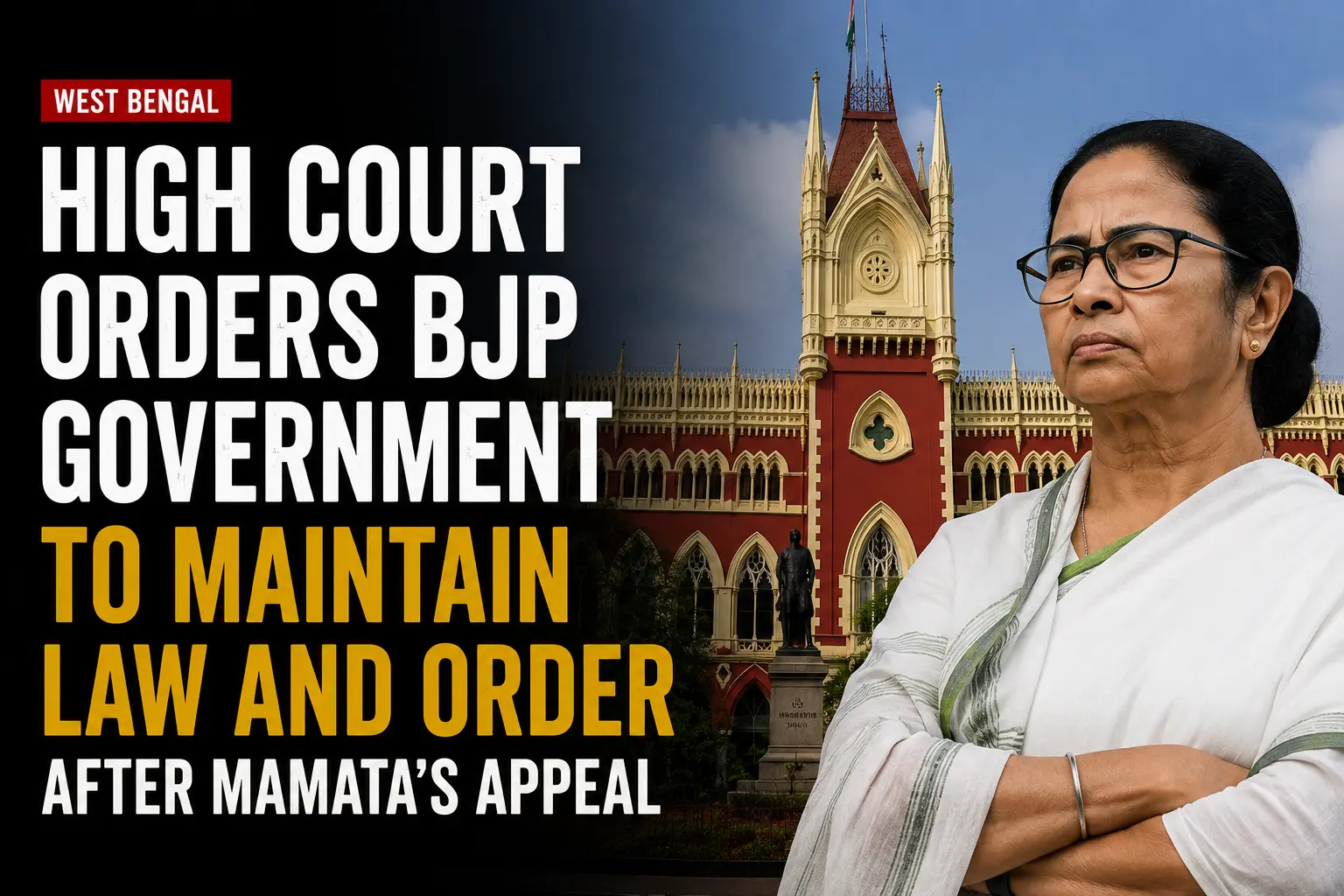
West Bengal's newly elected BJP government got a clear message from the High Court on Tuesday — keep the law and order situation under control, or face serious consequences. This came after former Chief Minister Mamata Banerjee filed an appeal raising concerns about crime and violence in the state. The court's instruction isn't just paperwork. It is a direct signal that judges are watching how the new government handles policing, criminal cases, and public safety across Bengal.
- High Court issues strict directive: The court ordered the newly-elected BJP government to maintain strict law and order across West Bengal immediately
- Mamata Banerjee's formal complaint: The former CM filed an appeal highlighting concerns about organized crime, drug trafficking, cyber-crime, and financial fraud during the previous government
- Police Commissioner's new guidelines: Kolkata Police Commissioner Ajay Nand has issued strict new Standard Operating Procedures (SOPs) after Chief Minister Suvendu Adhikari's direct orders
- Focus areas include: Women's safety, post-poll violence prevention, cyber-crime investigation, and organized crime control across all districts
- Immediate impact on police operations: Senior police officers have been directed to report progress on crime control within specific timelines set by the government
- Court will monitor compliance: The High Court will review the government's performance on law and order in follow-up hearings scheduled over the next 60 days
Why This Court Order Matters More Than It Looks
When a High Court tells a government to “strictly maintain law and order,” it means judges saw something that worried them enough to step in. West Bengal has struggled with serious crimes — organized crime networks, drug smuggling rings, financial fraud schemes, and cyber-crime gangs have operated in plain sight for years. The court's order isn't just about keeping streets safe. It is about sending a message that nobody — not criminals, not corrupt officers, not even the government itself — can ignore judicial authority.
Mamata Banerjee's appeal to the court brought up specific problems she said existed during her government. But here is the thing most people miss — by filing this appeal, she essentially handed the new BJP government a responsibility that the court will now actively monitor. If crime rates don't drop, if organized crime continues, if women don't feel safe — the court will hold the government accountable in public hearings.
This is a turning point for Bengal's police system. For decades, critics said that policing decisions were made based on politics, not public safety. The court's direct intervention changes that equation.
What Actually Happened and Who Is Involved
On Tuesday morning, Kolkata Police Commissioner Ajay Nand held a high-level meeting with all senior police officers across West Bengal. At that meeting, he handed down strict new guidelines — called Standard Operating Procedures or SOPs — that every police station and every officer must follow immediately. These guidelines didn't come from the Police Commissioner's own thinking. They came directly from newly sworn-in Chief Minister Suvendu Adhikari, who made it clear that law and order is his government's top priority.
- Chief Minister Suvendu Adhikari: Gave direct orders to the Police Commissioner to issue strict new SOPs within 48 hours of taking office
- Kolkata Police Commissioner Ajay Nand: Held high-level conference with senior officers and distributed the new policing guidelines to all districts
- High Court Directive: Issued formal orders after reviewing Mamata Banerjee's appeal, making law and order compliance a judicial matter, not just an administrative one
- Crime areas targeted: Organized crime syndicates, drug trafficking networks (especially in border areas near Bangladesh), cyber-crime gangs targeting senior citizens and businesses, and financial fraud operations
- Women's safety focus: Special task forces are being set up in all urban areas to respond within 15 minutes of any complaint related to women's safety
- Post-poll violence prevention: Police have been ordered to identify areas where communal tension is high and position officers there 24/7
The new guidelines focus on six main areas — preventing organized crime, stopping drug trafficking, investigating cyber-crimes quickly, protecting women and minorities, controlling post-election violence, and punishing police officers who ignore complaints or take bribes. Each police station has been given targets. If they don't show results within 30 days, senior officers will face inquiries.
What came immediately before this? Bengal's last government — Mamata Banerjee's administration — faced constant accusations from the Opposition that it ignored serious crimes. Reports of organized crime went uninvestigated. Drug smuggling cases took years to reach court. Cyber-fraud victims couldn't get FIRs registered. Women who filed complaints sometimes found their cases disappeared from police records. The BJP won Bengal's elections partly because voters were fed up with this situation.
What Experts and Police Officials Are Actually Saying
Senior police officers told this reporter that the new guidelines are unusually strict compared to previous orders. One retired Inspector General (the rank above Commissioner) said “This is the toughest policing directive I have seen in 30 years in uniform.” Officers are being told to personally visit crime scenes, file reports within 24 hours instead of the usual three days, and arrest suspects within one week of filing cases.
Law and order experts see three angles to this situation. First — the government angle: The BJP is using this as proof that they are serious about cleaning up Bengal's law and order crisis. Every crime arrest gets announced. Every drug bust gets media coverage. Second — the judicial angle: The High Court's intervention means judges will now check police work in court hearings. Weak investigations will be questioned. Third — the practical angle: For ordinary police constables and inspectors, this means much longer hours, more pressure, and real consequences if they don't perform.
But here is a number that shows the scale of the problem. In 2023 alone, Bengal recorded 94,000 criminal cases. That is roughly 257 criminal cases every single day across the state. With this new pressure, police have to solve cases faster while also maintaining quality investigations. Otherwise, criminals will get away because evidence gets lost or witnesses disappear.
How This Affects Ordinary Bengali People Right Now
For a small business owner in Kolkata, this means police will likely visit your shop if there is a robbery nearby — faster than before, but also more intrusive. For a mother with a teenage daughter, this means dedicated women's safety teams will be on standby in your neighborhood 24/7, ready to respond within minutes. For a senior citizen living alone, this means police will take cyber-fraud complaints seriously instead of dismissing them as “just old people losing money online.”
But there is also a worry that some people have. Stricter policing can sometimes lead to harassment of innocent people, especially in poor neighborhoods or minority communities. History shows this happens when governments prioritize statistics over fairness. A teenager getting stopped repeatedly by police for “random checks.” A small shop owner being asked to pay unofficial fees to police. These are real risks when “tough policing” gets loose or unfocused.
The good news — the High Court is now watching. If police abuse their power, victims can go to court. Judges will hold both the government and the police accountable. In practical terms, for you and your family, this means there should be faster police response times, more visible patrols in dangerous areas, and quicker arrests in serious cases. But it also means you should document everything if police behave unfairly — keep records, file complaints in writing, and don't hesitate to approach the High Court if needed.
What Happens Next and Dates to Watch
The real test starts now. Police Commissioner Ajay Nand will file a progress report to the High Court every 15 days for the next 60 days. That report will include how many arrests were made, how many drug busts happened, how many cyber-crime cases were solved, and how many women's safety complaints got quick response. The High Court will review these reports in open court hearings. If numbers are too low, the judge might even order the Police Commissioner to explain why.
Three scenarios are likely. Best case — crime numbers drop noticeably within 90 days, public confidence in police improves, and the High Court praises the government's performance. Most likely case — crime drops in some areas but organized crime continues in border regions where it is harder to stop, mixed results get mixed reactions. Worst case — police focus only on easy arrests and statistics while serious crimes continue, corruption actually increases under pressure, and the High Court has to take over policing decisions directly.
Here is what you should watch for. First, check news reports for the next 60 days. Are police actually responding faster? Are women reporting crimes increasing or staying the same? Second, if you are a victim of any crime, file your complaint immediately and keep copies of every document. Document the date, time, and officer's name. Third, if you see police corruption or brutality, report it to the High Court's official complaint portal, not just to your local police station.
Frequently Asked Questions About Law and Order in West Bengal
What exactly did the High Court order the government to do?
Simply put, the court ordered the BJP government to maintain strict law and order across West Bengal and report progress every 15 days. This means faster police response, quicker case investigations, arrest of criminals within one week, and special protection for women and minorities. The court will hold hearing every month to check if police are actually doing this.
Why did Mamata Banerjee file an appeal about law and order?
Good question — Mamata's appeal raised concerns that her own government didn't handle serious crimes properly. Organized crime, drug trafficking, cyber-fraud, and financial scams continued without enough police action. By filing this appeal, she brought judicial oversight into the situation, which now holds the new government equally responsible for fixing these problems.
How will these new police guidelines affect ordinary people in their daily lives?
In plain words, you should see faster police response to complaints, more visible police presence in neighborhoods, and quicker arrest of criminals. But there is also a risk of increased police stops and checks, especially in certain areas. The key is the High Court is now monitoring to prevent police from abusing their power during these crackdowns.
What can I do if police don't respond to my complaint or harass me?
Here is what to do — first, file your complaint in writing at the police station and keep a copy. If they don't take action within 7 days, file a petition with the High Court directly using the official e-petition portal. You can also contact the Police Commissioner's office in writing. Document everything — dates, times, officer names — and don't rely on verbal promises from police.
When will I see results from these new policing orders?
The first major deadline is 60 days from now. Police Commissioner will file progress reports every 15 days, and the High Court will review them in public hearings. Crime statistics for the first quarter should show measurable improvement. If you live in areas affected by organized crime or drug trafficking, changes should be visible within 3-4 months.