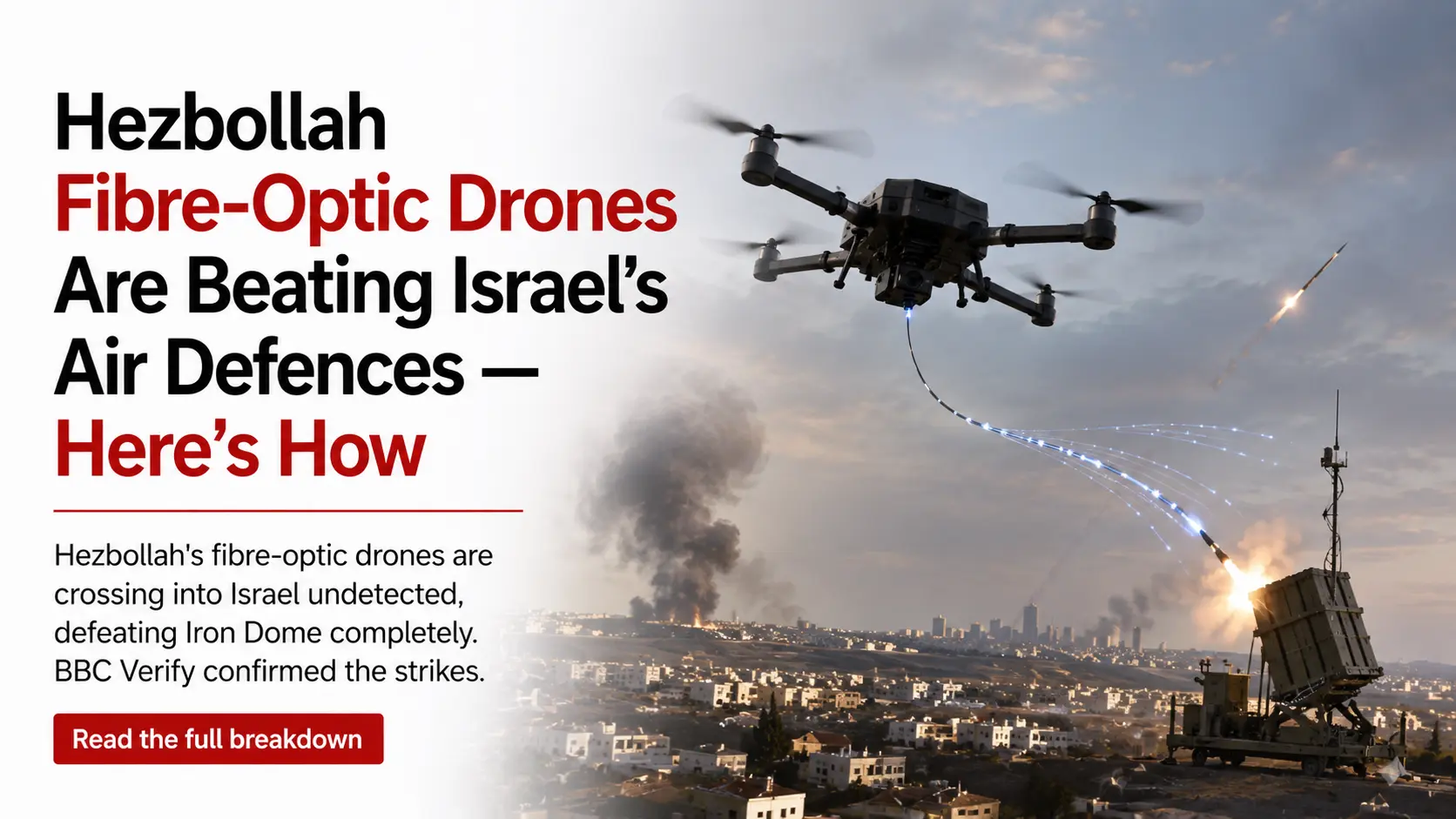
Hezbollah Fibre-Optic Drones Are Beating Israel's Air Defences — Here's How
A small drone—no bigger than a ceiling fan—crosses the Israel-Lebanon border without anyone noticing, weaves through trees, follows a soldier for several seconds, and then strikes. Unreal. Israel's Iron Dome, one of the most expensive air defence systems ever built, does absolutely nothing. No joke. Because this drone doesn't use radio signals; it uses a thin wire—thinner than your phone charger cable—made of glass fibre, and that wire makes it almost invisible to every radar and jamming system Israel has. BBC Verify has now gone through dozens of videos showing these attacks, and what they found is genuinely alarming. This isn't just a Middle East story. It's about a small armed group using cheap technology to outsmart a billion-dollar defence system—and it's working.
- Look, BBC Verify went through dozens of Hezbollah's fibre-optic drone attack videos targeting Israel Defence Forces (IDF) positions on the northern Lebanon border.
- Hezbollah's using fibre-optic guided drones, not radio-controlled ones, which makes them almost impossible for standard Israeli electronic defences to jam or even spot.
- There's at least one confirmed strike where a drone literally chased and hit an IDF soldier, crossing the border completely undetected and injuring personnel at an IDF position.
- Israel's Iron Dome air defence system, which costs a fortune (thousands of crores of rupees) to run, is proving pretty much useless against these low-flying, wire-guided drones.
- And experts think Hezbollah might be using drone tech similar to Russian FPV (first-person view) drones from the Ukraine war—a huge shift in tactics for non-state armed groups everywhere.
- Meanwhile, ceasefire talks are stuck, and analysts say these drone strikes aren't just military—they're a political pressure tool.
How Did a Lebanese Armed Group Get This Good at Drones?
Hezbollah has been around since the 1980s, and for most of its history, it fired rockets—the kind that go up in an arc and land somewhere, not always where you want. Big shift. Rockets are loud, radars catch them, and missiles can shoot them down. Not anymore. But drones are different. They fly low. They're quiet. And the newer ones don't even need a radio signal to fly—which means jamming equipment, the thing armies use to block enemy drones, simply doesn't work on them.
The fibre-optic drone is the latest version of this change. Think about it. Imagine flying a kite, but instead of wind, you're using a hair-thin glass wire to send instructions. That's real. The wire carries the signal from the operator to the drone. There's no wireless transmission to block. No radio wave to catch on radar. Nothing to jam. For an Israeli soldier on the ground, the first sign of the drone might be the last thing they see before it hits.
So how did Hezbollah get this technology? Key point. That's the question defence experts are scrambling to answer. And? And the early answer—as seen in multiple reports—points toward Russian military drone technology, specifically the FPV (first-person view) drones that Russia has been using extensively in Ukraine since 2022. Has Russia directly supplied Hezbollah? Or did Hezbollah's engineers simply study what Russia was doing and copy it? Either way, the result is the same.
Think about what this means for India's own security planners—because if a non-state group in Lebanon is now using military-grade drone tech adapted from a major war, every country in the world needs to take note. Huge. This isn't science fiction. Facts. It's happening right now, on video, for anyone to watch.
And here's why that matters.
What BBC Verify Actually Found in Those Drone Videos
BBC Verify—the BBC's fact-checking and visual investigation team—spent significant time going through dozens of videos that Hezbollah itself released, plus footage captured by IDF soldiers and bystanders. The result? Here's what the videos actually showed:
- Fibre-optic wire trailing behind the drone: In several clear shots, you can see a thin thread coming off the back of the drone as it flies. That's the optical fibre—the “wire” that makes these drones unjammable. It spools out from the drone like thread from a bobbin as it moves forward.
- First-person view camera footage: The operator sees exactly what the drone sees, in real time, through a headset or screen. This allows pinpoint control—the drone can literally chase a moving person.
- One drone chasing an IDF soldier: One of the most shared videos shows a drone tracking and then striking an individual Israeli soldier. The footage—confirmed as genuine by multiple visual verification teams—shows the drone adjusting its path as the soldier moves. The soldier didn't get away.
- Strikes on IDF positions near the northern border: Several videos show drones flying into military positions, vehicles, and structures. Some hit Iron Dome battery components. One strike was confirmed to have injured IDF soldiers.
- Border crossings go undetected: Multiple videos show drones crossing from Lebanese territory into Israel without any visible interception attempt. This is the part that has Israeli military planners so deeply worried.
- Evolving attack patterns: Early Hezbollah drone videos from 2023 showed simpler attacks. The 2025 and 2026 videos show much more complex flight paths—the drones now navigate around obstacles, follow moving targets, and approach from unexpected angles.
BBC Verify cross-checked the locations shown in the drone footage using satellite imagery and landmark matching. True. The strikes are real. Yep. The locations are confirmed. And the IDF hasn't publicly disputed most of them.
Wow.
What happened right after these strikes? Israel launched air raids into southern Lebanon. And more. More Hezbollah positions were hit. And now? But the drones kept coming. This isn't a problem you solve with bombs. You need a different kind of defence—and right now, Israel doesn't fully have one.
The kind of thing most people miss.
Why Israel's Iron Dome Can't Stop These Drones
Let's talk about Iron Dome for a second. Right? Most people in India have heard of it but don't know exactly what it does.
So Iron Dome is a missile-based defence system—it uses radar to detect incoming rockets and missiles, calculates where they'll land, and if they're heading somewhere dangerous, fires an interceptor missile to blow them up in the air. Big deal. It works brilliantly against rockets. Read that again. Israel's defence ministry says it has a success rate of over 90% against the rockets Hezbollah and Hamas usually fire.
Period.
But here's the problem: fibre-optic drones fly extremely low—sometimes just a few metres above the ground or treetops. That stings. They don't show up on the kind of radar that Iron Dome uses. Wild. Even if radar did catch them, sending a multi-lakh-rupee interceptor missile to shoot down a small drone would be like using a sledgehammer to swat a mosquito. You'd run out of missiles—and money—very quickly.
Look, Israel does have other systems—laser weapons, electronic jamming, small-drone interceptors—but the fibre-optic design specifically defeats electronic jamming. Not small. And laser systems, while promising, aren't yet deployed widely enough to cover every position along the 120-kilometre Lebanon border.
For an Israeli soldier stationed at a forward position near the border, this gap in defence is terrifying. Let that sit. Imagine sitting in a bunker knowing that a drone the size of a schoolbag could come through the window at any moment, and there's no alarm, no radar beep, no warning system that will go off before it gets there. That's the truth. That's the current reality for IDF troops in northern Israel.
And that's just the beginning.
What This Means for the Rest of the World — Including India
Here's the part that goes beyond Lebanon and Israel. Worth it. And where does that leave the rest of us?
And India has land borders with both Pakistan and China—two countries that have invested heavily in drone technology, with Pakistan using them to smuggle weapons into Punjab. And that's big. China has been developing military drones at a pace that has alarmed defence experts across Asia. Nobody talks about this. And the lesson from Lebanon is this: expensive, sophisticated air defence systems aren't automatically useful against cheap, wire-guided drones.
For an Indian Army officer stationed near the Line of Control in Jammu and Kashmir, this research from BBC Verify should be required reading. Big. Because the same fibre-optic drone technology that Hezbollah is using against IDF positions could, in theory, be used against Indian Army posts. Period. The technology isn't secret. It isn't rare. It can be built from commercially available parts with some technical knowledge.
Think.
Indian defence experts have been warning about FPV drones—the kind used heavily in the Russia-Ukraine war—for over two years now. And? The Indian Army has started its own drone programmes and has reportedly been studying Ukraine war drone tactics closely. Right? But translating that into frontline readiness takes time. And Hezbollah's videos show that time may be shorter than expected.
The global arms industry is also watching. Yep. Countries that export defence equipment—including Israel itself, which is one of the world's biggest weapons exporters—will now have to rethink what they sell and to whom. And here's why that matters. Because if a non-state group can beat a top-tier defence system with a glass wire and a small camera, the entire market for expensive air defence upgrades needs rethinking.
But not for the reasons you'd expect.
What Happens Next in Lebanon and Israel
Ceasefire talks between Hezbollah and Israel are still happening—but they've been going in circles. The result? The drone strikes are, according to multiple analysts, Hezbollah's way of keeping pressure on Israel at the negotiating table. True. Every time a drone hits an IDF position, it's a message: “We can keep doing this. Can you afford to ignore us?”
Three scenarios are possible right now. Think about it. First, the best case: ceasefire talks succeed, both sides pull back from the border, and the drone attacks stop—at least for now, likely requiring a deal brokered through Qatar or the United Nations. And now? Second, the most likely scenario: low-level drone attacks continue, Israel responds with targeted air strikes, and the situation stays in a dangerous stalemate for weeks or months. And third, the worst case: a drone kills a senior IDF officer or hits a major Israeli civilian target, Israel launches a large-scale ground operation into southern Lebanon, and the region tips into a wider war—pulling in Iran and potentially dragging in American military assets.
Here's what we know: Iran has already sent a warning to the UAE, according to Iranian Foreign Minister Abbas Araghchi, accusing countries that worked with Israel during the recent US-Israel conflict with Iran of “colluding” against the region. Let that sit. That warning shows how quickly the situation could spread beyond just Lebanon and Israel.
Watch for two things in the coming weeks. Key point. First, whether Israel announces any new anti-drone technology deployment along the northern border—that will be a sign of how seriously they're taking this threat. And more. Second, whether Hezbollah escalates to larger or more complex drone swarms—multiple drones attacking at once—which would be a major step up in their capabilities and a sign that a ceasefire is still far away.
Big shift.
Frequently Asked Questions About Hezbollah's Fibre-Optic Drone Attacks
What is a fibre-optic drone and why is it so hard to stop?
Honestly—it uses a thin glass wire, not radio signals, to get instructions. Since there's no wireless signal to block, standard jamming equipment is useless. Israel's electronic defences can't interfere, making them incredibly hard to stop.
How is Hezbollah getting this advanced drone technology?
Simply put, defence analysts believe the tech looks a lot like Russian FPV drones from the Ukraine war. It's not fully confirmed if Russia directly supplied them or if Hezbollah's engineers just copied the designs from public info. The 'how' is less important than the 'what'. And what's confirmed is that these drones are real, effective, and a massive leap forward from what they were using just a couple years ago.
Does this kind of drone threat affect India's security too?
Here's the short version: Absolutely. India faces drone threats from both Pakistan and China. The key lesson here is that cheap drones can beat pricey defence systems. Indian planners are studying this, but readiness gaps along the border are a real concern.
Can Israel's Iron Dome shoot down these drones?
Good question. The honest answer is no, not effectively. Iron Dome is built to stop high-flying rockets, not low-flying drones that don't use radio signals. It's like using a cannon to shoot a fly—you'd waste expensive interceptor missiles very quickly. Israel is developing other solutions, like lasers, but they just aren't widely deployed enough yet to cover the entire 120-kilometre border.
What is the current situation between Hezbollah and Israel — is a ceasefire coming?
Look—talks are ongoing, but no deal is signed. Both sides are still fighting, basically using violence as a negotiation tactic. While mediators from Qatar and the UN are involved, most experts think a real ceasefire is still weeks away, at best.