Title: Iran Seizes 'Floating Armoury' Ship in Gulf of Oman — What Happened
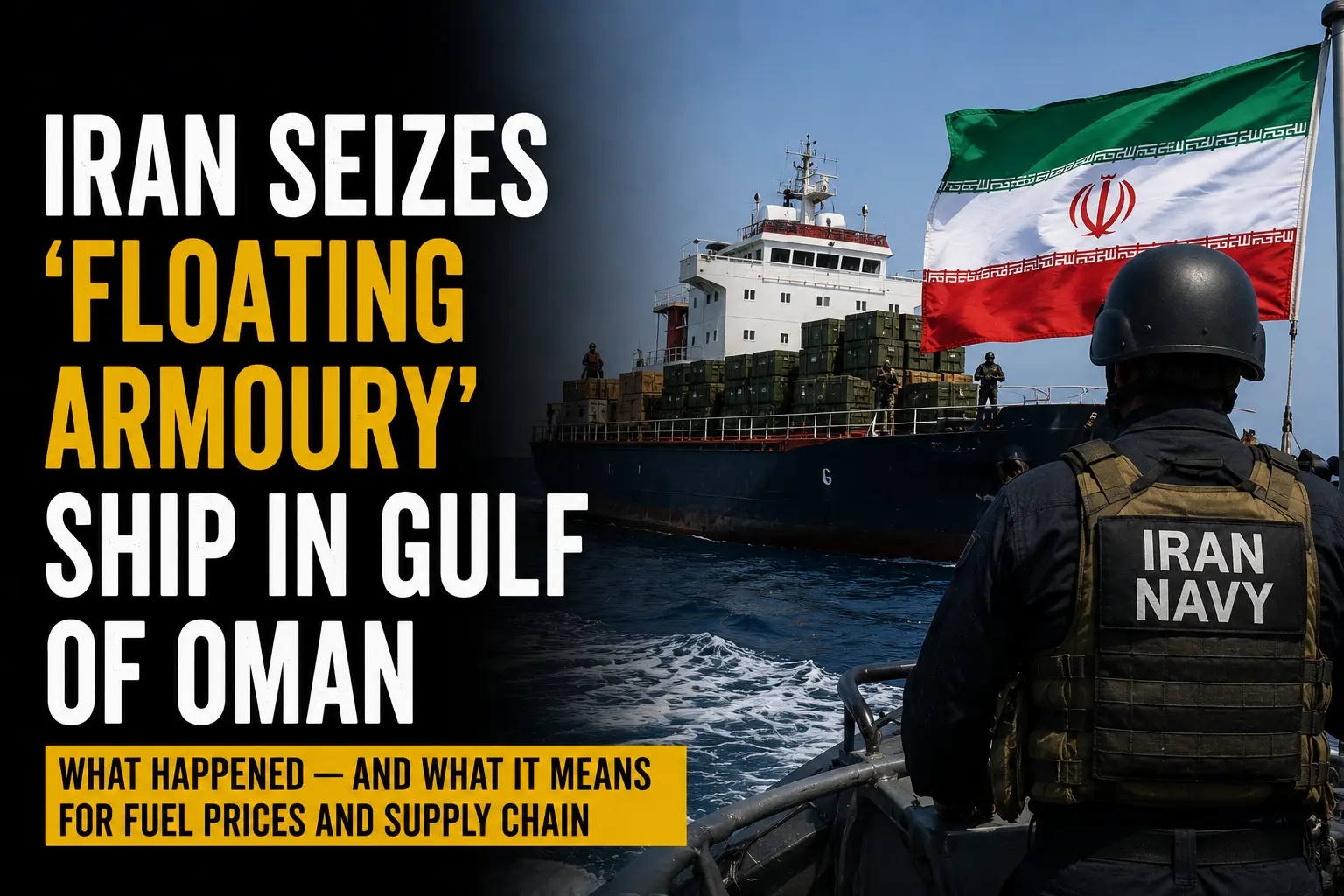
Armed Iranian soldiers just boarded and seized a ship in the Gulf of Oman — a vessel that officials are calling a “floating armoury” — which happened just days after Iran's Islamic Revolutionary Guard Corps (IRGC) grabbed two more commercial ships near the Strait of Hormuz. Big deal. One of them was even on its way to India. No joke. Think about that for a second: a ship carrying goods headed straight to Indian shores, stopped cold by masked gunmen in the middle of the sea. Is this really a surprise? If you ship anything, buy anything imported, or simply fill petrol in your car, this story is about you. So what exactly is going on in these waters — and why should every Indian family be paying attention right now?
- Iranian IRGC forces grabbed a ship they called a “floating armoury” out in the Gulf of Oman in April 2026.
- Two other ships, the MSC Francesca and Epaminondas, were also seized near the Strait of Hormuz; one was India-bound.
- Iran's official line is that the ships were “tampering with navigation systems” and didn't have the right permits.
- The Strait of Hormuz is a big deal, handling about 20% of the world's oil — any blockage there hits India's fuel prices. Hard.
- India hasn't yet officially confirmed crew details or made a formal public statement about the India-bound ship as of late April 2026.
- Look, if you're an Indian importer, run a shipping company, or just buy goods from the Middle East or Europe, you need to track this.
Think.
The Sea Route That Keeps India Running — And Why Iran Controls It
Picture a very narrow water channel, just about 33 kilometres wide at its thinnest point—that's the Strait of Hormuz. Wow. Every single day, roughly 20 million barrels of oil pass through it. True. For India, this isn't just a geography lesson. Almost 85% of India's crude oil (that's the raw oil we refine into petrol and diesel) comes from the Middle East. A big chunk of it travels through this exact strait before ever reaching Indian shores.
Now, imagine someone putting a checkpoint on that route and stopping ships whenever they want. That's real. That’s essentially what Iran has been doing. Period. The IRGC—Iran's powerful military force—has a history of seizing vessels in this area whenever tensions rise with Western countries or their allies. The last big round of ship seizures happened in 2023, and before that in 2021. But this latest wave? It's hitting closer to home for India than ever before.
The India-bound ship grabbed this time was reportedly headed to an Indian port when Iranian soldiers stopped it. That's not a small thing. That's a supply chain connecting Indian businesses, Indian factories, and ultimately Indian families, interrupted by a military force thousands of kilometres away. And now? So who exactly did this, and what did they say about it?
And here's why that matters.
What Actually Happened — Ships Seized, Soldiers with Guns, and Dramatic Footage
On April 22, 2026, Iran's IRGC Navy stopped and seized at least two commercial ships trying to cross the Strait of Hormuz. Big shift. Then, a day later, a separate vessel—described as a “floating armoury”—was seized in the nearby Gulf of Oman. A floating armoury, by the way, is a ship that stores weapons and ammunition for other vessels. Not anymore. Security companies use them so that cargo ships can pick up armed guards in international waters and then return the weapons before entering a port where guns aren't allowed.
- MSC Francesca: A Panama-flagged container ship that Iran's IRGC linked to “the Zionist regime”—meaning Israel. This ship reportedly took damage after being fired upon before soldiers boarded it.
- Epaminondas: The second vessel seized at the same time. And this is the ship that was reportedly bound for India when it was stopped and taken toward the Iranian coast.
- The “floating armoury” vessel: Seized in the Gulf of Oman, a body of water right next to the Strait of Hormuz. Fewer details are out there about this ship, but its seizure suggests Iran is widening the area it's willing to act in.
- Iran's official reason: The IRGC Navy put out a statement saying both MSC Francesca and Epaminondas were caught “operating without necessary permits and tampering with navigation systems,” which it claimed was endangering safety.
- Masked soldiers on video: And Iran released footage—clearly meant to send a message—showing armed, masked Iranian soldiers boarding and taking over the ships. The images went global within hours.
- Ships taken to Iran: Here's what we know: according to Iran's semi-official Tasnim News Agency, both seized commercial vessels were directed to the Iranian coast. Crews were still on board.
And the IRGC didn't mince words. Huge. Their statement called MSC Francesca a ship “linked to the Zionist regime”—this is Iran's way of saying the ship has ties to Israel or Israeli-connected businesses. Wild. The timing matters too. Iran and Israel have been in a fierce, dangerous standoff since late 2023, with strikes and counter-strikes. Seizing ships connected—even loosely—to Israel is part of how Iran fights that war without firing missiles directly.
But here's what makes this complicated: Epaminondas, the India-bound ship, doesn't have an obvious Israeli connection. That stings. So why was it stopped? Let that sit. That question is still unanswered—and it's the one New Delhi needs to be asking very, very loudly.
Really.
Nobody is talking about this enough.
The Real Picture — Why Iran Keeps Doing This and What the World Thinks
Iran has seized over a dozen ships in the Persian Gulf and Strait of Hormuz since 2019. Every single time, they give a legal-sounding reason—navigation violations, permit issues, environmental offences. Key point. But experts who watch this region closely say the real reason is almost always political. That's the truth. When the United States or Israel does something Iran doesn't like, ships start getting seized. It's Iran's way of showing muscle without starting a full-scale war.
From the Western point of view, this is straight-up piracy dressed up in official language. The United States, United Kingdom, and their allies have called these seizures illegal and violations of international maritime law. And? They've even tried running naval escort missions to protect commercial ships in the region—with mixed success. But who really benefits here?
From Iran's point of view, they're just protecting their territorial waters and pushing back against what they call unfair Western sanctions (these are rules that stop other countries from doing business with Iran). And now? Iran's economy has been badly hit by these sanctions, and seizing ships gives the government a way to show its own people that it's fighting back.
And India? India tries to stay in the middle—it has good trade ties with Iran, buys some oil from them, and doesn't want to take sides in a fight between Iran and the West. Yep. But when an India-bound ship gets grabbed, that balance becomes very hard to maintain. That's real. India can't just stay quiet when its own supply chains are being disrupted. Diplomatic circles in New Delhi were reportedly watching this situation very carefully as of late April 2026.
Worth paying attention to.
How This Hits Ordinary Indians — Your Grocery Bill, Your Petrol, Your Job
Let's be very direct about this. You might be sitting in Pune or Patna and thinking—what does a ship seizure in the Gulf of Oman have to do with me? And why does this matter right now? The answer is: quite a lot, actually.
For a truck driver in Gujarat hauling goods from a port city, any delay in ships reaching India means cargo piles up, schedules go haywire, and income gets uncertain. Think about it. For a small factory owner in Ludhiana who imports machinery parts from Europe via sea routes, a disruption near the Strait of Hormuz can delay deliveries by weeks and push costs up by 15 to 20 percent overnight. And for a family in Delhi filling up their car or cooking gas cylinder? If oil tankers face delays or rerouting through this critical chokepoint, fuel prices feel it within weeks. And more.
India imports goods worth thousands of crore rupees every month through sea routes that pass near or through the Gulf of Oman and the Strait of Hormuz. Big. Even a small increase in shipping insurance costs—which happens every time there's a seizure like this—adds up to higher prices on everything from electronics to medicines to cooking oil. The result?
So what should you do right now? If you run a business that imports goods through these routes, call your shipping agent today and ask specifically about insurance costs and rerouting risks. If you're a regular consumer, keep an eye on fuel prices over the next 3 to 4 weeks—that's usually when these events start showing up at the petrol pump. And if you're in the government job space or foreign affairs, this story is going to be a big one to follow in the coming months.
Period.
What Comes After This — Key Things to Watch in the Next Few Weeks
A few things will tell us how serious this situation is going to get. First, watch whether India officially raises this with Iran through diplomatic channels. Read that again. As of late April 2026, there's been no loud public statement from New Delhi—but that doesn't mean nothing is happening behind closed doors. Facts. India has an embassy in Tehran and uses quiet diplomacy in situations like this. Second, watch what happens to the crews on these ships. Crew welfare is usually the first thing governments push for—and if Indian nationals are on board any of these vessels, that will force India's hand much faster.
But here's the real question—what happens next? Three possible ways this plays out. Best case: Iran releases the ships quickly, offers a diplomatic explanation, and things go back to normal within a week or two. This has happened before. Most likely: the ships are held for a few weeks while Iran uses them as bargaining chips in a bigger negotiation with the West, and the crews are eventually released unharmed. Worst case: tensions between Iran and Israel escalate further, more ships get seized, and the entire Gulf region becomes too risky for normal commercial shipping, which would send oil and import prices spiralling across India.
Here's the thing—the single thing to keep your eye on right now is whether the United States imposes fresh sanctions on Iran in response to these seizures. That's usually the move that triggers Iran to either back down—or double down. And that's big. Watch the next two weeks very, very carefully.
And that's just the beginning.
Frequently Asked Questions About Iran Ship Seizures
What is a “floating armoury” ship and why was one seized by Iran?
Simply put, a floating armoury is a ship that stores weapons for hire. Security companies park these ships in international waters so cargo vessels can pick up armed guards and then return them. Iran seized one, likely to flex military muscle.
Why does the Strait of Hormuz matter so much to India?
Here's the short version: roughly 85% of India's crude oil comes from the Middle East, and a massive chunk of it travels through the Strait of Hormuz. This narrow sea channel—just about 33 kilometres wide—is essentially India's oil lifeline, a critical chokepoint for the nation's energy security. Any disruption here, even for a few days, can push up petrol, diesel, and cooking gas prices across the entire country within weeks. It's a direct hit to the economy.
How does an Iran ship seizure affect ordinary Indian families?
Honestly—it shows up in your wallet. When ships are seized, shipping companies charge more for insurance. That extra cost gets passed on to importers, then to sellers, and finally to you. Petrol prices, electronics, and even some food items get costlier.
What is India's official position on the seized India-bound ship?
Good question. As of late April 2026, India hasn't made a loud public statement about the Epaminondas seizure, which isn't unusual. India typically uses quiet diplomacy with Iran, given its complex trade and energy ties with Tehran. But if Indian crew members are on board, or if the ship carries critical Indian cargo, you can bet the government will be under immense pressure to speak up publicly and demand the vessel's immediate release.
What happens next — will Iran release the seized ships?
Look—Iran usually holds seized ships for days to weeks, uses them as diplomatic pressure, and then releases them. That's happened several times since 2019. The real question is whether fresh US sanctions or an Israeli military response changes that pattern this time. It's a high-stakes game. The next two weeks will tell us everything.