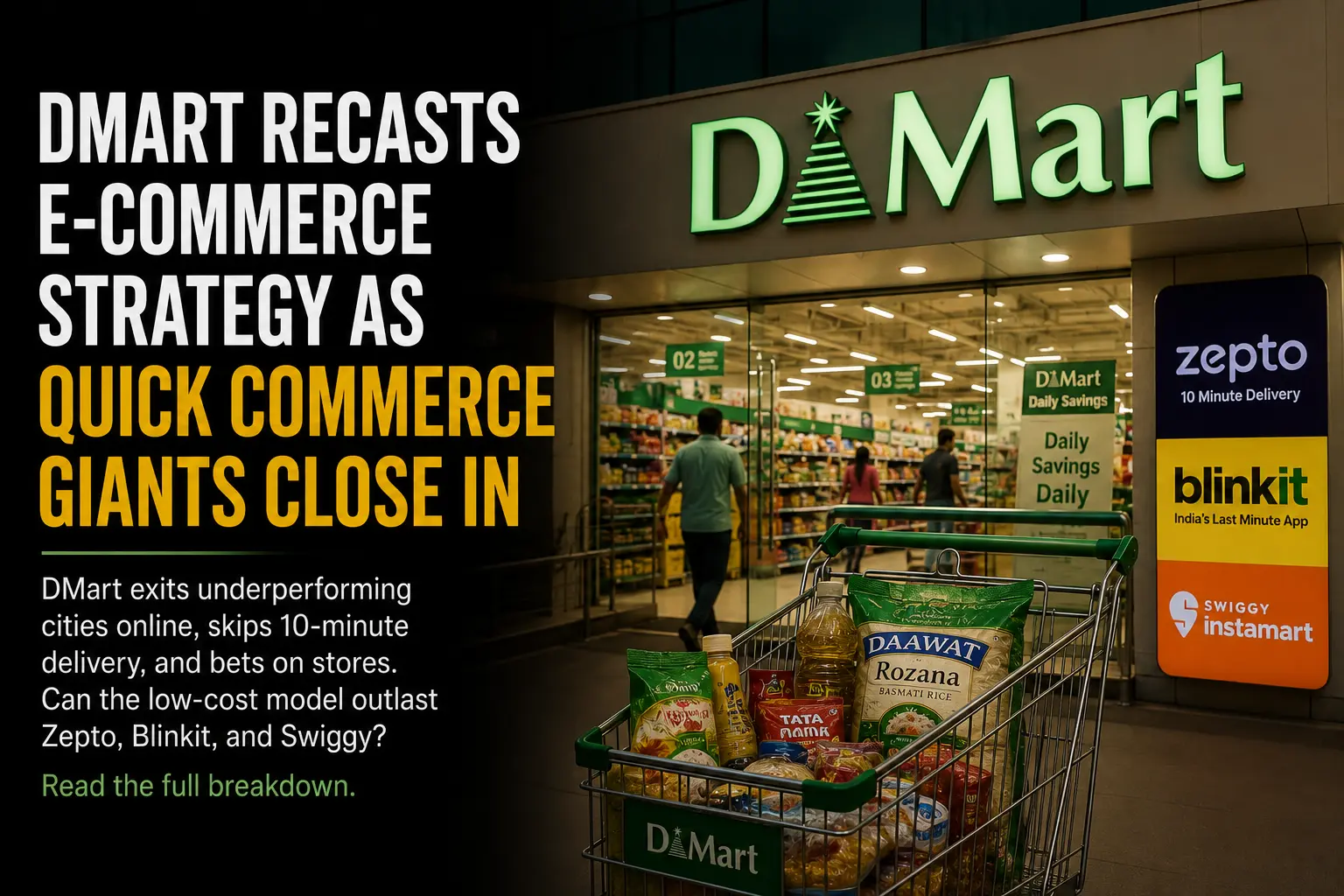
DMart has quietly pulled out of several cities where its online grocery arm was losing ground. There wasn't a press release or an earnings call explanation, just a clean exit. While Zepto, Blinkit, and Swiggy Instamart spend heavily to put groceries at your door in ten minutes, India's most disciplined retailer is making the opposite bet: that the physical store, priced sharper than anyone else, still wins.
- DMart has exited multiple cities where its e-commerce operations were underperforming, according to company disclosures.
- The retailer has chosen not to enter the ten-minute quick commerce race dominated by Zepto, Blinkit, and Swiggy Instamart.
- DMart's core strategy remains its low-cost, high-volume physical store model — a model that has made Avenue Supermarts one of India's most profitable retail businesses.
- Retail investors tracking Avenue Supermarts (NSE: DMART) should watch whether the e-commerce retreat affects quarterly same-store sales growth figures.
- The outcome of this bet will take time to show up in the numbers — but the strategic direction is now unmistakable.
The Retreat No One Announced
DMart Ready, the company's e-commerce arm, has been quietly shrinking its city footprint. There wasn't fanfare about the exit — which, in itself, tells you something. Avenue Supermarts, DMart's parent company, has always communicated in numbers rather than narratives. When a geography stops making sense, they leave it.
For a company that built its reputation on obsessive cost control — owning its store properties instead of leasing them, refusing to stock slow-moving SKUs, passing savings to customers rather than to marketing budgets — an unprofitable online operation in a distant city simply doesn't belong in the model. The logic is cold. But it's consistent.
This isn't a company that chases trends. DMart skipped the private label boom when every other supermarket chain was launching house brands. It skipped aggressive loyalty programs. And now, it's skipping ten-minute delivery — the most expensive trend in Indian retail today.
What Quick Commerce Actually Costs
Zepto, Blinkit (owned by Zomato), and Swiggy Instamart have built their speed on a network of dark stores — small urban warehouses stocked specifically for fast delivery, not browsing. Each dark store costs money to lease, staff, and replenish. Each delivery involves a rider, a platform cut, and often a discount. Unit economics for quick commerce, by most analysts' reading, remain deeply challenged even as order volumes grow.
For a family buying groceries in Bandra or Koramangala, ten-minute delivery feels like magic. But somewhere in that transaction, someone's absorbing a cost that the ticket price alone doesn't cover. Right now, that someone is the platform — funded by venture capital and public market patience.
DMart's management has watched this and, per the company's strategic positioning, decided not to play that game. The market's asking: what happens when the subsidies run out?
The Store Model — Still the Core Bet
Walk into any DMart on a Saturday morning in Pune, Ahmedabad, or Hyderabad and you'll understand what the company's protecting. The stores are crowded, the prices are visibly lower than neighborhood kirana shops on staples, and the checkout queues — long as they are — keep moving. The experience is transactional, not aspirational. And for most Indian middle-class families doing a weekly or fortnightly grocery run, that's exactly what they want.
DMart's physical retail model works because of scale and discipline. The company owns most of its store properties, which means its fixed costs don't rise when rents do. It stocks a curated range — not everything, but the things most families actually buy. It doesn't discount selectively; the low price is the everyday price.
For a household in Nagpur or Surat spending ₹6,000–₹8,000 a month on groceries, a consistent 10–15% saving at DMart over the neighborhood general store adds up to real money across the year. That value proposition doesn't disappear because Blinkit delivers Maggi in eight minutes.
The Risk DMart Is Taking
The concern for long-term investors in Avenue Supermarts (NSE: DMART) is a straightforward one: what if quick commerce doesn't collapse under its own costs? What if it finds a sustainable model — through higher basket sizes, premium memberships, or advertising revenue — before DMart's store-first strategy can respond?
Urban grocery habits are shifting. A younger buyer in Bengaluru who uses Blinkit for top-ups and Swiggy Instamart for midnight snack runs may never build the habit of the weekend DMart trip. If that behavior locks in across enough households in enough cities, DMart's addressable urban market shrinks — not suddenly, but steadily.
DMart's e-commerce exit from underperforming cities is honest about the present reality. But it also signals a company that's, for now, choosing depth over breadth — serving its existing, loyal, price-sensitive base exceptionally well rather than chasing a new kind of customer it hasn't figured out how to serve profitably.
What Retail Investors Should Watch
Avenue Supermarts trades on the NSE under the ticker DMART. It has historically commanded a premium valuation — a reflection of market confidence in the company's execution discipline. The e-commerce pullback, on its own, isn't likely to move that needle significantly. DMart Ready was never a material contributor to revenue compared to the physical store network.
What matters more is same-store sales growth in the physical network, new store additions, and whether gross margins hold as competition for the price-sensitive customer intensifies — not just from quick commerce, but from a resurgent kirana sector enabled by wholesale apps like Udaan and JioMart.
Investors watching DMART should track quarterly earnings commentary from Avenue Supermarts' management on two specific questions: how many new stores were added, and whether ticket sizes at existing stores are growing or shrinking. Those two data points will tell you far more about DMart's health than the e-commerce headlines will.
Frequently Asked Questions About DMart and Quick Commerce
Why did DMart exit some cities on its e-commerce platform?
DMart exited cities where its online grocery arm wasn't performing well financially. The company has always prioritized cost discipline over scale for its own sake. Operating an unprofitable e-commerce presence in a distant city doesn't fit that model, so the company pulled back rather than spend to chase market share.
Is DMart entering ten-minute quick commerce delivery?
No, per the company's strategic direction. DMart has chosen not to compete in the ten-minute delivery space dominated by Zepto, Blinkit, and Swiggy Instamart. The company's position is that its low-cost physical store network serves its core customer base better than an expensive rapid-delivery model would.
Does the e-commerce pullback hurt DMart's stock or financials?
DMart Ready, the e-commerce arm, isn't a major revenue driver compared to the company's physical stores. The pullback from underperforming cities is unlikely to materially affect Avenue Supermarts' overall financials. Investors should focus on same-store sales growth and new store openings as more reliable indicators of business health.
Can DMart's store model survive the rise of quick commerce?
That depends on whether quick commerce platforms find a sustainable unit economics model. For now, DMart's stores retain a strong hold on price-sensitive, middle-class households doing large weekly or fortnightly grocery runs. The risk is that younger, urban consumers may permanently shift to on-demand delivery habits over time.
What should I watch to track DMart's performance going forward?
Track Avenue Supermarts' quarterly earnings for three metrics: same-store sales growth at existing stores, the pace of new store additions, and any commentary from management on whether the e-commerce strategy is being reconsidered. These will signal whether the store-first bet is holding.
The biggest supermarket chain built on the principle that a great store, at a great price, in the right location doesn't need to also be an app. That principle is now being tested at scale — by three well-funded rivals who believe location is irrelevant when delivery takes ten minutes. One of them is wrong. The market will find out which.
Investment Disclaimer: This article is for informational purposes only and does not constitute investment advice. Stock market investments are subject to market risks. Past performance is not indicative of future results. Please consult a SEBI-registered financial advisor before making investment decisions.