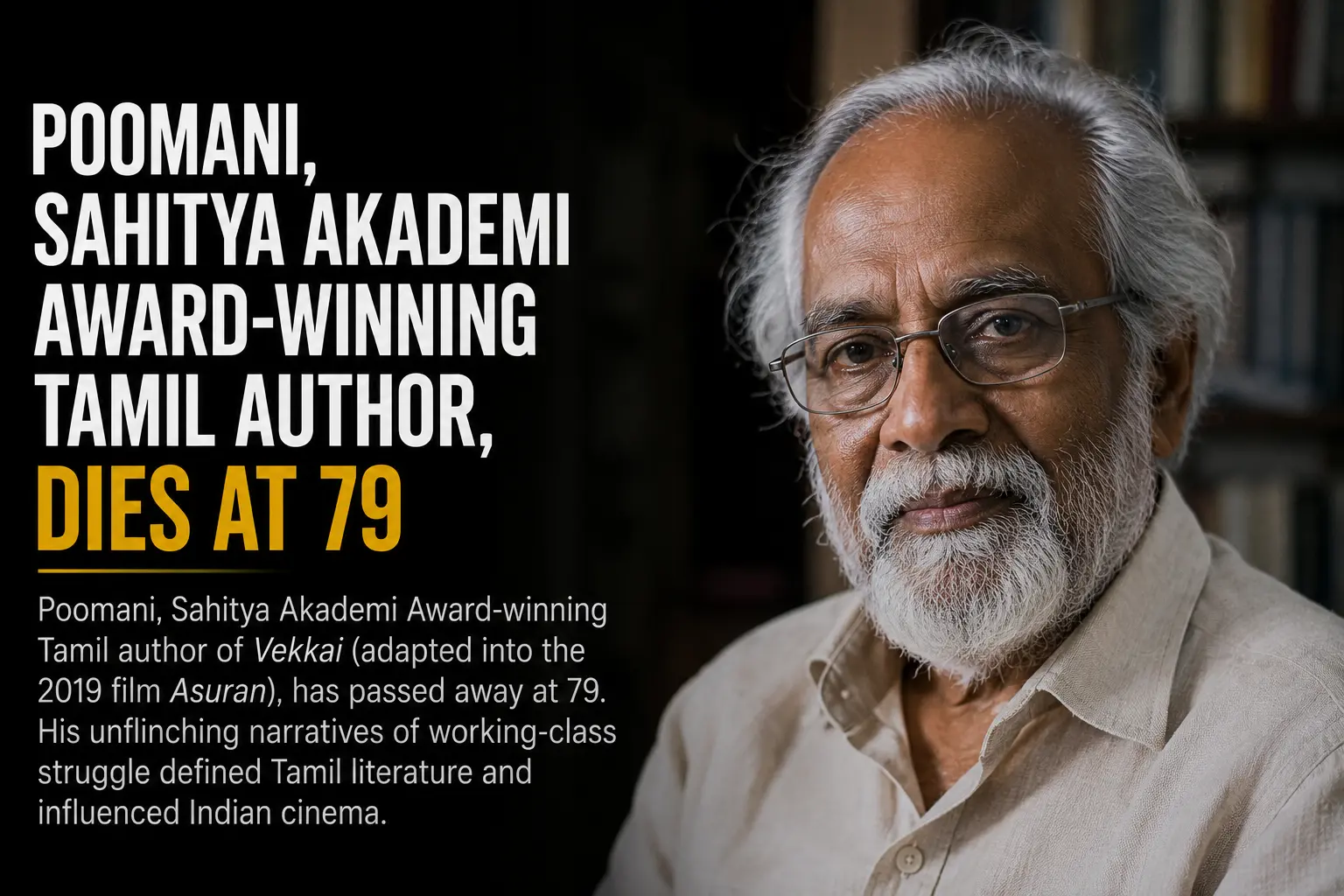
Poomani is gone. The writer who spent a lifetime giving voice to the voiceless — to landless farmers, to the dispossessed, to ordinary people living ordinary lives in extraordinary pain — died recently at 79. The news landed quietly in literary circles before reaching filmmakers and readers. But for those who knew his work, the silence felt enormous.
He was more than a name on a book jacket. Poomani was the author of Vekkai, the novel that became the 2019 film Asuran — a story so raw and real that it reached millions who would never have picked up the original book. For a writer concerned only with authenticity, that mattered. Not the acclaim. Not the awards. Just the reach.
- Poomani, Sahitya Akademi Award winner, passed away recently at age 79 — a loss to Tamil literature and Indian cinema
- His novel Vekkai was adapted into the 2019 film Asuran — starring Dhanush and directed by Vetrimaaran, which became a commercial and critical success
- He explicitly rejected the “Dalit victory” interpretation of Asuran — insisting the story was about human survival, not political messaging
- Poomani also directed Karuvelam Pookkal for the National Film Development Corporation (NFDC) — proving his versatility across mediums
- His literary philosophy centered on authentic narratives of common people — depicting struggles, sufferings, and dignity of ordinary Indians
- Writers, readers, and filmmakers have mourned the loss of a voice that refused to compromise on truth
The Writer Who Refused to Simplify
Tamil literature lost one of its most unflinching observers. Poomani was not a writer interested in easy answers or comfortable narratives. His stories did not flatter. They did not look away. A Sahitya Akademi Award winner — India's highest literary honor — he could have written for the academy. Instead, he wrote for the people. That choice defined everything.
His novels and short stories were populated by characters whom literature typically ignores. Landless laborers. People broken by systems larger than themselves. Families caught between survival and dignity. If you wanted prettiness, you did not read Poomani. You read him if you wanted to understand how ordinary Indians actually lived — the weight they carried, the choices they faced, the small rebellions they staged against forces that seemed permanent and unchangeable.
This was not reportage masquerading as fiction. This was a writer who had looked hard at the world and refused to turn away. Every sentence earned its place because Poomani did not believe in waste. Not in words. Not in the reader's time. Not in pretense.
The Novel That Became a Film That Reached Millions
In 2019, a Tamil film called Asuran arrived in theaters. It starred Dhanush in a role that demanded everything — a man pushed to violence not by choice but by circumstance, by systems that crush slowly and then all at once. The director was Vetrimaaran, a filmmaker with his own reputation for unflinching storytelling. The source material was Poomani's Vekkai.
The film worked. Not because it softened the novel. But because Vetrimaaran understood what Poomani understood: that the best stories do not need embellishment. Two hours of screen time. An audience unable to look away. That was enough.
Asuran became a commercial success. It reached audiences that would never have encountered the original novel. For many filmgoers, this was their introduction to Poomani's worldview — the unflinching gaze, the refusal to let viewers off easy. In that sense, Vetrimaaran did what every great adapter should do: he honoured the source by capturing its spirit, not by replicating its pages.
Poomani watched this unfold. And here is where the story gets interesting.
The Rejection That Revealed Everything
Some readers and critics interpreted Asuran as a story of Dalit triumph — the oppressed rising against their oppressors, justice finally breaking through. It was a reading that felt right. A story about landlessness, about systems of exploitation, about dignity reclaimed through violence. The narrative arc seemed clear.
Poomani rejected it entirely.
In interviews, the author made clear that he did not see his story as a political allegory. He was not writing about Dalit victory over oppression. He was writing about a human being pushed to an extreme — about what happens when someone has nothing left to lose, when survival itself becomes an act of resistance. The distinction matters. It matters a lot.
“The success of the film,” Poomani said, “is that Vetrimaaran kept the audience riveted for two full hours.” Not that it scored political points. Not that it sent the right message. But that it told the truth about a human being in extremis. That was the victory he cared about.
This tells you everything about Poomani as a writer. He was not interested in writing stories that confirmed what readers already believed. He was interested in writing stories that were true — even if the truth was messier, more complicated, less satisfying than the interpretation readers preferred. That kind of integrity is rare. It becomes rarer the more successful you become.
Beyond the Novel: A Life Across Mediums
Poomani was not confined to the novel. He directed Karuvelam Pookkal for the National Film Development Corporation — another project that demonstrated his commitment to authentic storytelling across different forms. Whether writing prose or directing film, his philosophy remained constant: show the world as it is. Do not soften it. Do not make it easier for the audience.
This is harder than it sounds. Audiences want comfort. Publishers want books that sell. Directors want films that generate buzz. Poomani wanted something simpler and far more difficult: truth. In the work itself. In the character. In the refusal to let either become a vehicle for messaging.
Writers and filmmakers who worked with him speak of his precision. Not a word wasted. Not a scene padded. Not a line of dialogue added because it sounded good. Everything served the story. Everything served the character. Poomani's discipline was not restraint — it was love. Love for the work. Love for the reader. Love for the audience.
What He Left Behind
When a writer dies, what remains? Books. Film adaptations. The influence on other writers and filmmakers who read him and thought differently about storytelling. A body of work that refuses to be forgotten because it refuses to be ignored.
For students of Tamil literature, Poomani's novels will remain essential. Not because they are beautiful — though some passages are. Not because they are comfortable — they are not. But because they are true. They show a world most literature does not bother to depict. They do it with precision and without sentimentality. They make you see people you have perhaps looked past your entire life.
For cinema lovers, Asuran stands as proof of what adaptation can be when both the original writer and the filmmaker share the same commitment to truth. The film will endure. And every time someone watches it, they will be encountering Poomani's vision — his refusal to simplify, his insistence on the dignity of ordinary people, his understanding that survival itself is a kind of heroism.
That is the legacy. Not a celebrated name. Not awards on a shelf. But work that continues to matter because it continues to be true.
Frequently Asked Questions About Poomani and His Legacy
Who was Poomani and why was he important to Tamil literature?
Poomani was a Sahitya Akademi Award-winning Tamil author known for authentic narratives about working-class life and ordinary struggle. He refused to simplify or romanticize suffering, instead depicting the world as it was. His influence extended beyond literature into cinema, where his adaptations reached millions of readers who would never have picked up the original novels.
What was Asuran and how did it connect to Poomani's work?
The 2019 film Asuran, directed by Vetrimaaran and starring Dhanush, was an adaptation of Poomani's novel Vekkai. It became a commercial and critical success — a story of a man pushed to extremes by circumstance. The film proved that cinema could honor literary work by capturing its spirit rather than replicating its pages, reaching audiences far beyond the novel's original readership.
Did Poomani approve of the Asuran interpretation of his work?
Poomani explicitly rejected readings of Asuran as a story of Dalit victory. He saw it instead as a narrative about human survival under extreme pressure — about dignity reclaimed through necessity, not ideology. This distinction reveals his commitment to truth over political messaging, even when audiences preferred a simpler interpretation.
What other works did Poomani create beyond novels?
Beyond his literary work, Poomani directed Karuvelam Pookkal for the National Film Development Corporation (NFDC). This demonstrated his mastery across multiple mediums. Whether writing prose or directing film, Poomani maintained the same philosophy: unflinching authenticity, precision, and refusal to soften reality for audience comfort.
What is Poomani's lasting impact on Indian literature and cinema?
Poomani leaves behind a body of work that refuses to be ignored because it refuses to be comfortable. His novels remain essential for understanding working-class Tamil life. His influence on filmmakers like Vetrimaaran proves that literature and cinema can collaborate to reach broader audiences. Most importantly, he established that storytelling need not choose between truth and accessibility — it can honor both.
A Final Word
Writers die. Books remain. Sometimes, if the writer was good enough and cared enough, the work becomes larger than the life — not because the life was unimportant, but because the work continues to matter to people the writer never met, in ways the writer never anticipated.
Poomani's readers and audiences will keep encountering him. In the novel Vekkai. In the film Asuran. In the body of work he leaves behind. Each encounter will be the same: a refusal to look away, a insistence on seeing people as they are, a belief that ordinary struggles deserve to be told with precision and without apology.
That is not a small thing. In a world of easy answers and comfortable narratives, a writer who spent his life telling the truth — even when the truth was difficult — becomes something close to essential.