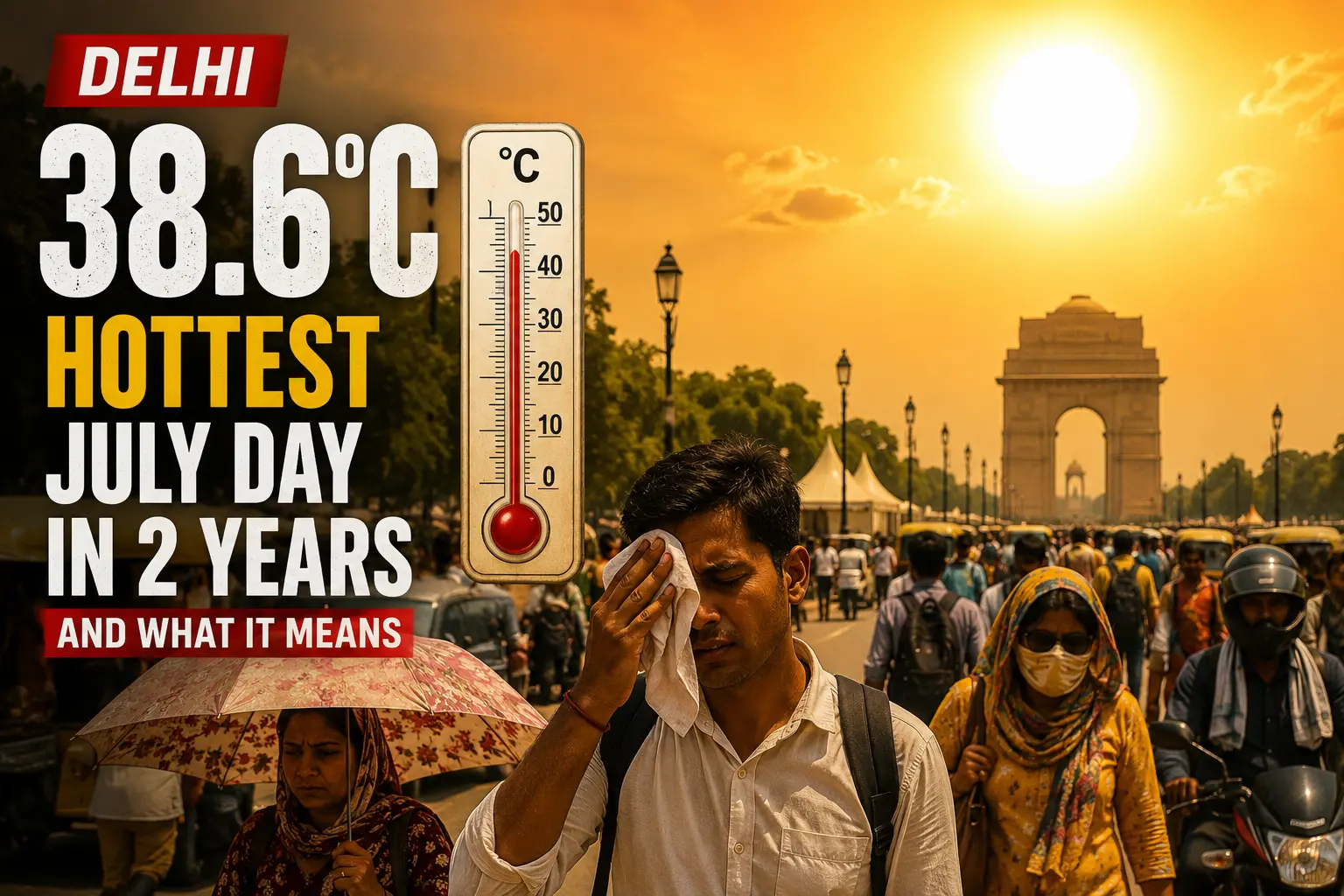
Sunday hit Delhi like a wall. The thermometer climbed to 38.6 degrees Celsius — the highest the capital has seen on a July day in two years. Add the humidity hanging thick over Lutyens' bungalows and Lajpat Nagar lanes alike, and what you got was a city that felt far hotter than any number could capture. For the auto driver waiting at a red light on Ring Road, or the construction worker pouring concrete in Rohini with no shade in sight, that number wasn't a weather bulletin. It was just another brutal afternoon to survive.
- Delhi recorded a maximum temperature of 38.6 degrees Celsius on Sunday — the hottest July day in the capital in two years.
- The minimum temperature that night was 27 degrees Celsius, about 0.9 degrees below the seasonal normal for July.
- High humidity levels made the actual feel-like temperature significantly worse than 38.6°C, according to the India Meteorological Department (IMD).
- Delhi's all-time high temperature record was set in May 2024, when three weather stations crossed 49.8°C — that context makes July's reading notable but not unprecedented in trend.
- Outdoor workers — daily-wage labourers, delivery riders, street vendors — face the sharpest health risk during such extreme heat days with no institutional cooling support.
- IMD issues heat action advisories during such events; residents should check imd.gov.in for city-specific alerts and avoid outdoor exposure between 11 AM and 4 PM.
Why a July Reading of 38.6°C Is More Unusual Than It Sounds
Most people think of May and June as Delhi's furnace months. July is supposed to bring relief — the monsoon rolls in, clouds cover the sky, and the city breathes again. That's the pattern Delhiites have lived with for generations. So when July records a temperature that would feel normal in peak summer but arrives mid-monsoon, something has shifted.
The India Meteorological Department (IMD), which maintains weather records across the country, classifies July as part of the southwest monsoon season for Delhi. During this period, maximum temperatures typically hover between 33°C and 35°C. A reading of 38.6°C — the highest since a comparable day two years ago — sits nearly 4 degrees above that range. That gap matters. It means the monsoon's cooling effect, which millions of people depend on for relief from months of blistering heat, is not arriving on schedule or not holding.
Think about what that means practically. School children walking home. Vendors selling fruit from handcarts with no shade. Elderly residents in flats with no air conditioning on upper floors of old DDA buildings. For all of them, that 4-degree gap between expected and actual is the difference between discomfort and genuine medical risk. So how did we get here — and is this part of a bigger pattern?
What Actually Happened on Sunday — The Full Picture
The Safdarjung weather observatory — IMD's primary recording station for Delhi, and the one whose readings are treated as the city's official temperature — logged 38.6 degrees Celsius as the maximum on Sunday. That figure made it the warmest July day the capital has recorded in two years, according to IMD data cited by Times Now.
- Maximum temperature: 38.6°C — about 3 to 4 degrees above the July seasonal normal for Delhi, which IMD places around 34–35°C.
- Minimum temperature: 27°C — this was actually 0.9 degrees below normal, which is unusual. Nights were cooler than average even as afternoons turned brutal.
- Humidity: High — exact percentage readings were not released in the initial bulletins, but IMD confirmed that high humidity levels compounded the heat stress significantly on Sunday.
- Last comparable reading: A similar July temperature was recorded two years ago — meaning Sunday broke a two-year streak of relatively manageable July maximums in the capital.
- Heat index (feel-like temperature): When humidity is factored in alongside a 38.6°C reading, the actual felt temperature for a person outdoors crosses 42–44°C in many urban pockets, according to standard heat index calculations used by IMD.
- No rain relief: Unlike some July days where brief monsoon showers bring afternoon temperature drops, Sunday did not see significant rainfall in the city that would have broken the heat.
The IMD had issued advisories urging residents to avoid outdoor activity during peak afternoon hours. Dr. Mrutyunjay Mohapatra, Director General of the India Meteorological Department, has previously stated — during heat event briefings in 2024 — that urban heat island effects in large metros like Delhi routinely push actual street-level temperatures 2 to 5 degrees higher than what observatory instruments record in controlled settings. That means the 38.6°C number, already uncomfortable, undersells what millions of people actually felt on Sunday afternoon.
What came immediately before this reading also matters. July 2025 had not been uniformly brutal — there were stretches of cloud cover and some monsoon activity. Sunday's spike came after a dry gap, when monsoon cloud cover thinned and direct sun returned to the city for an extended period. After this reading, IMD forecast a return of monsoon activity in the days ahead, which should bring temperatures down — but forecasts at this time of year shift quickly.
The Real Picture Behind the Numbers — What Experts Are Saying
A single hot July day can be dismissed as an outlier. But climate scientists and meteorologists have been pointing to a longer, harder-to-dismiss trend for several years now. Delhi's temperature records in recent seasons have rewritten the record books repeatedly. In May 2024, three of the capital's weather stations crossed 49.8 degrees Celsius, setting records that stunned even veteran meteorologists, as reported by The New York Times. That reading — nearly 50°C — was not a statistical blip. It was confirmation of a direction of travel.
July's 38.6°C sits within a different season and a different scale, but the underlying logic is the same. The monsoon that is supposed to cool Delhi is becoming less reliable in its timing and intensity. Urban heat islands — the effect of concrete, asphalt, reduced tree cover, and vehicle exhaust turning cities into heat traps — are pushing temperatures higher even when the broader weather pattern should be milder. The Centre for Science and Environment (CSE), based in New Delhi, has documented in its urban heat studies that Delhi's green cover has declined sharply over the past two decades, directly worsening the city's heat vulnerability.
From the government's side, the National Disaster Management Authority (NDMA) has a heat action plan framework in place that it asks state governments to activate during extreme heat events. Delhi's own heat action plan — updated in 2023 — recommends opening cooling centres, issuing public health advisories, and coordinating with hospitals to prepare for heat-related illness cases. Whether those measures were activated in full on Sunday is not yet confirmed in official statements reviewed at time of publication. Opposition leaders in the Delhi assembly have, in previous sessions, raised the point that cooling centre availability in densely populated working-class areas — Shaheen Bagh, Seemapuri, Trilokpuri — remains insufficient relative to the population exposed. The Aam Aadmi Party government and the Lieutenant Governor's office have both claimed action on this front, though independent assessments of actual coverage are limited.
Globally, July 2023 was confirmed by the World Meteorological Organization (WMO) as the hottest month ever recorded on Earth. July 2024 challenged those records again. Delhi's Sunday reading fits into a world where the statistical definition of a “normal” summer is being revised upward, season by season, year by year.
Who Gets Hit First — and Hardest
The number 38.6°C lands differently depending on where you live and what you do for a living. That's the part weather bulletins rarely say out loud.
For Ramesh Kumar, a daily-wage construction worker on one of the dozens of infrastructure projects running across Delhi's outer ring roads, Sunday's temperature meant six to eight hours of physical work under direct sun with one water break per hour if his contractor was decent — fewer if he wasn't. Heat stroke risk rises sharply above 35°C for someone doing physical labour outdoors, according to the Indian Council of Medical Research (ICMR)'s occupational heat stress guidelines. At 38.6°C with high humidity, that risk becomes acute. There is no paid sick leave. There is no insurance. If he stops working, he doesn't get paid. So he works.
For a delivery rider covering 40 to 60 kilometres a day on a motorbike through Delhi's traffic — someone working for any of the major quick-commerce or food delivery platforms — Sunday meant riding through heat radiating off asphalt that routinely reaches 55 to 60°C in direct sun, even when the air temperature is 38°C. These workers have no institutional shade, no regulated break schedules, and face rating penalties on most platforms for delays. The gig economy, which employs an estimated 70 lakh workers across India's top cities according to NITI Aayog's 2022 report on gig and platform workers, has essentially no mandatory heat safety standards at present.
For a middle-class family in a South Delhi apartment with air conditioning, Sunday was uncomfortable but manageable. For an elderly resident in an east Delhi jhuggi with a tin roof and no fan, it was potentially life-threatening. That gap — between who can afford to cool down and who cannot — is the real story inside every temperature record.
What should you do, practically, if you're in Delhi or any other north Indian city during such a heat spike? First, stay indoors between 11 AM and 4 PM whenever possible. Second, drink water before you feel thirsty — by the time thirst kicks in on a 38°C day, mild dehydration has already started. Third, check on elderly neighbours or family members who live alone and may not have cooling. Fourth, visit imd.gov.in or the Mausam app (IMD's official mobile application) for daily heat advisories specific to your city. Fifth — and this one most people skip — wear light-coloured, loose cotton clothing outdoors. It makes a measurable difference to body temperature in direct sun.
What to Watch for Next — The Dates and Decisions That Matter
IMD forecasts for Delhi in the days after Sunday's reading pointed toward renewed monsoon activity, which should pull maximum temperatures back below 36°C — closer to seasonal normals. But “should” and “will” are different words, and the monsoon's behaviour over the Indo-Gangetic plain has become harder to predict with confidence over the past five years.
Three things are worth watching closely. First, whether IMD's extended range forecast for the rest of July 2025 shows a return to above-normal temperatures for Delhi — if it does, this Sunday won't be a one-off. Second, whether the Delhi government's health department releases data on heat-related illness admissions for the week — that number, more than the thermometer reading, shows the real human cost. Third, whether the Supreme Court-monitored committee on air quality — which has expanded its mandate to include urban heat in some recent orders — takes note of the capital's July temperature anomaly in its next sitting.
The bigger question — one that climate scientists, urban planners, and public health officials are all circling — is whether Indian cities are ready for a future where July feels like May used to. The infrastructure, the labour laws, the public health systems, the urban tree cover: none of it was designed for the temperatures being recorded now. Redesigning all of it takes political will, budget allocation, and time. The heat, meanwhile, does not wait.
Delhi's next IMD forecast bulletin is due Monday morning. The monsoon trough position — the key variable determining whether relief comes this week or not — will be the number to watch.
Frequently Asked Questions About Delhi Heat Wave July 2025
Why did Delhi record such high temperatures in July when the monsoon should have cooled things down?
Simply put, the monsoon's cooling effect depends on consistent cloud cover and rainfall, both of which can break down for short periods. When a dry gap opens up mid-monsoon, direct sunlight returns, and Delhi's urban heat island effect — caused by concrete, reduced green cover, and vehicle heat — pushes temperatures sharply above seasonal norms. That's what happened on Sunday.
How does 38.6°C in July compare to Delhi's historical temperature records?
Here's the thing: July's 38.6°C is the highest in two years for that specific month, but it is far below Delhi's all-time record. In May 2024, three of the city's weather stations crossed 49.8°C, the highest ever recorded. July temperatures above 38°C are unusual but not without precedent — they signal a monsoon disruption rather than a summer record event.
Who is most at risk during extreme heat days in Delhi?
The groups at highest risk are outdoor workers — construction labourers, delivery riders, street vendors — elderly people living alone without cooling, and children under five. According to ICMR guidelines, heat stroke risk rises sharply for anyone doing physical work outdoors above 35°C. At 38.6°C with high humidity, even short outdoor exposure becomes dangerous for vulnerable groups.
What should Delhi residents actually do during a heat spike like this?
The short answer: stay indoors between 11 AM and 4 PM, drink water before you feel thirsty, wear loose light cotton outdoors, and check the IMD Mausam app or imd.gov.in for daily city-specific heat advisories. Check on elderly neighbours who live alone. If you must work outdoors, take shade breaks every 30 minutes and watch for signs of dizziness or confusion — early heat exhaustion signals.
Is Delhi's July heat this year part of a larger climate trend or just a one-day spike?
Good question — climate scientists would say both. A single day's reading is weather. But the pattern of July temperatures repeatedly crossing 38°C, combined with May 2024's near-50°C records, reflects a documented warming trend for north India. The World Meteorological Organization confirmed July 2023 as the hottest month globally on record. Delhi's Sunday reading fits a direction, not just a date.