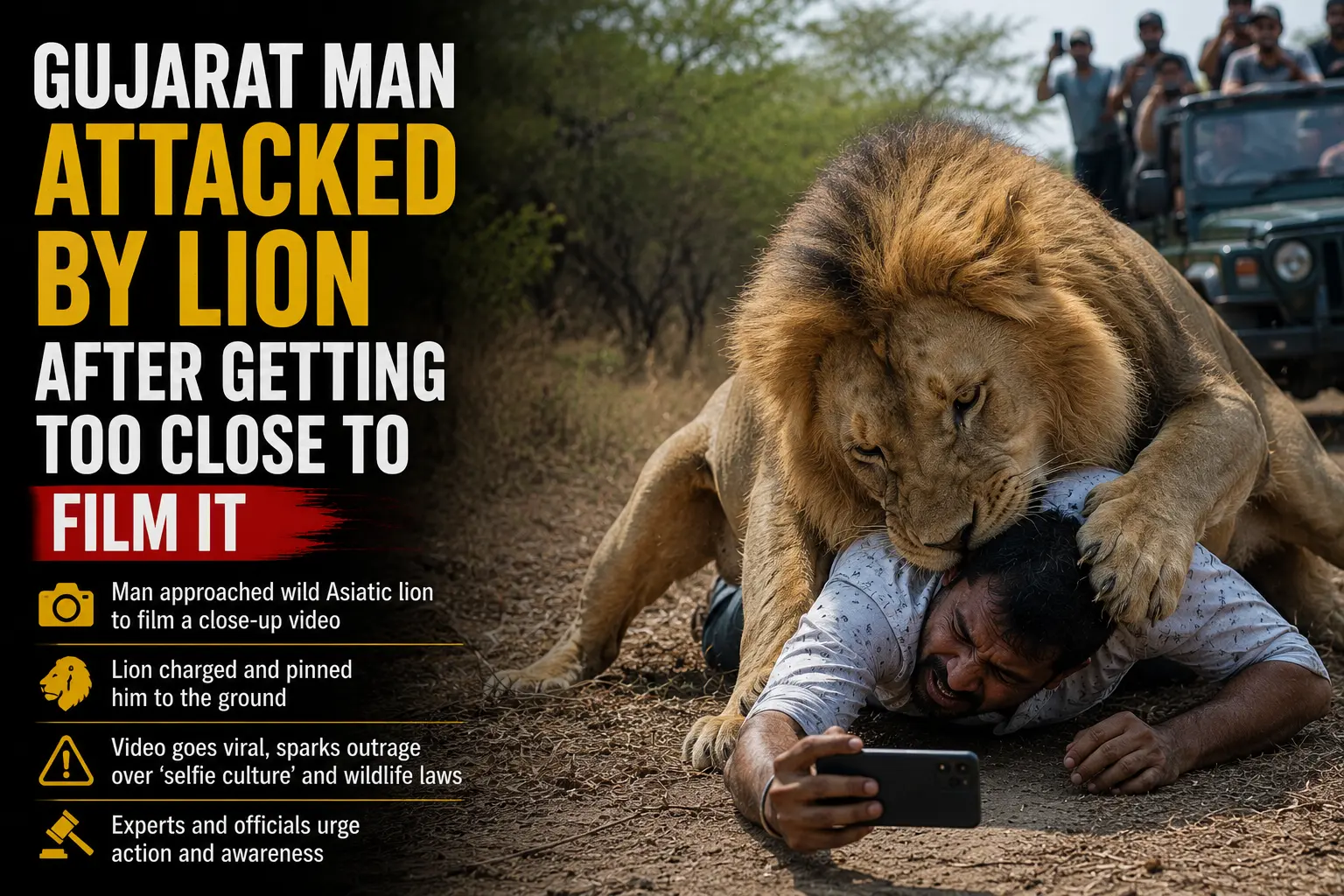
He had a phone in his hand and a lion in front of him. That combination, as a viral video from Gujarat's Bhavnagar district now shows the world, was always going to end badly. The man — whose identity has not been officially confirmed by local authorities — walked toward a wild Asiatic lion to record it on his phone. The lion waited. Then it didn't. What followed was 30 seconds of footage that has shaken wildlife officers, gone viral across every social media platform, and reopened a very uncomfortable conversation about human behaviour inside one of India's most sensitive wildlife zones.
- A viral video from Bhavnagar, Gujarat shows a man being pinned to the ground by a wild Asiatic lion after he walked close to it to record a video on his phone.
- The lion gripped the man's leg with its paws and clamped his hand in its jaws — the attack lasted several seconds before the animal released him.
- The incident took place in or near the Gir forest landscape, home to the world's only surviving wild population of Asiatic lions, currently estimated at over 674 individuals according to the 2020 lion census by the Gujarat Forest Department.
- Wildlife officials from the Gujarat Forest Department have been alerted; no formal FIR or arrest had been publicly announced at the time of this report.
- Provoked or harassed wildlife — including Asiatic lions — can be prosecuted under Sections 9 and 51 of the Wildlife Protection Act, 1972, which carries imprisonment of up to seven years.
- Incidents of tourists and locals approaching Gir lions for photographs have risen sharply, with the Gujarat Forest Department repeatedly issuing public advisories against such behaviour.
The Forest That Belongs to the Lion — Not the Selfie
Gujarat's Gir landscape is not a zoo. It is the last address on earth of the Asiatic lion (Panthera leo persica), a subspecies that once roamed from Greece to Bangladesh and now survives only because of decades of conservation work by the Gujarat Forest Department and the Government of India. The 2020 lion census, conducted by the Gujarat Forest Department and published by the Ministry of Environment, Forest and Climate Change, counted 674 Asiatic lions across the Saurashtra region — an increase from 523 in 2015 and 411 in 2010. That growth story is one of India's genuine conservation successes.
But success has a side effect nobody planned for. As the lion population expanded beyond the core Gir National Park and Wildlife Sanctuary into surrounding villages, farms, and revenue land, human-wildlife contact went up. And as smartphone cameras got better and social media appetites got bigger, a new kind of recklessness took hold. People started walking up to lions. For a video. For likes. For the story they could tell at the next family gathering.
The Gujarat Forest Department has issued multiple public advisories — most recently reinforced through district-level awareness campaigns in Junagadh, Amreli, Gir Somnath, and Bhavnagar — warning that approaching a wild lion is both illegal and potentially fatal. Those advisories, clearly, have not reached everyone. So what happens when someone decides the warning doesn't apply to them?
What the Video Actually Shows
The footage, first circulated widely on social media platforms including Instagram and Facebook on or around the second week of May 2025, is not easy to watch. But it is important to describe clearly, because the details matter.
The man is seen approaching the lion — phone raised, recording. The animal is resting. It tracks the man's movement. Then, in a single fluid motion that takes less than a second, the lion moves. It pins the man to the ground, grips one of his legs with its forepaws, and clamps his hand in its jaws. The man does not escape through effort. The lion eventually releases him.
- The approach: The man walked toward the lion voluntarily, ignoring the animal's visible awareness of his presence.
- The attack: The lion did not chase the man. It waited, then responded to what it likely perceived as a threat or provocation at close range.
- The grip: The lion held the man's leg with its forepaws while biting down on his hand — a controlled response, not a kill attempt.
- The release: The lion let go. Wildlife experts say this is consistent with a warning response rather than a predatory attack.
- The aftermath: The man survived. The extent of his injuries has not been officially confirmed in any statement by the Gujarat Forest Department or district health authorities at the time this report was published.
- The phone: The device — the entire reason this happened — is visible throughout the footage.
Wildlife biologist Dr. Ravi Chellam, one of India's foremost authorities on Asiatic lion ecology, has consistently said in public forums that a lion's response to a human who approaches it at close range is almost always defensive. “Lions are not looking for trouble with humans,” he said in an earlier interview with a national publication. “But they are also not going to let a perceived threat walk up to them without a response.” That observation, made in a different context, fits this video with uncomfortable precision.
What came before this footage was likely a few minutes of overconfidence. What came after was a hospital visit and a video that will be shown at wildlife awareness programmes for years.
The Real Picture Behind the Viral Moment
Here is what the likes and shares don't tell you. This is not an isolated incident.
Human-lion conflict incidents in the Gir landscape have been documented annually by the Gujarat Forest Department. Between 2015 and 2023, according to data compiled by wildlife researchers and submitted to the National Tiger Conservation Authority (NTCA) and related bodies, there were dozens of recorded cases of lions injuring humans — with a significant number involving people who had approached the animals, not the other way around. The distinction matters legally and ecologically.
From a legal angle, the Wildlife Protection Act, 1972 — specifically Sections 9 and 51 — prohibits any act that disturbs, harasses, or provokes a wild animal listed in Schedule I. The Asiatic lion is a Schedule I species, giving it the highest level of legal protection in India. Approaching a wild lion closely enough to film it almost certainly qualifies as a disturbance or provocation under this provision. The punishment? Imprisonment of up to seven years and a monetary fine. Whether the man in this video will face any legal action remains unclear, since no official statement from the Gujarat Forest Department's Bhavnagar division had been released at the time of publication.
Then there is the question of what this does to the animal. Every negative interaction with a human raises a lion's stress levels and can, over time, condition it to associate humans with threat — making future encounters more dangerous for everyone. Conservation scientists call this “habituation inversion” — when an animal that has become used to human presence suddenly receives a reason to fear or aggress toward humans again. One bad viral moment can undo years of careful human-lion coexistence work in a landscape.
From a social angle, the pressure to create viral content has visibly changed how people behave around wildlife. This is not unique to Gujarat or to India. But in the Gir landscape — where lions move freely through farmland and village edges — the stakes are exceptionally high. A farmer whose family has shared space with lions for generations understands the boundaries intuitively. A visitor with a smartphone sometimes does not.
Note: Any legal or judicial matters referenced in this article are sub-judice and should not be treated as final. All persons are presumed innocent unless convicted by a competent court.
Who Gets Hurt — and Who Pays the Price
Think about Harjibhai Boricha for a moment. Not a real name — a composite. But a real type of person. He's a farmer in Amreli district whose family has lived alongside Gir lions for three generations. He knows not to leave livestock unpenned after dark. He knows which paths the lions use. He has never once tried to photograph a lion up close, not because he's afraid of going viral, but because he respects what the forest holds. Every incident like the one in Bhavnagar — every viral video of a person provoking a lion — adds pressure on the Forest Department to “do something” about lion movement. Sometimes “doing something” means relocating animals. Sometimes it means increased fencing. Every one of those decisions affects Harjibhai's land, his access routes, his livelihood.
For tourists visiting Gir National Park — where entry is regulated through the Gujarat Forest Department's official permit system — this kind of incident creates problems too. Safari permits are limited and monitored. Officials become more restrictive. The experience gets constrained. One person's recklessness becomes everyone's reduced access.
And for wildlife conservation officers on the ground — forest guards earning between ₹18,000 and ₹35,000 a month, responsible for monitoring lion movement across hundreds of square kilometres — every viral provocation incident means extra hours, extra paperwork, and the constant fear that the next video will involve a fatality rather than a bite.
The irony is sharp. The Asiatic lion's recovery from fewer than 200 individuals in the early 20th century to 674 today is one of the most cited examples of successful wildlife conservation anywhere in Asia. And the biggest threat to that story right now is not poaching. It's a smartphone camera held by someone who wanted a memorable video.
What Comes Next — for the Man, the Lion, and the Law
The Gujarat Forest Department's Bhavnagar territorial division is the relevant authority here. Officials there have the power to register a case under the Wildlife Protection Act, 1972, issue a show-cause notice, or pursue a formal complaint. Whether they do so depends partly on political will and partly on whether the man's identity can be confirmed from the footage.
The lion in the video — if it can be identified by Forest Department trackers through markings, GPS collar data, or camera trap cross-referencing — will almost certainly be monitored more closely for any change in behaviour. In extreme cases, if an animal is deemed to have developed aggressive tendencies, it can be translocated to a rescue centre. That outcome would be a tragedy born entirely from one person's decision to walk toward it with a phone.
Three scenarios are now in play. Best case: the Forest Department registers and prosecutes a case, sends a public deterrent message, the man recovers fully, and the lion remains undisturbed in its territory. Most likely: the video circulates widely, sparks some headlines, the Forest Department issues another advisory, and nothing structurally changes until the next incident. Worst case: the man's injuries are more serious than reported, the lion is identified as “aggressive,” and a conservation success story quietly loses one of its animals to a relocation order.
Watch for an official statement from the Gujarat Forest Department's Principal Chief Conservator of Forests (Wildlife) in Gandhinagar — that office is the senior-most authority on decisions about individual lions. If that statement comes, it will tell you everything about how seriously the administration is taking this.
Frequently Asked Questions About the Gujarat Lion Attack Video
What happened in the Gujarat lion attack video that went viral?
Simply put, a man in Bhavnagar district, Gujarat, walked up to a wild Asiatic lion to record it on his phone. The lion charged and pinned him — gripping his leg with its paws and biting his hand. The man survived. The video spread rapidly across social media platforms in May 2025, triggering sharp criticism from wildlife officials and conservationists.
Is it illegal to approach a wild lion in India?
Here's the thing: yes, absolutely. The Asiatic lion is listed under Schedule I of the Wildlife Protection Act, 1972 — India's strictest legal protection category. Approaching, disturbing, or provoking a Schedule I animal can result in imprisonment of up to seven years and a fine. The Gujarat Forest Department has repeatedly issued advisories against approaching lions in the Gir landscape.
How many Asiatic lions are left in India, and where do they live?
Good question — the 2020 lion census by the Gujarat Forest Department counted 674 Asiatic lions across the Saurashtra region of Gujarat. They live entirely in Gujarat, primarily across Gir National Park, Girnar Wildlife Sanctuary, and surrounding revenue and forest land in Junagadh, Amreli, Gir Somnath, and Bhavnagar districts. India is the only country in the world with a wild Asiatic lion population.
What should you do if you encounter a wild lion in Gujarat?
In plain words, do not approach it. Back away slowly without turning your back to the animal. Do not make sudden movements or loud sounds. Do not raise your phone toward it. Alert the nearest Forest Department range office immediately. The Gujarat Forest Department has a 24-hour wildlife helpline — 1800-233-9900 — that covers lion encounters in the Gir landscape.
What happens to a lion that attacks a human in India?
The short answer: it depends on whether the attack was provoked. If a lion is assessed by Forest Department officials to have attacked unprovoked — or if it shows repeated aggressive behaviour — it can be translocated to a lion rescue centre. Provoked attacks, like the one in this video, typically result in closer monitoring rather than relocation. Final decisions rest with the Principal Chief Conservator of Forests (Wildlife), Gujarat.