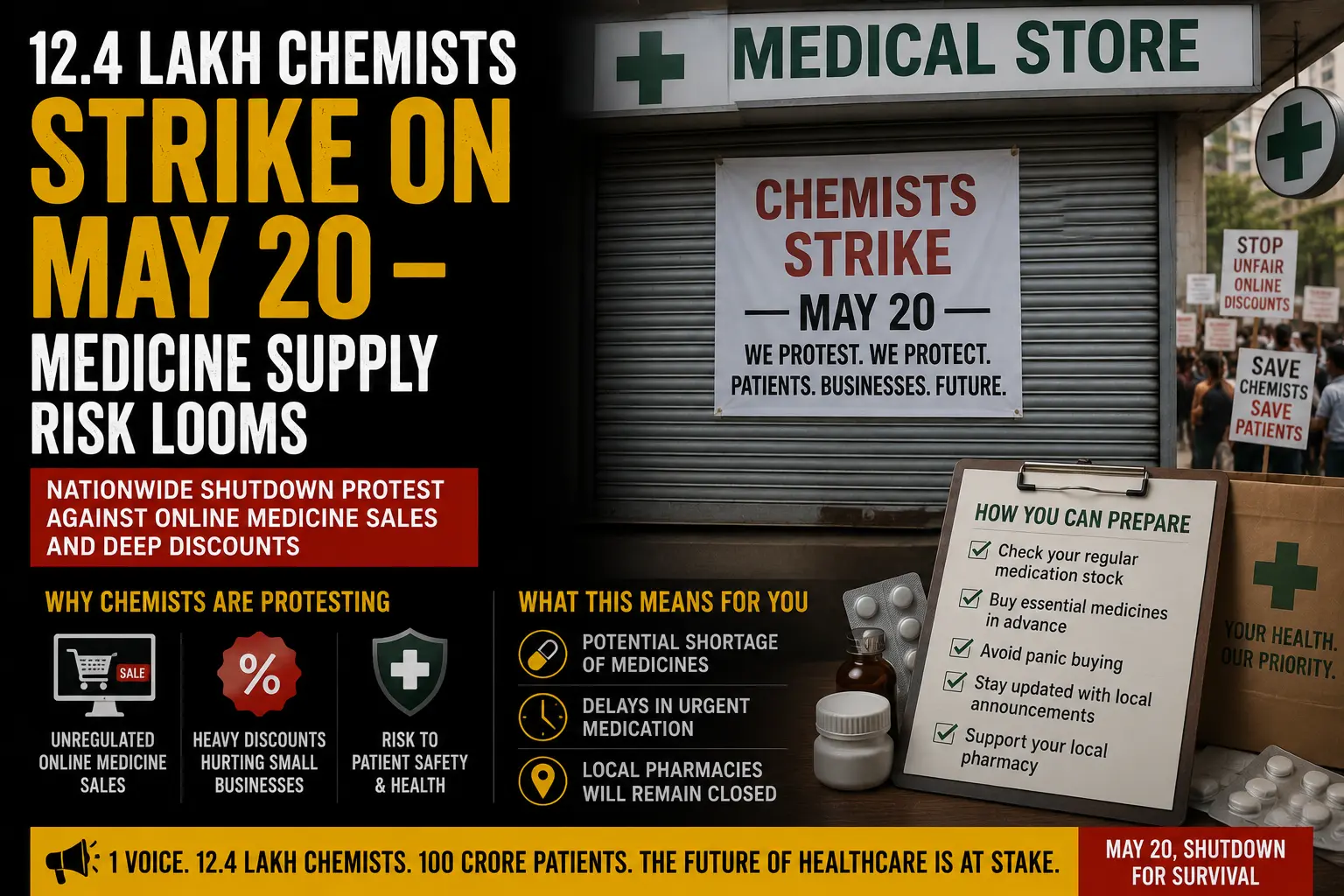
Picture this. You wake up on May 20 needing your blood pressure medicine. You head to your local chemist. The shutter is down. Locked. Because across India, 12.4 lakh chemists and drug store owners will shut down their shops that day. This is not a small protest. This is the biggest pushback from India's pharmacy sector in years — and it could leave millions scrambling for medicines they depend on.
The All India Organisation of Chemists and Druggists (AIOCD) announced this shutdown because of one thing: online medicine sales and deep discounts that are killing their businesses. But here is what worries health experts even more — patient safety. When prescriptions get filled without proper checks, when antibiotics get sold without doctor approval, when medicines meant for one disease are used for another — people get hurt. Sometimes seriously.
- 12.4 lakh chemists nationwide — across every city, town, and village in India — will close their shops on May 20, 2026
- The protest targets online pharmacy platforms and government relaxations that allow doorstep medicine delivery without in-person checks
- Patient safety is the core concern — unregulated online sales mean prescriptions can be misused and wrong medicines can be bought without medical guidance
- Rural and small-town pharmacies face extinction — online platforms with deep discounts cannot be matched by traditional chemists, especially in villages
- Medicine supply will face severe disruption on May 20, affecting patients needing urgent refills, chronic disease medicines, and emergency drugs
- A memo has been sent to PM Modi demanding rollback of Covid-era e-pharmacy rules that were meant to be temporary but are now permanent
How We Got Here — The Online Medicine Story
During Covid-19, the government allowed doorstep medicine delivery. Makes sense, right? People could not go out. They needed medicines at home. So the rules were relaxed temporarily. But temporary became permanent. Online pharmacy platforms — companies like Pharmeasy, Netmeds, and others — exploded. They offered medicines at 30%, 40%, sometimes 50% discounts.
Traditional chemists could not compete. A medicine costing ₹500 offline was being sold for ₹250 online. How do you survive that? Your profit margin is already thin. You rent a shop. You pay staff. You stock inventory. An online platform? No rent. No staff in every location. Algorithms handle everything. They can afford to lose money for years if it means crushing the competition and taking over the market.
Now here is where patient safety enters the picture. A registered pharmacist must verify prescriptions. They must check if the medicine is right for that patient. They must warn about side effects. They must refuse to sell antibiotics without a proper prescription. But when orders come through an app and medicines are delivered by courier? No pharmacist interaction. No face-to-face check. Just a package at your door.
And there is more. Some online platforms have been caught selling prescription medicines without requiring actual prescriptions. Patients with fake or expired prescriptions still get their orders filled. Medicines meant for one condition get used for something completely different. This is how antibiotic resistance happens. This is how people take wrong doses of heart medicines.
What the Chemists Are Actually Demanding
The AIOCD submitted a memo directly to Prime Minister Narendra Modi. What do they want? Simple. Rollback the Covid-era e-pharmacy relaxations. Go back to stricter rules that require proper verification. Make online pharmacies follow the same standards as physical shops.
They are asking for five main things:
- Licensed pharmacist verification for every online prescription — not just an automated system checking a PDF, but an actual person confirming it is real and matches the patient
- No doorstep delivery of antibiotics and controlled medicines — these should only be sold in-person where a pharmacist can counsel the patient
- Price regulation to prevent predatory discounting — online platforms cannot undercut physical shops by 50% and still operate legitimately. Someone is losing money on purpose to kill competitors
- Mandatory stock verification — online platforms should face surprise audits like physical chemists do, to ensure they are not selling expired or counterfeit medicines
- Equal tax treatment — right now online platforms use startup tax benefits while traditional chemists pay full corporate tax, even though they provide the same service with more accountability
This is not about protecting profits. This is about protecting people who trust their chemist with their health.
Why Your Local Chemist Matters More Than You Think
You probably think of your chemist as just a store where you pick up medicines. But they are so much more. Your local chemist knows you and your family's health history. They remember that your mother takes blood pressure medicine. They know your father is diabetic. When you come with a new prescription, they can warn you if it will clash with your existing medicines. They can spot mistakes from the doctor.
In villages, the local chemist is often the first point of medical advice. Someone has a fever at midnight? The chemist suggests what to do. Someone is pregnant and has questions? The chemist counsels them. A child has allergies? The chemist knows which syrup to recommend. Over 60% of Indians in rural areas depend on chemists as their primary health advisor — more than they depend on doctors, because doctors are too far away or too expensive.
Online platforms cannot replace this. An app cannot know your history. A delivery person cannot answer medical questions. A pharmacist 100 km away cannot tell if you are having a serious allergic reaction when you call.
If traditional chemists shut down — and that is exactly what is happening in big cities right now — who will serve rural India? Online platforms do not deliver to villages regularly. Why? No profit. Too expensive. So the poorest, most vulnerable Indians lose access to even basic medicines.
What Happens If This Shutdown Actually Happens
May 20 is just days away now. The AIOCD is serious. They have sent formal notice. Union leaders have confirmed. This is not a threat. This is a scheduled event.
If 12.4 lakh chemists close for even one day, the impact will be massive. Think about the ripple effect:
- Patients on daily medicines — blood pressure pills, insulin, thyroid tablets, heart medicines — will miss doses. Even one day of missed doses can spike blood pressure or blood sugar dangerously
- Emergencies will go unfilled — someone has an asthma attack at night. The nearest chemist is closed. Online delivery takes 2-3 hours minimum. What happens in between?
- Cancer patients getting chemotherapy will struggle to get supportive medicines. One day delay is one day without pain relief, anti-nausea drugs, or immune support
- New mothers needing post-delivery medicines — antibiotics, pain relief, lactation support — will have nowhere to turn
- Vaccination centers will have no vaccines because most vaccines come through chemist supply chains, and if chemists are closed, delivery logistics break down
- Hospitals will face shortages — they rely on chemists for emergency stock of common medicines. If chemists are closed, hospital pharmacies cannot restock
Is one day bearable? Maybe. But the AIOCD has hinted this could turn into longer strikes if the government does not respond. One week without chemists? That is a public health emergency.
The Real Numbers Behind This Fight
Let us put faces and numbers on this. 12.4 lakh chemists means one chemist for every 100 Indians. In your neighborhood, there is probably one within 500 meters. That chemist is not some corporate billionaire. Most are ordinary Indians — often a family business passed down from parent to child.
Many chemists earn ₹20,000 to ₹40,000 per month as profit. A young couple runs the shop. They have a child in school. They rent a small shop space for ₹10,000 to ₹15,000 monthly. Their margins are 15% to 20% on average. Now an online platform offers the same medicine at 40% discount. Suddenly their margin becomes negative. They lose money on every sale.
How long can you survive that? Most traditional chemists are closing. In cities like Mumbai, Bangalore, and Delhi, 10% to 15% of traditional chemist shops have already closed in the last two years. Small towns and villages are losing theirs even faster because online delivery there is cheaper and online platforms do not care about losing money — they want market control.
For a chemist in Pune earning ₹30,000 monthly before, now making ₹5,000 or ₹0? This is existential. Their family's income disappears. Their children's school fees are at risk. They cannot survive. So they shut down or sell their license to a big chain. Either way, the neighborhood loses a trusted health advisor.
What Experts and Doctors Say About This
Do not think this is just chemists whining about competition. The Indian Medical Association and multiple hospital groups have backed this protest. Why? Because they see patient harm every single day from unregulated online medicine sales.
Doctors report cases where patients bought antibiotics online without any prescription. They took them wrongly. Now they developed antibiotic resistance. The same antibiotic no longer works for them. Now when they have a real bacterial infection, doctors have to use stronger, more expensive antibiotics with worse side effects. Antibiotic resistance is already killing thousands of Indians yearly, and every unregulated online sale makes it worse.
Hospitals report patients buying medicines online based on wrong diagnoses made by unqualified people on chat apps. Someone had heartburn. They were told by an app ‘doctor’ to buy a certain medicine. Turns out they had a stomach ulcer. The medicine made it worse. Now they are hospitalized. The online platform? Gone. Disappeared into the internet. No accountability.
Even the government's own health ministry has quietly acknowledged concerns about unregulated e-pharmacies. But they have not acted. Why? Because big online pharmacy companies have money and political connections. Traditional chemists do not. So whose voice gets heard in policy meetings?
What Ordinary Indians Should Know Right Now
If you take any regular medicine — diabetes, heart condition, blood pressure, thyroid, mental health — you need to prepare for May 20. Here is what to do:
First, stock up before May 19. If your medicine usually lasts 30 days, get a 45-day supply. If you take insulin daily, buy extra needles and storage pens. If you take psychiatric medication, missing even one dose can cause serious problems — so prepare especially carefully. Your chemist will understand. They expect this.
Second, identify backup chemists. Find out if there are chain pharmacies in your area that might stay open (big chains sometimes do not participate in strikes). Know their location and hours. Talk to your doctor now about where they recommend you get medicines on May 20 if needed.
Third, talk to your doctor beforehand. Tell them about the strike. Ask if any of your medicines absolutely cannot wait. Ask if there are alternatives you should know about. Ask for a written note in case you need to justify emergency purchases from unexpected sources.
Fourth, avoid May 20 for new prescriptions if possible. If your doctor appointment is scheduled that day, reschedule it if you can. You will get the prescription but nowhere to fill it. Not helpful. Schedule it for May 19 or May 21.
For people without regular medicines — healthy individuals — this is less scary. But stay alert. If someone in your family has health emergencies that day, you might struggle to find an open pharmacy. Plan ahead. Know the nearest hospital. Know if any 24-hour medical stores exist near you.
Why This Matters Beyond May 20
This strike is about much more than one day. It is a pressure point. The government needs to choose a side: regulate e-pharmacies properly, or watch traditional medicine distribution collapse. There is no middle ground that works.
If the government backs down and rolls back e-pharmacy relaxations? Good news for traditional chemists, and arguably good news for patient safety. Medicines will be sold with proper verification.
If the government ignores the protest and sides with online platforms? More traditional chemists close. Rural medicine supply gets worse. Online platforms, freed from any real oversight, sell medicines even more recklessly. Patient harm increases. This is the path we are on right now.
India has 12.4 lakh chemists and about 50,000 online medicine transactions daily. One is a human network built over decades. The other is technology that is 5 years old. Which one do you want responsible for your grandmother’s heart medicine?
What Happens After May 20
The AIOCD has scheduled this as a one-day strike, but leadership has made clear: if the government does not respond, longer strikes will follow. There is talk of a 7-day nationwide shutdown if there is no movement by early June. If that happens, the impact will be severe enough that hospitals and patients will pressure the government to act.
The government will likely have to choose within the next 30-45 days. Option one: negotiate with the AIOCD and roll back some e-pharmacy relaxations. This restores traditional chemist viability and adds patient safety guardrails. Option two: side with big online pharmacy companies and ignore chemists. This accelerates the collapse of traditional pharmacy networks and probably increases patient harm, but makes wealthy investors very happy.
Watch the government’s official statement after May 20. If they call for ‘dialogue,’ that means they are thinking about negotiating. If they use language like ‘protecting consumer choice’ and ‘innovation,’ that means they are siding with online companies. Pay attention to which way the wind blows.
Frequently Asked Questions About the Chemist Strike
Why are chemists striking on May 20, and what is their main complaint?
Simply put, 12.4 lakh chemists are protesting online pharmacy platforms and government relaxations that allow doorstep medicine delivery without proper checks. Online companies sell medicines at 30-50% discounts that traditional chemists cannot match, threatening their livelihoods. More importantly, unregulated online sales risk patient safety because prescriptions are not verified by a pharmacist in person.
What medicines will be hard to find on May 20, and who will be affected most?
People taking daily medicines for chronic conditions — blood pressure, diabetes, heart disease, thyroid, psychiatric medication — face the biggest risk. Missing even one day can be dangerous. Rural patients are affected most because online platforms do not deliver regularly to villages, and if local chemists close, they have no backup option for emergency medicines.
Can I buy medicines online on May 20 if all chemist shops are closed?
Online platforms might still deliver, but response times will be slow because many workers participate in the shutdown or lack adequate pharmacy staffing. Delivery could take 3-12 hours instead of the usual 30 minutes to 2 hours. For non-emergency medicines you have planned for, ordering a day early is safer. For true emergencies, hospitals remain open.
What should I do to prepare for the May 20 shutdown if I take regular medicines?
Stock up on May 19 — buy a 45-day supply instead of your usual 30-day supply. Identify backup chemists near you, especially chain pharmacies that might stay open. Talk to your doctor before May 20 about emergency options. Reschedule any doctor appointments scheduled for that day because you will not be able to fill new prescriptions easily.
Is the government likely to give in to the chemists' demands, or is this strike just symbolic?
The AIOCD is serious — this is organized, large-scale, and backed by doctor organizations and hospital groups. If the one-day strike succeeds in creating disruption, longer shutdowns will follow. The government will likely face pressure to negotiate within 30-45 days, especially if the strike leads to actual patient emergencies that make headlines.
The Bottom Line
May 20, 2026 is coming. Millions of Indians depend on their local chemist — not just for medicine, but for health advice, safety checks, and accessible healthcare. Online platforms are convenient, but they cannot replace the human judgment and accountability that a registered pharmacist provides face-to-face.
This strike is not about old versus new. It is about whether profit margins matter more than patient safety. It is about whether we want our medicines sold by people who know us and stand behind their work, or by algorithms that have never heard of us.
Prepare now. Stock your medicines. Talk to your doctor. Know your backup options. And pay attention to what the government says after May 20. Their response will tell you which direction India’s healthcare is heading.